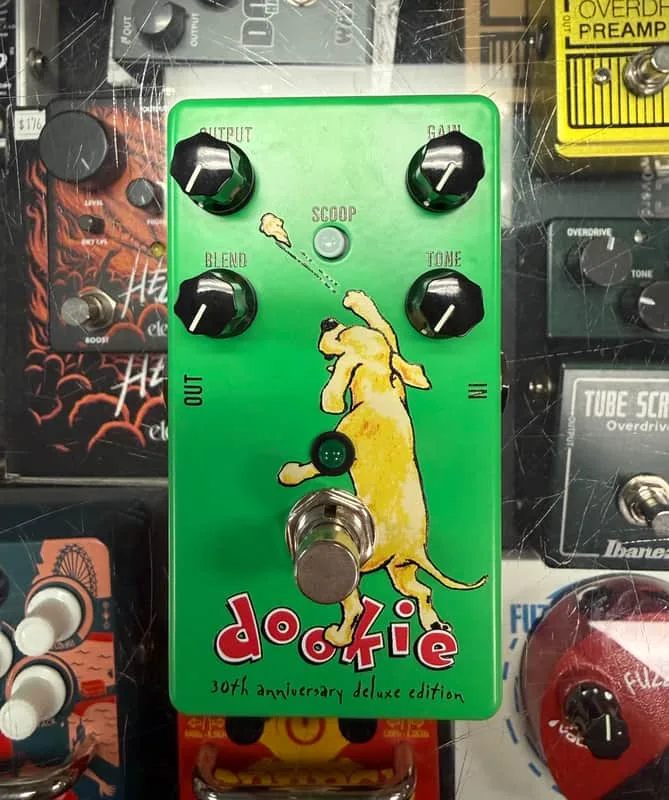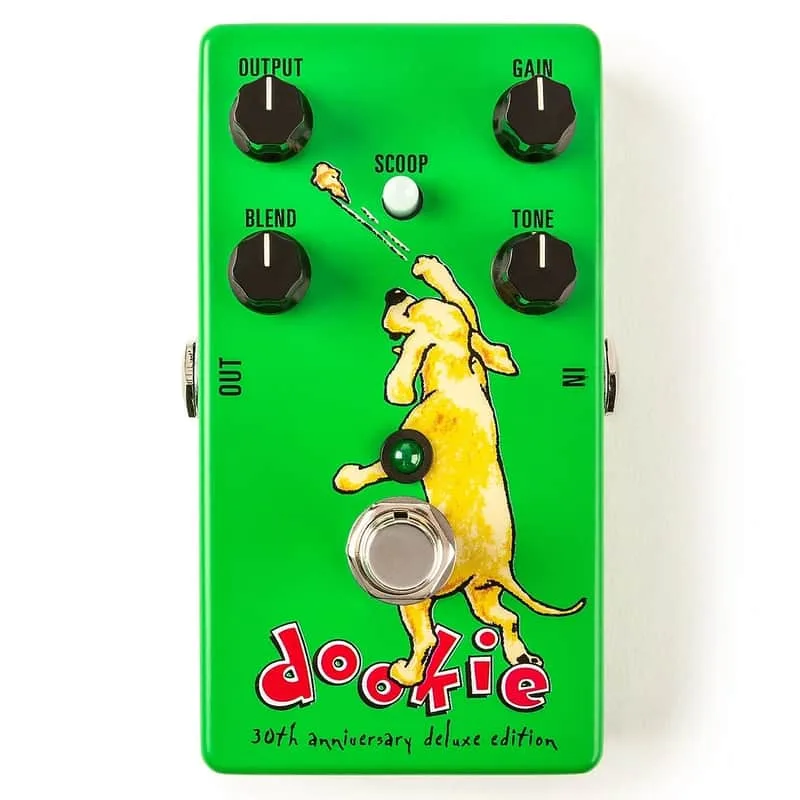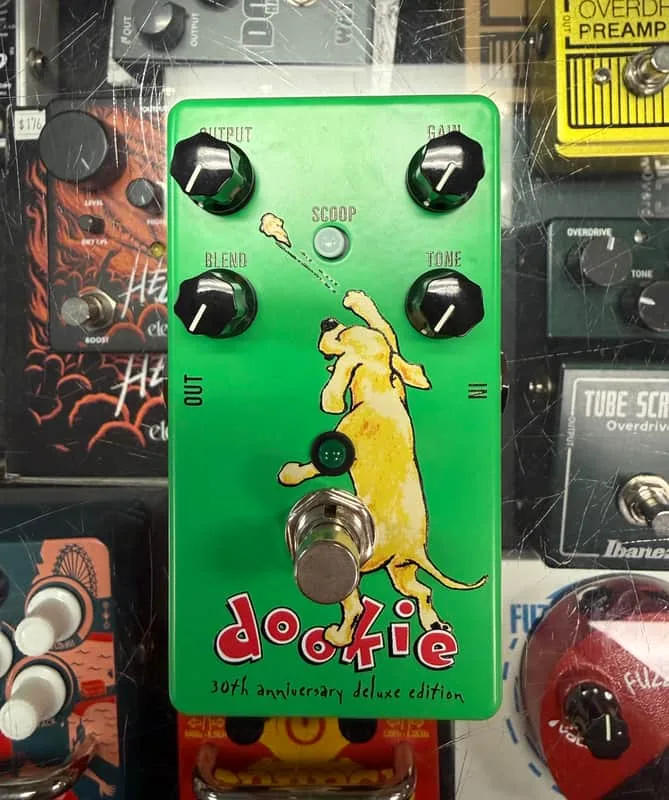
The Dunlop DD25V3 Dookie Drive Pedal is a distortion pedal that recreates the sounds of the two heavily modified amplifiers behind Billie Joe Armstrong's recorded guitar tone on Green Day's Dookie, represented as separate and blendable High Gain and Crunch Gain circuits1. Dunlop's manual says Armstrong "used to get his dirty yet articulate sound when recording Green Day's groundbreaking record, Dookie", and this pedal puts that setup in a stompbox1. It sits among distortion pedals that lean toward overdrive-style gain, and Dunlop has since released later versions, including the DD25V4 Dookie Drive Pedal and the DD30 Dookie Drive 30th Anniversary Edition Pedal.
Controls
The pedal's two gain circuits are the heart of it: the BLEND knob sets the mix of the High Gain and Crunch Gain circuits, so you can run either amplifier voicing alone or blend the two1.
| Control | What it does |
|---|---|
| BLEND knob | Sets mix of High Gain and Crunch Gain circuits1 |
| SCOOP switch | Push to the IN position to cut midrange frequencies for a modern scooped sound1 |
The SCOOP cut is specified at -8 dB at 1 kHz, and the tone control covers ±5 dB at 10 kHz1.
Gain range
The two circuits have distinct gain ranges, which is what lets the BLEND knob move between Armstrong's crunchier rhythm sounds and the higher-gain voicing1:
Power and connections
The Dookie Drive runs on DC 9 volts and draws 11 mA1. It can be battery powered: the manual says it "is powered by one 9-volt battery (remove bottom plate to install)"1. For a power supply, Dunlop lists the ECB003 9-volt adapter, or the DC Brick, Iso-Brick and Mini Iso-Brick power supplies1.
With an 11 mA draw and a 9-volt battery option, the Dookie Drive is light on power compared with many digital pedals, but the battery compartment is under the bottom plate, so plan on removing it to swap batteries.
Specifications
| Specification | Value |
|---|---|
| Nominal output level | -8 dBV, A-weighted, all controls mid position1 |
| Signal-to-noise ratio | 89 dBV, A-weighted, all controls mid position1 |
| Input impedance | 770 kΩ1 |
| Output impedance | 900 Ω1 |
| Bypass | True Hardwire1 |
Questions
Does the Dunlop Dookie Drive take a battery?
Yes. According to Dunlop's manual, the Dookie Drive Pedal is powered by one 9-volt battery, and you remove the bottom plate to install it. It can also run on a DC 9 volt supply, such as the Dunlop ECB003 9-volt adapter or the DC Brick, Iso-Brick and Mini Iso-Brick power supplies.
Is the Dookie Drive true bypass?
Dunlop's manual lists the bypass type as True Hardwire, so the pedal sits out of the signal path when it is switched off.
What does the Scoop switch do on the Dookie Drive?
Push the SCOOP switch to the IN position to cut midrange frequencies for a modern scooped sound. The manual specifies the scoop as -8 dB at 1 kHz.
Which amps does the Dookie Drive recreate?
The pedal recreates the sounds of the two heavily modified amplifiers behind Billie Joe Armstrong's sound on Green Day's Dookie, represented as separate and blendable High Gain and Crunch Gain circuits.
How much current does the Dookie Drive draw?
Dunlop's manual gives a current draw of 11 mA at 9 volts DC.
Did Billie Joe Armstrong use the Dookie Drive on Dookie?
The pedal is Dunlop's recreation of the setup behind that record: the manual says Billie Joe Armstrong used to get his dirty yet articulate sound when recording Green Day's groundbreaking record, Dookie, and the pedal models the two modified amplifiers behind it. The pedal itself is a later Dunlop product, not the original recording rig.
Sources (1)
- DD25V3.pdf, Jim Dunlop, 2020