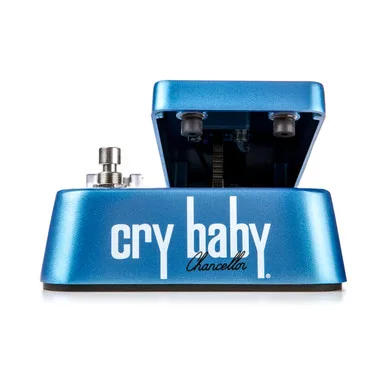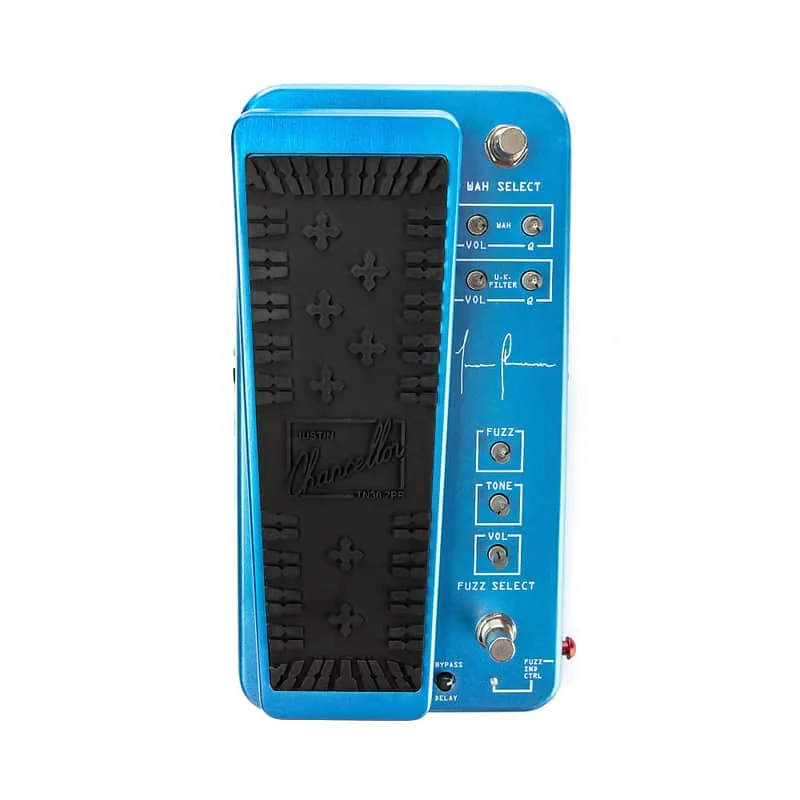


The Dunlop JCT95, the Justin Chancellor Cry Baby Wah, is a signature wah pedal with a built-in fuzz effect, made by Dunlop and aimed at bassists12. It combines three of the Tool bassist's effects in one pedal: two rocker-operated filter modes, U.K. Filter and Wah, plus a vintage U.K.-style fuzz that can be paired with either mode or run on its own32. MusicRadar notes it uses a sprung treadle like Dunlop's WTF pedal1.
A detail that matters for bass players: in both rocker modes, the clean signal is boosted at 400Hz and blended in with the effect at the very beginning of the rocker's sweep, so low end is preserved under the filter3.
A wah, a U.K. Filter and a fuzz in one pedal
The JCT95 is built around three effects, selected with two footswitches. The WAH SELECT footswitch toggles between U.K. Filter mode (blue-lit controls) and Wah mode (yellow-lit controls), and the FUZZ SELECT footswitch turns the fuzz on and off3.
Wah mode is a modified Cry Baby wah. Dunlop's manual says it uses the famous red Fasel inductor for a bright, aggressive tone and lush harmonics, and the company's buying guide describes the modified Cry Baby wah sound as lush and aggressive32.
U.K. Filter mode uses a custom solid-state circuit to generate a thick, throaty effect with pronounced peaks3. Dunlop says it was inspired by Chancellor's bass tone circuit and sounds thick and voice-like2.
Fuzz is a vintage U.K.-style fuzz that can be paired with either rocker mode or operated independently2. Its intensity, level and EQ can all be customized2.
Controls
| Control | What it does |
|---|---|
| WAH SELECT footswitch | Toggles between U.K. Filter (blue-lit) and Wah (yellow-lit) modes3 |
| WAH VOL knob | Sets overall volume of Wah mode3 |
| WAH Q knob | Adjusts Wah mode's bandpass shape from wide to narrow3 |
| U.K. FILTER Q knob | Adjusts U.K. Filter mode's bandpass shape from wide to narrow3 |
| FUZZ knob | Adjusts gain of the fuzz effect3 |
| TONE knob | Adjusts EQ of the fuzz signal3 |
Dunlop's buying guide also notes the two rocker modes can be customized with Volume and Q controls2.
The pedal ships with an optional Pedal Topper that mounts over the FUZZ SELECT footswitch, giving that switch a larger, non-slip surface area3.
Power and connections
Setup is conventional: an instrument cable runs from the instrument to the JCT95's INSTRUMENT jack, and another instrument cable runs from the AMPLIFIER jack to the amplifier's input3.
The JCT95 runs on 9 volts DC and draws 48 mA3. Power options are:
- One 9-volt battery, accessed via the bottom of the pedal3
- The Dunlop ECB003 9-volt adapter3
- An MXR Brick Series power supply3
The bypass is automatic buffered rather than true bypass, with a bypass noise floor of -98 dBV (A-weighted) and a ring-out delay of 30ms to 560ms, meaning the effect rings out for that time before disengaging3.
Sweep ranges, gain and noise figures
The two rocker modes cover different frequency territory. Wah mode sweeps a resonant frequency range of 340 Hz to 1920 Hz, while U.K. Filter mode reaches both lower and higher, 232 Hz to 2700 Hz3.
| Measurement | Value |
|---|---|
| Wah resonant frequency range | 340 Hz to 1920 Hz3 |
| U.K. Filter resonant frequency range | 232 Hz to 2700 Hz3 |
| Wah gain, heel down | +12.5 dB3 |
| Wah gain, toe down | +19 dB3 |
| U.K. Filter gain, heel down | +8 dB3 |
| Fuzz gain | 250 Hz, +21 dB, +59 dB3 |
| Tone tilt at 100Hz | -7 dB to +5 dB3 |
| Tone tilt at 5000Hz | +8 dB to -11 dB3 |
| Max input level (all modes) | +12 dBV to -4 dBV3 |
| Max output level, bypass/Wah/U.K. Filter | +12 dBV3 |
| Max output level, fuzz | +2 dBV3 |
Noise floors, all A-weighted, vary by mode3:
- Bypass: -98 dBV
- Wah heel down: -92 dBV
- Wah toe down: -78 dBV
- U.K. Filter heel down: -97 dBV
- U.K. Filter toe down: -91 dBV
- Fuzz: -75 dBV
The fuzz toe-down and fuzz-on figures show the trade-off a player makes when engaging the fuzz: it is the noisiest state of the pedal, while the filter modes stay close to the bypass floor3.
Where it sits among Dunlop's wah-fuzz pedals
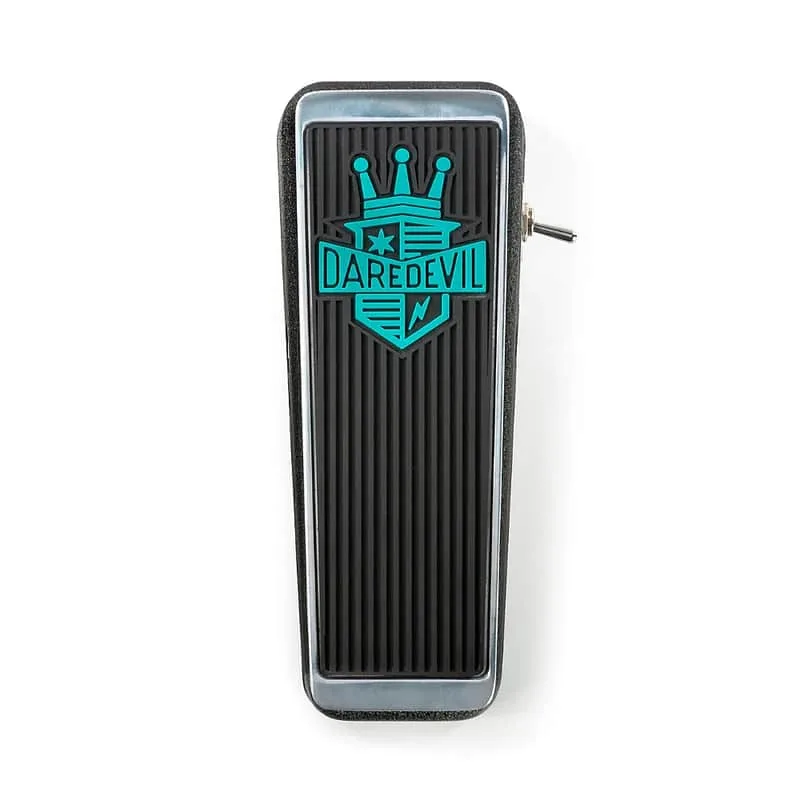
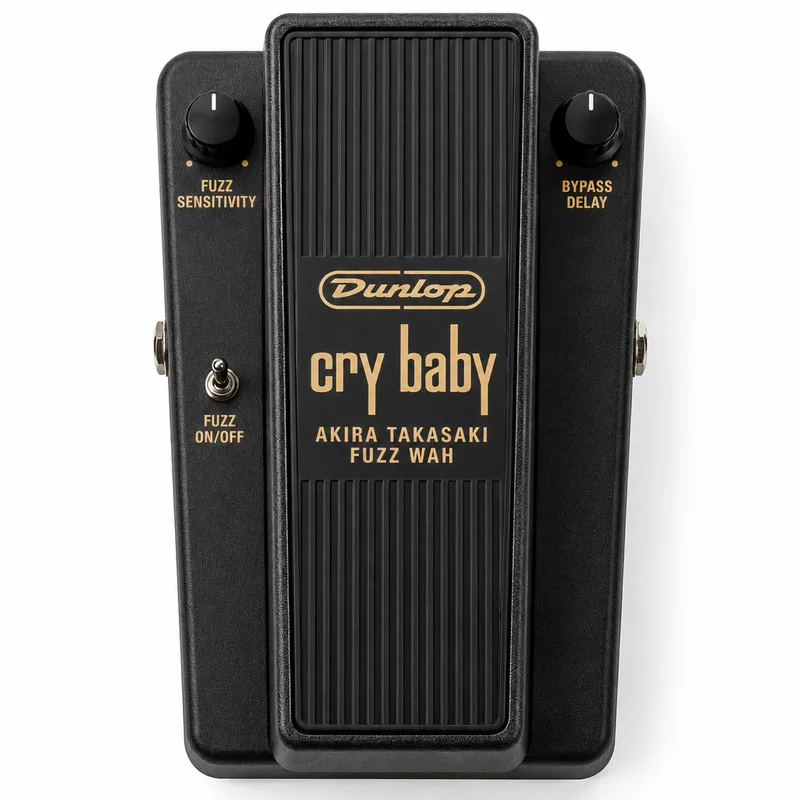
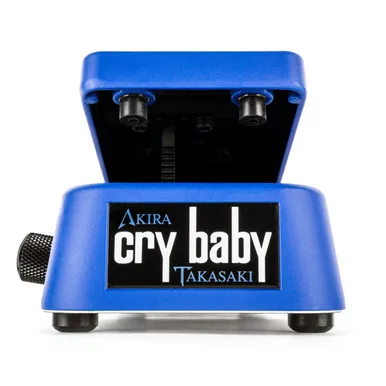
The JCT95 is one of several Dunlop pedals that pair a Cry Baby wah circuit with fuzz. Others include the Dunlop DD95FW Daredevil Cry Baby Fuzz Wah, a collaboration with Daredevil Pedals, and the Dunlop AT95M Cry Baby Akira Takasaki Fuzz Wah for the Loudness guitarist. What sets the JCT95 apart is its bass-focused design: the clean blend at 400Hz, the lower-reaching U.K. Filter sweep, and its aim at bassists rather than guitarists13.
Videos
BassTheWorld.com
The Bass Channel
Rich Bischoff
Questions
Does the Dunlop JCT95 take a battery?
Yes. The JCT95 is powered by one 9-volt battery, accessed via the bottom of the pedal. It can also run on the Dunlop ECB003 9-volt adapter or an MXR Brick Series power supply, drawing 48 mA.
Is the Dunlop JCT95 true bypass?
No. The JCT95 uses an automatic buffered bypass, with a measured bypass noise floor of -98 dBV (A-weighted). It also has a ring-out delay of 30ms to 560ms before the effect switches off.
What is the difference between the U.K. Filter and Wah modes on the JCT95?
Wah mode is a modified Cry Baby wah using the red Fasel inductor, sweeping 340 Hz to 1920 Hz. U.K. Filter mode uses a custom solid-state circuit inspired by Chancellor's bass tone circuit, sweeping lower, 232 Hz to 2700 Hz, for a thick, voice-like sound. Each mode has its own volume and Q controls.
Does the JCT95 use a Fasel inductor?
Yes, in Wah mode. Dunlop's manual states the Wah mode uses the famous red Fasel inductor for a bright, aggressive tone and lush harmonics. U.K. Filter mode instead uses a custom solid-state circuit.
What is the Pedal Topper on the JCT95 for?
The JCT95 ships with an optional Pedal Topper that mounts over the FUZZ SELECT footswitch, giving that switch a larger, non-slip surface area. It is a user-installed accessory, not required for normal operation.
Sources (3)
- DOD x Morley Wah-OcTo-Fuzz review, musicradar.com, 2026-07-24
- RANGE OF EXPRESSION: FIND YOUR CRY BABY® WAH, Dunlop (lifestyle.jimdunlop.com), 2021-10-08
- JCT95.pdf, Jim Dunlop, 2021