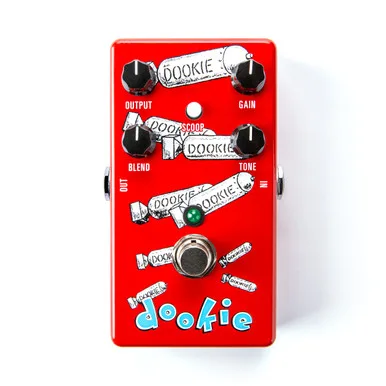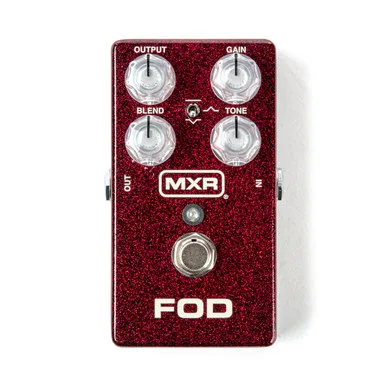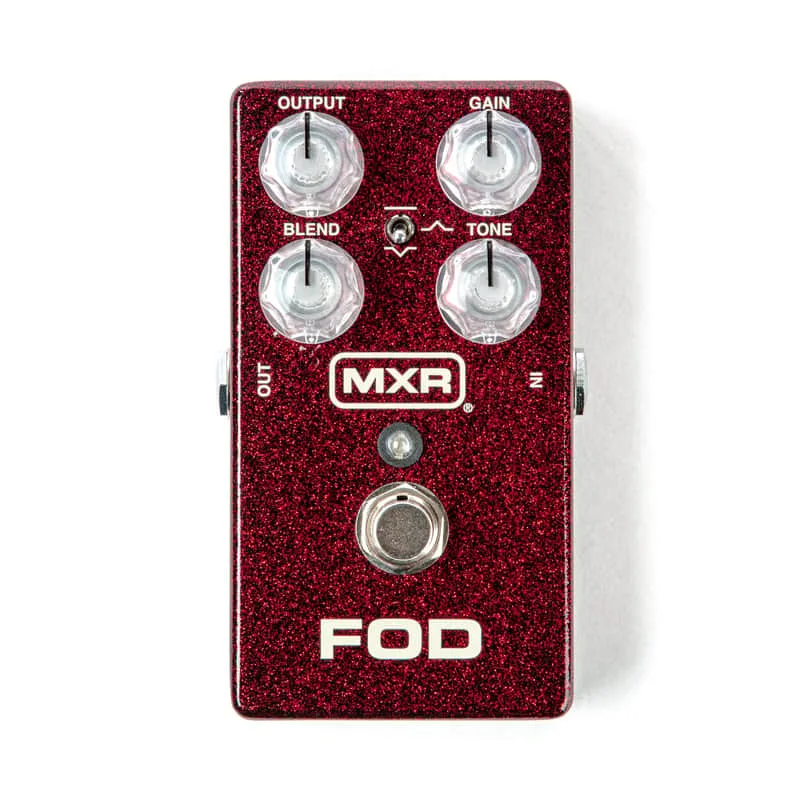


The MXR M251 FOD Drive is an overdrive pedal from Dunlop that puts two separate overdrive circuits in one housing and lets you blend them. Dunlop describes it as supplying "the sonic power of two highly sought-after amp stacks in a single housing," with the idea that you "dial in just the right sonic signature for each side and blend the two sounds together to your tonechasing taste"1. Guitar World's Trevor Curwen notes it follows the concept of the MXR Dookie Drive, "albeit with no artist affiliation"2.
The two sides are a High Gain channel on the right and a Crunch Gain channel on the left. Curwen found that "both sides have the flavour of a nicely cranked stack and each individually has a range of useful tones whether you're looking for rhythmic graunch or saturated leads"2.
Two overdrive circuits blended together
The core of the pedal is the pairing of its two circuits. The High Gain channel is controlled from the front panel by its own Gain knob, while the Crunch Gain channel is set by internal trimmers. The BLEND knob then sets the mix of the two, so you can lean toward the saturated High Gain side, the lower-gain Crunch side, or sit anywhere between1.
Guitar World's reviewer summed up the design: "The FOD does a neat job in combining two different but complementary overdrive flavours and the controls you need to blend them"2.
The two gain ranges, from Dunlop's manual1:
| Circuit | Gain range (at 1 kHz) | Where it is set |
|---|---|---|
| High Gain | +9 dB to +70 dB | Front-panel Gain knob |
| Crunch Gain | +2 dB to +45 dB | Internal Crunch Gain trimmer |
Controls
The front panel keeps the day-to-day adjustments simple, with the Crunch channel's fine tuning tucked away inside1.
| Control | What it does |
|---|---|
| GAIN (High Gain channel) | Sets the gain of the High Gain circuit |
| BLEND | Sets the mix of the High Gain and Crunch Gain circuits |
| OUTPUT | Sets overall volume |
| TONE | Controls overall EQ, ±5 dB at 10 kHz |
| SCOOP switch | Selects flat, scooped or boosted midrange frequencies |
| FOOTSWITCH | Toggles the effect on and bypass, with a clear blue LED indicating on |
Inside the pedal, under the bottom plate, are two set-and-forget trimmers for the Crunch Gain circuit1:
- CRUNCH GAIN knob: sets the intensity of the Crunch Gain circuit's overdrive
- CRUNCH VOLUME knob: sets the output level of the Crunch Gain circuit
Curwen describes these as "internal set-and-forget trimmers for its gain and volume if you want to deviate from the factory settings"2, so the pedal works out of the box and the trimmers are there for players who want to rebalance the Crunch side against the High Gain side.
The Scoop switch: flat, mid boost or mid cut
The three-position SCOOP switch shapes the midrange that overdriven tones often live or die by. Guitar World highlights "the option of a toggle-switched midrange boost, plus a scoop and a flat setting"2. Dunlop's manual gives the measured effect of each position1:
| Switch position | Midrange effect |
|---|---|
| Up | Flat, no cut or boost |
| Mid | +5 dB at 600 Hz (mid boost) |
| Down | -8 dB at 1 kHz (mid cut, or scoop) |
The up position leaves the mids untouched, the middle position pushes the 600 Hz region for a sound that sits forward in a mix, and the down position cuts around 1 kHz for a scooped feel1.
Power and specifications
The FOD Drive runs on 9 volts DC and draws 11 mA1. You can power it three ways12:
- One 9-volt battery, installed by removing the bottom plate
- The Dunlop ECB003 9-volt adapter, which is not supplied with the pedal
- Dunlop's DC Brick, Iso-Brick or Mini Iso-Brick power supplies
Connections are straightforward: a cable from the guitar to the INPUT jack, and a cable from the OUTPUT jack to the amplifier1. The bypass is True Hardwire, so the signal path is out of the circuit when the pedal is off1.
Remaining specifications from Dunlop's manual1:
| Specification | Value |
|---|---|
| Input impedance | 770 kΩ |
| Output impedance | <900 Ω |
| Nominal output level | -8 dBV (A-weighted, Midrange control in up position, all other controls at mid position) |
| Noise floor | -89 dBV (A-weighted, Midrange control in up position, all other controls at mid position) |
| Tone control | ±5 dB, 10 kHz |
Videos
GAK
Jim Dunlop UK
Beau Monde Guitars
Questions
Does the MXR FOD Drive take a battery?
Yes. The FOD Drive runs on one 9-volt battery, which you install by removing the bottom plate. It can also be powered by a 9V DC adapter such as the Dunlop ECB003, which is not supplied with the pedal. Current draw is 11 mA.
Is the MXR FOD Drive true bypass?
Yes. Dunlop's manual lists the bypass as True Hardwire, and Guitar World's review also describes the pedal as true bypass, so the signal passes through untouched when the effect is switched off.
What is the internal Crunch Volume knob on the FOD Drive?
The Crunch Volume knob is an internal trimmer inside the pedal that sets the output level of the Crunch Gain circuit. There is also an internal Crunch Gain trimmer for that circuit's overdrive intensity. Both are set-and-forget adjustments you can use to deviate from the factory settings.
How much gain does the FOD Drive have?
The High Gain circuit offers +9 dB to +70 dB of gain at 1 kHz, while the Crunch Gain circuit offers +2 dB to +45 dB at 1 kHz. A front-panel Gain knob controls the High Gain channel, and the BLEND knob sets the mix of the two circuits.
What power supply does the MXR FOD Drive use?
The pedal runs on 9 volts DC at 11 mA. Dunlop recommends its ECB003 9-volt adapter, or the DC Brick, Iso-Brick and Mini Iso-Brick power supplies. A 9V battery also works, and the adapter is not supplied with the pedal.
Sources (2)
- M251.pdf, Jim Dunlop, 2020
- MXR FOD Drive review, Guitar World, 2021-04-08