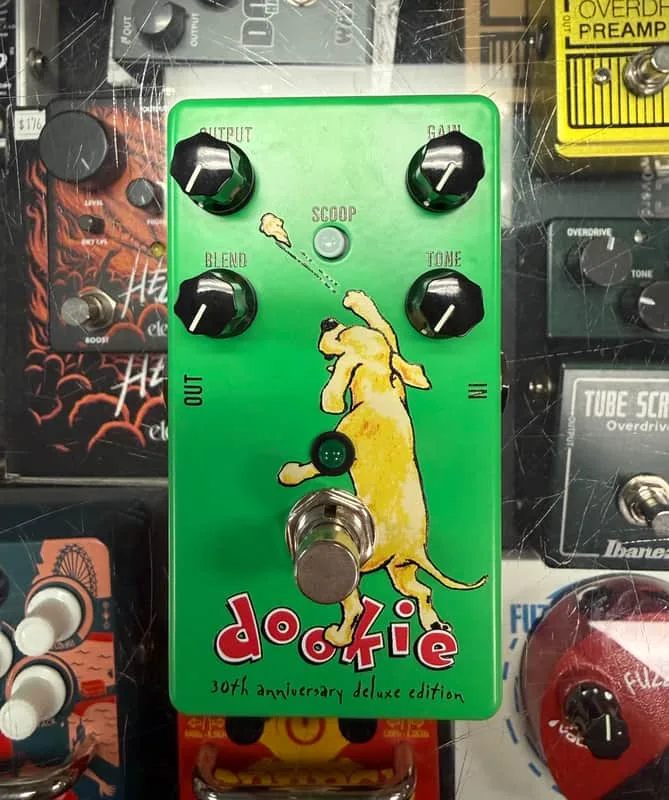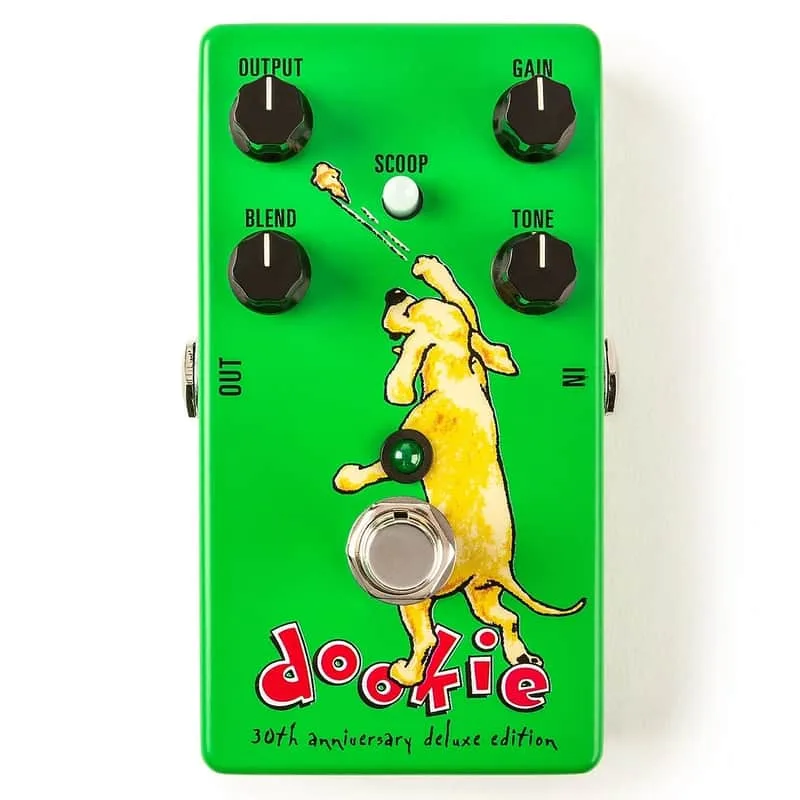


The MXR Dookie Drive is a guitar effects pedal from MXR that combines the sounds of two heavily modified amplifiers into a single stomp box: the amps Billie Joe Armstrong used to get his dirty yet articulate sound recording Green Day's album Dookie1. Rather than modeling one amp, the pedal carries two separate and blendable gain circuits, so a player can mix them in any ratio, the way Green Day blended the two amp signals in the studio1.
The pedal was announced on January 21, 2019, to celebrate the 25th anniversary of Dookie, and launched at NAMM 2019, where Guitar.com reported it quickly became one of the most popular gear releases of the show23. MXR describes the result as a full harmonic range of overdriven tones for a playing experience full of depth and dimension1.
Two Dookie amp sounds blended in one pedal
The core idea of the Dookie Drive is that the Dookie guitar sound was never one amp. According to MXR, Billie Joe Armstrong got that sound by running his signal through two heavily modified amplifiers, one scooped with a ton of gain and the other with a well-defined midrange, blended in different ratios during mixing6. MXR borrowed his amps so the team could carefully analyze all the sonic qualities that make them sound good, then rebuilt the amps from scratch in pedal circuit form and fit them into a single housing1.
The two amps appear in the pedal as separate circuits:
- High Gain: the scooped, high-gain side of the pair, with its own controls1
- Crunch Gain: the midrange-forward, crunchier side, with its own controls1
- Blend: a knob that sets the mix of the two circuits, just like Green Day did in the studio110
MusicRadar's Michael Astley-Brown described the pedal as one that "aims to capture the sound of Billie Joe Armstrong's amps on Green Day's iconic Dookie album," with the ability to blend between the two tones10. Gearnews noted the additional scoop function accessed via a button9.
"The pedal offers the ability to blend between the two tones"
On the amps themselves, Guitar.com reported that the pedal's lineage includes a 100-watt Marshall Plexi Super Lead that Billie Joe Armstrong used to record the stompbox's namesake album3. Delicious Audio's 2024 guide to plexi-style pedals lists the Dookie Drive among Marshall-inspired drive pedals, describing it as a drive pedal celebrating the 25th anniversary of the album, at $18911.
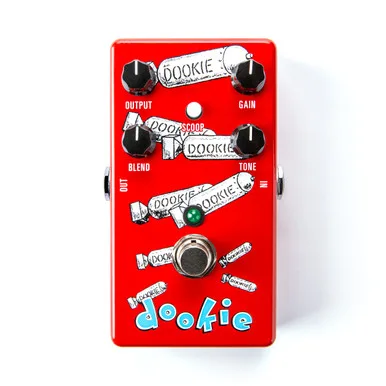
The controls: High Gain, Crunch Gain, Blend and Scoop
The control layout follows the two-circuit design. The Dunlop manual for the V4 lists the controls plainly12:
| Control | What it does |
|---|---|
| High Gain section | Gain circuit voiced for the scooped, high-gain amp, with its own controls13 |
| Crunch Gain section | Gain circuit voiced for the midrange-defined crunch amp, with its own controls13 |
| Blend knob | Sets the mix of the High Gain and Crunch Gain circuits12 |
| Scoop switch | Adds extra scoop in the midrange of the overall output signal6 |
The Blend control is the heart of the pedal for players chasing the album sound: instead of choosing one amp voice, you dial in the ratio between them, the same approach the band used when mixing the record1. The Scoop switch then shapes the blended output, cutting mids across the whole signal rather than within one circuit6.
Power: 9V, 11mA
The Dookie Drive is an easy pedal to power. RockBoard's listing for the V3 gives the electrical specifications as 9V DC, center negative, with a current draw of 11mA, and an analog circuit type5. That draw is low enough that the pedal shares comfortably with other drives on a multi-output supply.
Powering options across the versions16:
- A single 9-volt battery (remove the bottom plate to install)13
- A Dunlop ECB003 9-volt adapter13
- An MXR Brick Series power supply, or the Dunlop DC Brick, Iso-Brick and Mini Iso-Brick supplies (not included)1
The battery is installed by removing the pedal's bottom plate, so keep a screwdriver handy if you plan to run it on battery power6.
History and versions
The Dookie Drive has gone through several versions since its 2019 debut. Dunlop's product pages identify the line as DD25, DD25V2, DD25V3, DD25V3-PARTS, DD25V4, and the DD30 30th Anniversary edition8610.
| Version | What it is | Status |
|---|---|---|
| DD25 (2019) | Original release for the album's 25th anniversary, with Dookie album cover graphics197 | Legacy, no longer in production1 |
| DD25V2 | Second version, same two-circuit design8 | Legacy, no longer in production19 |
| DD25V3 (2020) | Limited-edition third version with the rainbow-spewing unicorn artwork from the album art147 | Legacy, no longer in production19 |
| DD25V4 | Fourth version, dressed in a special edition finish themed on the record138 | See DD30 listing13 |
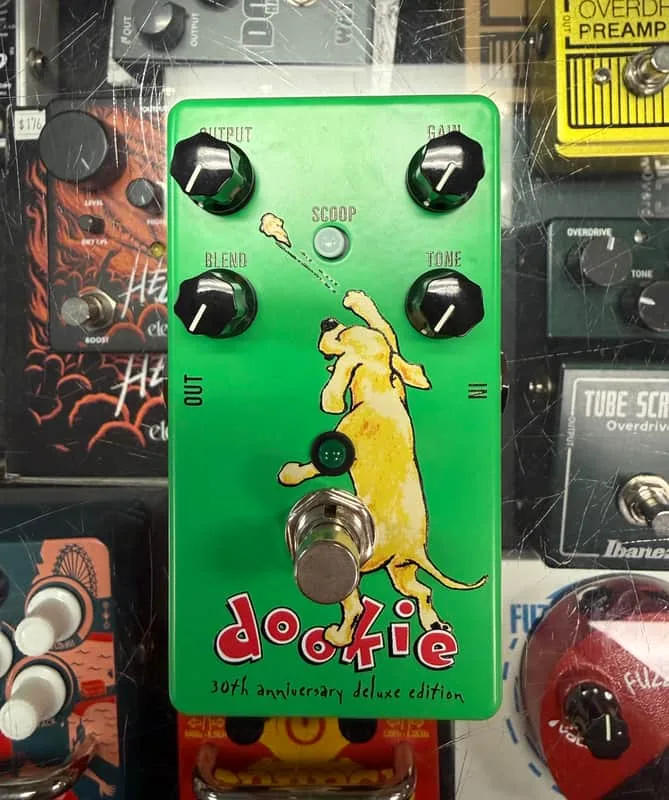
| DD30 30th Anniversary | Special edition with an all-new finish celebrating the 30th anniversary of Dookie's 1994 release6 | Current release18 |
The original pedal was emblazoned with the graphics from the Dookie album cover, which Gearnews called a nice tribute to the record9. The V3 arrived at NAMM 2020 as a special limited-edition third version, released in a year when the band was celebrating a new studio album, and featuring the rainbow-spewing unicorn seen on the album art14. Guitar World's Amit Sharma described the V3 as recreating "that biting guitar sound that the group have been long-famous for"14. The DD30 30th Anniversary edition carries an all-new finish celebrating the 30th anniversary of the album's 1994 release6.
On price, the 2019 launch carried an expected street price of $189.991015, and MusicRadar reported it available that summer for $189 in the US and £219 in the UK1510. The V3 and the DD30 are listed at $169.99 on Dunlop's product pages76, though some Dunlop listings also show $209.99 for the DD3068.
Billie Joe Armstrong's involvement
The pedal is a collaboration, not just an endorsement. Dunlop's artist page for Billie Joe Armstrong says he teamed up with the MXR design team to capture the dirty punch and articulation of the guitar tone he used on the record16. The manual for the V4 likewise frames the pedal around the sound Billie Joe Armstrong used to get his dirty yet articulate sound when recording Dookie12. At launch, MusicRadar and Gearnews both covered a demo video in which Billie Joe Armstrong himself demonstrated the tones available from the pedal10.
Videos
Pete Thorn
jimdunlopusa
jimdunlopusa
Questions
Is the MXR Dookie Drive still made?
The original Dookie Drive versions (DD25, DD25V2 and DD25V3) are legacy products that MXR no longer produces. The DD30 Dookie Overdrive 30th Anniversary edition, released to mark 30 years of the album, is the current version of the pedal.
Can the Dookie Drive run on a battery?
Yes. The pedal runs on a single 9-volt battery, installed by removing the bottom plate. It can also be powered by a Dunlop ECB003 9-volt adapter or an MXR Brick Series power supply, which are sold separately.
What amp is the Dookie Drive based on?
It is based on two heavily modified amplifiers Billie Joe Armstrong used to record Dookie: one scooped with a ton of gain and one with a well-defined midrange. MXR borrowed the amps, analyzed them and A/B tested them, then rebuilt both circuits from scratch in pedal form. Press coverage also identifies a 100-watt Marshall Plexi Super Lead among the amps used on the album.
Did Billie Joe Armstrong help design the Dookie Drive?
Yes. Billie Joe Armstrong teamed up with the MXR design team to capture the dirty punch and articulation of the guitar tone he used on Dookie. MXR borrowed his actual amps so its engineers could analyze their sonic qualities and rebuild them as pedal circuits.
How much did the MXR Dookie Drive cost?
At launch in 2019 it carried an expected street price of $189.99 in the US. The V3 and the DD30 30th Anniversary edition are listed at $169.99, and some Dunlop listings also show $209.99 for the DD30.
Sources (16)
- MXR® DOOKIE DRIVE™ PEDAL, Dunlop (jimdunlop.com)
- Dunlop Unveils the Dookie Drive, Premier Guitar, 2019-01-21
- NAMM 2020: There's a V3 version of the MXR Dookie Drive, with unicorn graphics, Guitar.com, 2020-01-18
- MXR Dookie Drive V3, Delicious Audio, 2020-10-27
- DOOKIE DRIVE V3 by MXR, RockBoard (rockboard.de), 2026
- MXR® DOOKIE DRIVE™ PEDAL 30TH ANNIVERSARY, Jim Dunlop (jimdunlop.com)
- MXR® DOOKIE DRIVE™ PEDAL V3, Jim Dunlop (jimdunlop.com)
- MXR® DOOKIE DRIVE™ PEDAL V2, Dunlop (jimdunlop.com)
- Watch Billie Joe Armstrong demo the new MXR Dookie Drive pedal, gearnews.com, 2019-07-24
- MXR heralds the release of the Dookie Drive Pedal with Billie Joe Armstrong demo, MusicRadar, 2019-07-23
- 2024 Best Plexi Pedals & Marshall-Style Distortions: A Buyer's Guide, Delicious Audio, 2024-09-16
- DD25V4.pdf, Jim Dunlop, 2023
- MXR® DOOKIE DRIVE™ PEDAL V4, Jim Dunlop (jimdunlop.com)
- NAMM 2020: Jim Dunlop announces 4 new pedals, including the Green Day Dookie Drive V3, Guitar World, 2020-01-17
- NAMM 2019: MXR's Dookie Drive recreates Billie Joe Armstrong's classic blended amp tone in pedal form, MusicRadar, 2019-01-25
- Billie Joe Armstrong is a Dunlop Artist., Jim Dunlop (www.jimdunlop.com)