
The Dunlop MC406 BUFFER is a buffer pedal: it takes your instrument's signal, presents it with a 1 MΩ input impedance, and drives it from a low output impedance of under 1 kΩ, which helps keep long cable runs and crowded pedalboards from dulling your tone. Dunlop describes it as a low noise buffer in a small, rugged steel housing, with a signal to noise ratio of more than 100 dB A-weighted at all settings1.
It is built for players who want more than a simple pass-through. The buffered signal can be sent to two outputs, shaped with Hi and Lo cut switches, and boosted by up to +6 dB with a GAIN slider. The frequency response is 20 Hz to 20 kHz within ±0.1 dB, with a maximum input of 12 dBV and a maximum output of 19 dBV1.
Two outputs, one internal switch
The MC406 has three jacks. The INPUT jack receives the instrument signal. OUTPUT 1 sends out either the unaffected INPUT signal or the buffered signal, depending on the internal BUFFER switch. OUTPUT 2 always sends out the buffered signal1.
The BUFFER switch is internal, not a footswitch on the top panel. Its two positions work like this1:
- UP (factory setting): OUTPUT 1 is not buffered, and carries the unaffected INPUT signal1.
- DOWN: OUTPUT 1 is buffered, so both outputs carry the buffered signal1.
That matters if you split your signal: a player sending one line to an amp and another to a long cable run or a tuner can choose whether the first output stays untouched or gets the same low-impedance drive as the second.
The controls
| Control | What it does |
|---|---|
| BUFFER switch (internal) | Toggles whether the unaffected INPUT signal or the buffered signal is sent to OUTPUT 11 |
| GAIN slider | Adds up to +6 dB of gain to the buffered signal1 |
| HI CUT switch | Cuts top end frequencies of the buffered signal, -6 dB @ 7 kHz, with an indication LED1 |
| LO CUT switch | Cuts bottom end frequencies of the buffered signal, -6 dB @ 140 Hz, with an indication LED1 |
The Hi and Lo cut switches give the MC406 a use beyond pure buffering: taming a harsh top end or a flabby bottom end on the buffered line, with LEDs showing when each is engaged. The GAIN slider can make up for level lost elsewhere in a chain, or push the buffered signal up to +6 dB1.
Power and bypass
The MC406 runs on 9 volts DC at a current draw of 43 mA, powered by a Dunlop ECB003 AC adapter (ECB003E in Europe) through a 5.5 x 2.1 mm positive barrel connector1.
The manual describes external power only and mentions no battery option. The bypass is a True Hardwire Relay, and the MC406 is bypassed only when power is removed, so it needs power to pass signal in its active state1.
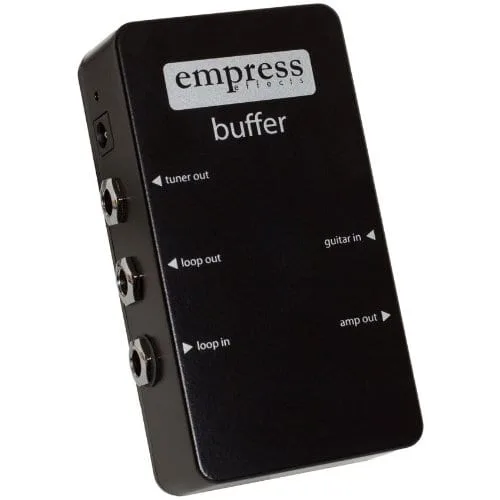
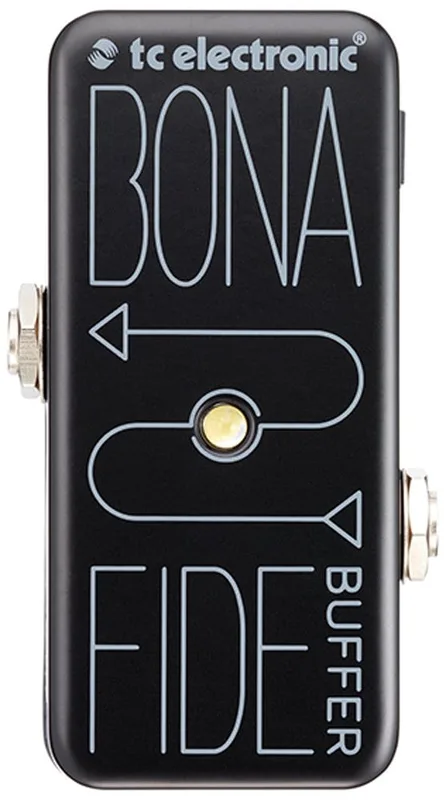
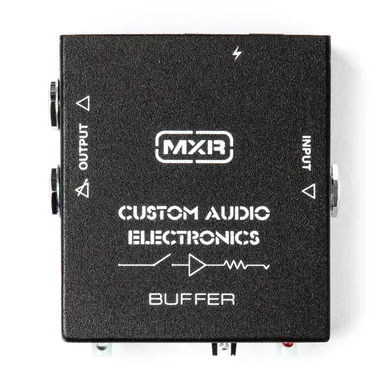
For more on how buffers work and how the MC406 compares with other options, see Buffer Pedals, or the pages for the Empress Effects Buffer, the TC Electronic Bonafide Buffer, and the MXR CAE Buffer.
Videos
Psyckadeli TV
Questions
Does the Dunlop MC406 Buffer run on a battery?
No. The manual describes external power only: the MC406 is powered by a Dunlop ECB003 AC adapter (ECB003E in Europe) delivering 9 volts DC through a 5.5 x 2.1 mm positive barrel connector. It draws 43 mA, so plan your pedalboard power supply accordingly.
Is the MC406 buffered on both outputs?
Output 2 always sends a buffered signal. Output 1 depends on the internal BUFFER switch: in the UP position, the factory setting, Output 1 sends the unaffected INPUT signal; in the DOWN position, Output 1 is buffered as well.
What do the Hi Cut and Lo Cut switches do?
The LO CUT switch cuts bottom end frequencies of the buffered signal, at -6 dB @ 140 Hz. The HI CUT switch cuts top end frequencies of the buffered signal, at -6 dB @ 7 kHz. Both options have indication LEDs.
What is the MC406 power connector polarity?
The MC406 uses a 5.5 x 2.1 mm positive barrel connector and runs on 9 volts DC, powered by a Dunlop ECB003 AC adapter (ECB003E in Europe).
Is the Dunlop MC406 true bypass?
Yes. The manual lists the bypass type as True Hardwire Relay, and notes that the MC406 is bypassed only when power is removed.
Sources (1)
- MC406.pdf, Dunlop Manufacturing, Inc., 2012-02-17