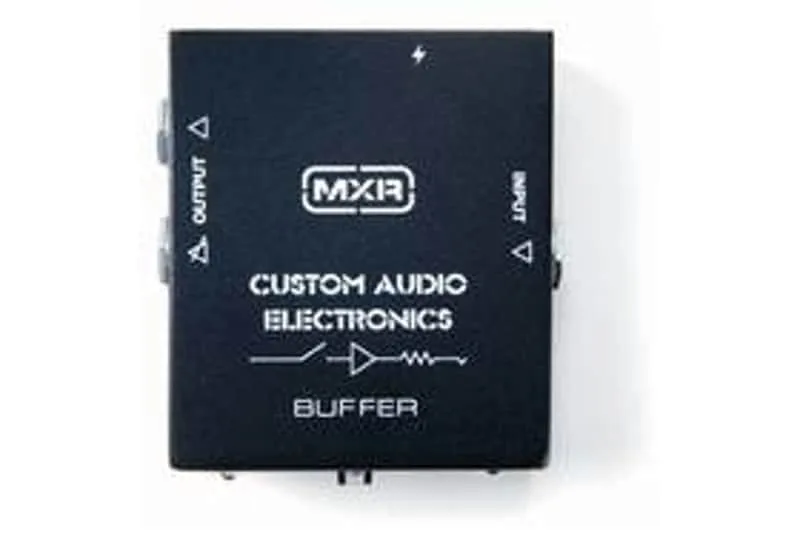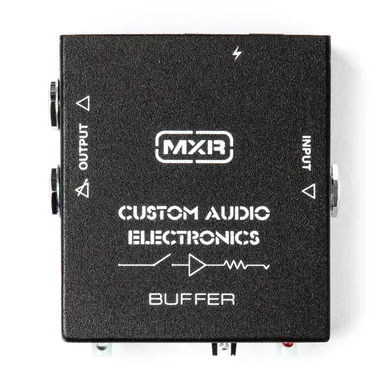


The MXR CAE Buffer is a buffer pedal made by MXR, the effects brand owned by Dunlop. A buffer's job is to keep a guitar's signal from weakening as it passes through long cables and rows of pedals, and the CAE Buffer does that in what Dunlop describes as "a low-noise buffer in a small, rugged housing"1.
What sets it apart from a plain buffer is the amount of control it gives you over the signal it hands back. Dunlop sums up the design this way1:
"The CAE Buffer features a +6dB gain slider with Hi/Lo cut switches to make up for signal loss along with other features"
Controls and features
The pedal's controls are aimed at restoring a signal that has already been dulled by cable capacitance and pedalboard wiring1:
- A +6dB gain slider that makes up for signal loss accumulated along your chain1
- Hi and Lo cut switches that fine-tune signal recovery, letting you shape the top and bottom of what comes back1
- An extra output for a tuner, a separate effects chain or a second amp, so one input can feed two destinations1
The Hi and Lo cut switches are worth a note for players comparing buffers: most simple buffers offer no tone shaping at all, while this one lets you tailor the recovery rather than take it as it comes1.
Power
The CAE Buffer has no battery option built around a standard snap; Dunlop specifies it runs from a 9-volt adapter or a dedicated pedalboard supply1:
None of these are included with the pedal1.
The pedal is not supplied with a power adapter. Plan for an ECB003 or one of Dunlop's brick supplies when adding it to a board1.
Where it sits on a board
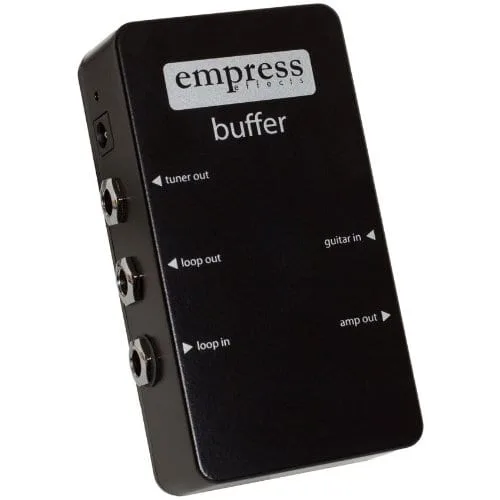
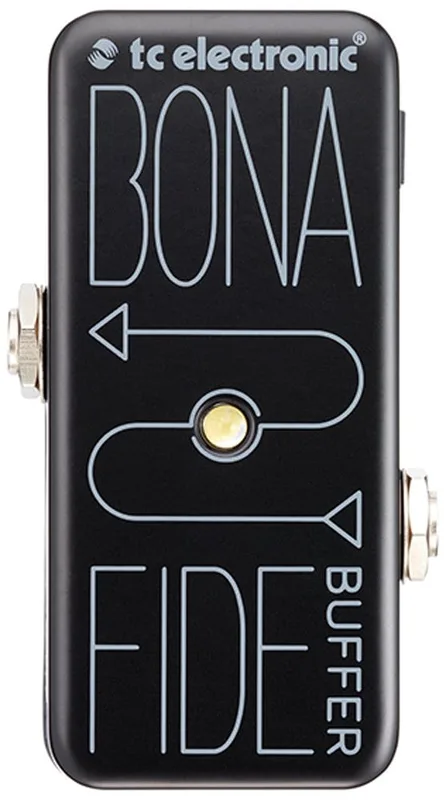
Buffers like this one are usually placed where signal loss starts to matter: at the front of a long chain, or after fuzzes and wahs that prefer to see a guitar's raw signal. The second output makes it practical as a split point too, feeding a tuner silently while the main chain carries on to the amp1. Players comparing it with other options in the same territory can look at the Dunlop MC406 BUFFER, the Empress Effects Buffer or the TC Electronic Bonafide Buffer.
Videos
Psyckadeli TV
Riccardo Cherubini
Daryl Hannigan
Questions
What does the MXR CAE Buffer do?
It is a low-noise buffer pedal that counteracts the signal loss that builds up along a pedalboard and long cable runs. It carries a +6dB gain slider together with Hi and Lo cut switches so you can fine-tune how the signal is recovered, and it offers an extra output for a tuner, a separate effects chain or a second amp.
How is the MXR CAE Buffer powered?
MXR specifies a Dunlop ECB003 9-volt adapter, or one of the Dunlop DC Brick, Iso-Brick or Mini Iso-Brick power supplies. None of these are included with the pedal, so you need to supply your own 9-volt power source.
Sources (1)
- MXR® CAE BUFFER, Dunlop (jimdunlop.com)