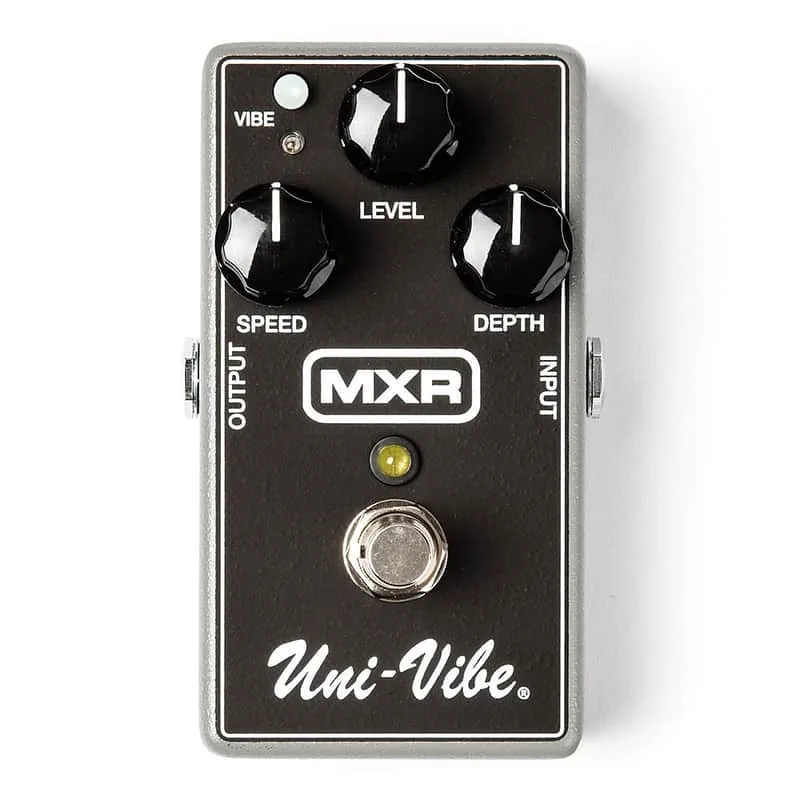


The Dunlop MXR Uni-Vibe Chorus/Vibrato (M68) is a chorus and vibrato pedal from MXR that recreates the classic Shin-Ei Uni-Vibe effect in a standard MXR housing, at a fraction of the size and weight of the original12. It delivers what Dunlop describes as "the same lush, chewy textures that players have used since the late '60s," updated for modern gigging players with true bypass switching1.
Guitar World's reviewer found it provides "genuine Uni-Vibe effects with thick, rich swirling textures in a pedal," with a simple three-knob interface and a mode switch3. Pedal of the Day's Mike B described it as "a nice, neat, well-designed and compact pedal" that packs the lush, gooey, shimmery tones heard on so many albums into an affordable, easy-to-use format2.
What the M68 does: Uni-Vibe chorus and vibrato
The Uni-Vibe is a vintage effect that produces a swirling, modulated texture, and the M68 aims to recreate that classic effect in a modern, compact pedal21. The pedal offers two modes: Chorus Mode, where your dry signal is mixed with a pitch-shifted signal, and Vibrato Mode, where only the pitch-shifted signal is produced1.
Dunlop positions the M68 as classic Uni-Vibe textures and tones from the late '60s, updated with modern components and true bypass switching in a standard MXR housing15. Pedal of the Day noted that with modern components and true-bypass switching, "the malfunction likelihood is next to nothing"2.
The mode selection works through a mini push switch that lets users select chorus or vibe effects, which Guitar World noted is "just like the original unit"3.
The controls: Level, Speed, Depth and the Vibe button
The M68 keeps things simple with three knobs and two switches. Dunlop's suggested setup order is to first use the VIBE switch to select a mode, then set the effect volume, sweep rate and intensity with the knobs1.
| Control | What it does |
|---|---|
| LEVEL knob | Controls overall volume of the effect4 |
| SPEED knob | Controls the sweep rate of the effect1 |
| DEPTH knob | Controls overall intensity of the effect4 |
| VIBE button | Toggles between default Chorus Mode and Vibrato Mode4 |
| FOOTSWITCH | Toggles effect on/bypass (white LED indicates on)4 |
Pedal of the Day broke down the controls in player terms: "The Level controls how loud or soft the effect is overall, the Speed controls how fast or slow the sweep is, and the Depth lets you adjust how intense the pedal's output will be"2.
The Vibe button is the key to the two personalities of the pedal. When pressed, the pedal goes into Vibrato mode, which essentially takes your guitar's dry signal out of the path and produces only the pitch-shifter signal2. Left unpressed, the pedal stays in Chorus mode, blending dry and pitch-shifted signals1.
Chorus mode versus vibrato mode
The two modes give the pedal two distinct characters. In Chorus mode, the dry signal is mixed with the pitch-shifted signal, and the manual describes the result as rich and lush4. Pedal of the Day noted that in regular Chorus mode, "you can easily dial up sounds from The Police, Nirvana and Rush"2.
In Vibrato mode, with the dry signal removed, the effect becomes a pure pitch modulation. Guitar World's reviewer characterized the difference as "Vibe mode delivering subtle, psychedelic swirls and Chorus mode producing deep throbbing bass and thick, chewy, snarling treble"3.
The Hendrix '68 Shrine Series mini version
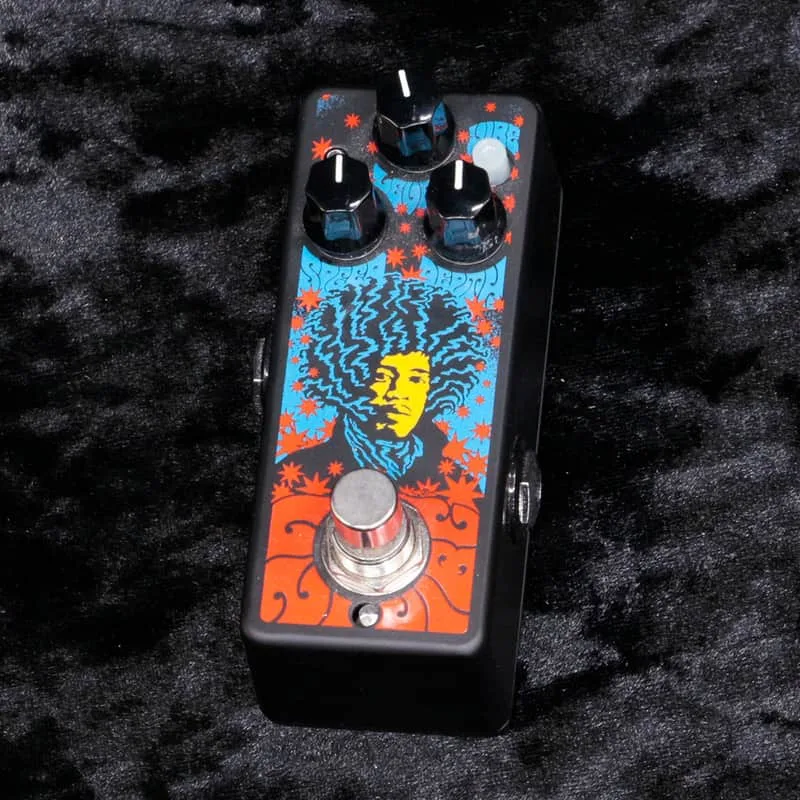
Dunlop also makes a smaller sibling: the Dunlop JHMS3 Authentic Hendrix '68 Shrine Series Uni-Vibe Chorus/Vibrato. It is packed into an MXR mini housing, at a fraction of the size of the vintage Shin-ei unit that Jimi Hendrix used from 1969 to 197067. Dunlop says it delivers the thick wash of tones and textures that permeate the landmark Band of Gypsys album, in analog form6.
The mini version keeps the same control set and mode switching as the M68:
- LEVEL knob controls overall volume of the effect4
- SPEED knob controls sweep rate of the effect, with a range of 0.5 Hz to 10.5 Hz7
- VIBE switch toggles between chorus mode and vibrato mode7
- FOOTSWITCH toggles effect on/bypass (white LED indicates on)4
- Bypass: True Hardwire412
Its manual details the mode behavior the same way: with the VIBE switch in its OUT position the pedal is set to chorus mode, and pushing the VIBE switch IN engages vibrato mode, indicated by an associated LED7.
What reviewers said
Published reviews of the M68 were positive about both its sound and its practicality32.
Guitar World's 2014 review called it "a rugged, professional-quality pedal" and concluded:
"The MXR M68 Uni-Vibe may be small in size and price"3
The same review noted one trade-off against the original: the M68 lacks the foot-controller speed adjustment of the vintage unit, but the reviewer judged that "most players will probably prefer the cost savings over this rarely used feature"3.
Pedal of the Day's Mike B summed up his 2014 review:
"Simple to use, easy to maintain, great sounding: these are all aspects any of us want in any of our pedals."2
He also praised the MXR team for managing to get "all the lush, gooey, shimmery tones heard on so many albums jammed into a nice, neat" compact pedal2.
Videos
ProGuitarShopDemos
Sweetwater
Guitar World
Questions
Is the MXR Uni-Vibe Chorus/Vibrato true bypass?
Yes. Dunlop's product page and the M68 manual both list true bypass, and the manual gives the bypass type as True Hardwire. The footswitch toggles the effect on and bypass, with a white LED indicating when the effect is on.
What does the Vibe button do on the M68?
The Vibe button toggles between the default Chorus Mode and Vibrato Mode. In chorus mode your dry signal is mixed with the pitch-shifted signal; in vibrato mode the dry signal is taken out of the path and only the pitch-shifted signal is produced.
Is the MXR M68 based on the original Shin-Ei Uni-Vibe?
Yes. The M68 is a recreation of the classic Shin-Ei Uni-Vibe effect, aimed at delivering the lush, gooey, shimmery tones of the original in a compact modern pedal with true bypass switching.
What is the difference between the M68 and the Hendrix Shrine Series Uni-Vibe?
The Authentic Hendrix '68 Shrine Series Uni-Vibe Chorus/Vibrato is a smaller variant packed into an MXR mini housing, at a fraction of the size of the vintage Shin-ei unit Jimi Hendrix used from 1969 to 1970. It carries the same chorus and vibrato modes with a Vibe switch, in a mini pedal format.
What is the difference between chorus mode and vibrato mode on the M68?
Chorus mode mixes your dry signal with the pitch-shifted signal for a rich, lush sound. Vibrato mode removes the dry signal and produces only the pitch-shifted signal, giving subtle, psychedelic swirls rather than a mixed chorus texture.
Sources (7)
- MXR® UNI-VIBE® CHORUS/VIBRATO, Dunlop (jimdunlop.com)
- Dunlop MXR Uni-Vibe Chorus / Vibrato, Pedal of the Day (pedal-of-the-day.com), 2014-12-20
- Review: MXR M68 Uni-Vibe Chorus/Vibrato Pedal, Guitar World, 2014-09-26
- M68.pdf, Jim Dunlop, 2019
- MXR® LAYERS™ PEDAL, Jim Dunlop (jimdunlop.com)
- AUTHENTIC HENDRIX™ '68 SHRINE SERIES UNI-VIBE® CHORUS/VIBRATO, Jim Dunlop (jimdunlop.com)
- JHMS3.pdf, Jim Dunlop (jimdunlop.com), 2023