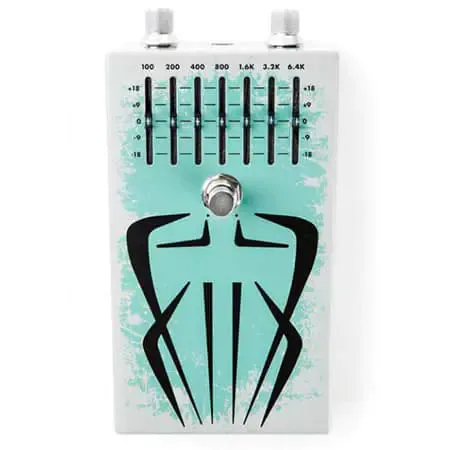


The Dunlop Siete Santos Octave Fuzz is a fuzz pedal from Dunlop that combines two things in one box: an octave fuzz circuit based on the Jimi Hendrix Octavio, and a seven-band graphic EQ for shaping the tone12. It is a signature pedal built around Billy Gibbons' approach to fuzz, and Dunlop describes it as putting "Billy's secret solo recipe into a single pedal"3. MusicRadar's Trevor Curwen summed up the concept: Dunlop "has combined both the octave fuzz (with circuitry based on its Jimi Hendrix Octavio fuzz) and a graphic EQ in a single pedal"1.
The fuzz side follows the vintage Octavio design, whose upper octave sits over the fuzz rather than sounding like a separate effect. Curwen found that "the essential fuzz, though, apes the vintage design with that upper octave bedding in just right like a ghostly overtone"1. The EQ side is what separates it from the original Dunlop Octavio: seven sliders that cut or boost the fuzz's frequency response after the fact.
An Octavio octave fuzz with a seven-band graphic EQ
The Siete Santos takes the Octavio Fuzz circuit and adds seven graphic EQ sliders, so you can cut or boost a full spectrum of frequencies after the fuzz stage34. Delicious Audio, reporting on the pedal at NAMM 2019, called the EQ section "what sets this pedal apart"2. The pairing is unusual: Guitar.com's Richard Purvis wrote that "It's not an obvious partner for the fuzz, but it is a potentially creative one"6.
For a player, that means the pedal can do two jobs. The fuzz side delivers the vintage octave-up fuzz character, while the EQ lets you carve it to fit an amp or a mix without reaching for a separate EQ pedal. With all seven sliders at their center detent positions, Curwen heard "a bright gritty fuzz"1.
The controls: Fuzz, Level and seven EQ sliders
The control set is small on the fuzz side and detailed on the EQ side. The Level and Fuzz controls from the original Octavio pedal remain34, and the manual describes their jobs plainly34.
| Control | What it does |
|---|---|
| Fuzz knob | Controls effect intensity; front-mounted15 |
| Level knob | Controls overall output; front-mounted15 |
| Seven graphic EQ sliders | Boost or cut the indicated frequency, up to ±18dB each5 |
| Footswitch | Toggles the effect on and bypass5 |
Dunlop's recommended starting point, from the manual5:
- Set the Fuzz and Level knobs to 12 o'clock.
- Set all graphic EQ sliders to 0dB.
- Adjust from there to taste.
The EQ sliders sit on the top panel, where Curwen found them easy to access, and each is lit with an individual blue LED1. Guitar.com also noted the sliders "have handy LED markers"6. The Fuzz and Level knobs are a different story: Curwen found the front-mounted pair "not the easiest to set" and said they "could be difficult to access on a pedalboard"1, worth knowing if the pedal will sit tight against other boxes.
EQ range: 100Hz to 6.4kHz, 18dB per band
The seven bands cover a range from 100Hz to 6.4kHz, and each offers up to 18dB of cut or boost412. Curwen found the coverage practical, writing that the bands "cover all the salient areas of guitar/amp tone"1. That span reaches from the low end of a guitar's fundamentals up past the presence region, so a player can thicken the bottom of the fuzz, pull harshness out of the midrange, or add bite on top.
The cheese-wedge enclosure and Pinstripe Billy design
The pedal comes in the classic Octavio Fuzz cheese-wedge shape, finished in a custom color scheme with the "Pinstripe Billy" design35. MusicRadar traced the look further back, noting the Siete Santos "appears to take its styling cues from a late-60s Roger Mayer pedal with a wedge-of-cheese shape and weighty construction"1. The styling earned a place among the pluses in that review's verdict1.
How it differs from the original Octavio Fuzz
The core differences from the original Octavio are the EQ and the power options. The original pedal had Level and Fuzz controls only; the Siete Santos keeps those and adds the seven-band EQ34. It also adds "the modern convenience of an AC power jack," which the manual calls out directly5, and which Delicious Audio noted "was not present in the original"2.
Where the pedal follows the vintage design is in its fuzz character: MusicRadar describes the essential fuzz as aping the vintage design, with the upper octave bedding in like a ghostly overtone1. The seven sliders for the graphic EQ on the top panel are easy to access and are lit up with individual blue LEDs1, a control layout the original octave fuzz did not carry.
What reviewers said
MusicRadar's review was positive on the fundamentals, listing an authentic-sounding vintage octave fuzz, a very flexible EQ, smart styling and the blue LEDs as pluses, with the front-mounted knobs as the noted drawback1. Guitar.com's review framed the EQ as an unconventional but creative addition rather than an obvious upgrade6. Both reviews agree on the pedal's identity: a vintage-style octave fuzz with a tone-shaping layer the original never had.
Videos
GAK
Evenstad Music
Budda Guedes
Questions
Is the Siete Santos a Billy Gibbons signature pedal?
Yes. Dunlop describes it as putting Billy Gibbons' solo recipe of Octavio Fuzz plus a seven-band EQ into a single pedal, and the manual calls it updated and dressed up for the Reverend Billy Gibbons. MusicRadar notes it is endorsed by Billy Gibbons, and Guitar.com calls it an octave fuzz with seven-band EQ created for the ZZ Top guitarist.
Does the Siete Santos Octavio Fuzz need an AC adapter?
No. It can run on one 9-volt battery, accessed through the bottom of the pedal, or on a Dunlop ECB003 9-volt adapter, or Dunlop's DC Brick, Iso-Brick and Mini Iso-Brick power supplies. The AC power jack is an addition over the original Octavio, which did not have one.
Where is the Dunlop Siete Santos made?
Guitar.com's review lists it as made in the USA. The pedal is built by Jim Dunlop, the maker behind the MXR and Cry Baby lines as well as the Jimi Hendrix series of fuzz pedals.
How is the Siete Santos different from the original Octavio Fuzz?
The circuit is based on the Jimi Hendrix Octavio Fuzz, but Dunlop added a seven-band graphic EQ with sliders covering 100Hz to 6.4kHz and up to 18dB of cut or boost per band, plus an AC power jack the original lacked. The Level and Fuzz controls from the original pedal remain.
Are the knobs on the Siete Santos hard to reach on a pedalboard?
Possibly. MusicRadar's reviewer found the front-mounted Fuzz and Level knobs not the easiest to set and said they could be difficult to access on a pedalboard. The seven EQ sliders sit on the top panel, which the same reviewer found easy to access.
Sources (6)
- Dunlop Siete Santos Octave Fuzz review, MusicRadar, 2019-06-30
- New At NAMM 2019: Dunlop Siete Santos Octavio Fuzz, Delicious Audio, 2019-01-24
- SIETE SANTOS™ OCTAVIO® FUZZ, Jim Dunlop (jimdunlop.com)
- BFG07 Siete Santos Octavio Fuzz by Dunlop, RockBoard PedalPedia, 2026
- BFG07.pdf, Jim Dunlop (www.jimdunlop.com), 2019
- Review: Dunlop Siete Santos Octavio Fuzz & Jerry Cantrell Cry Baby Wah, Guitar.com, 2019-05-14