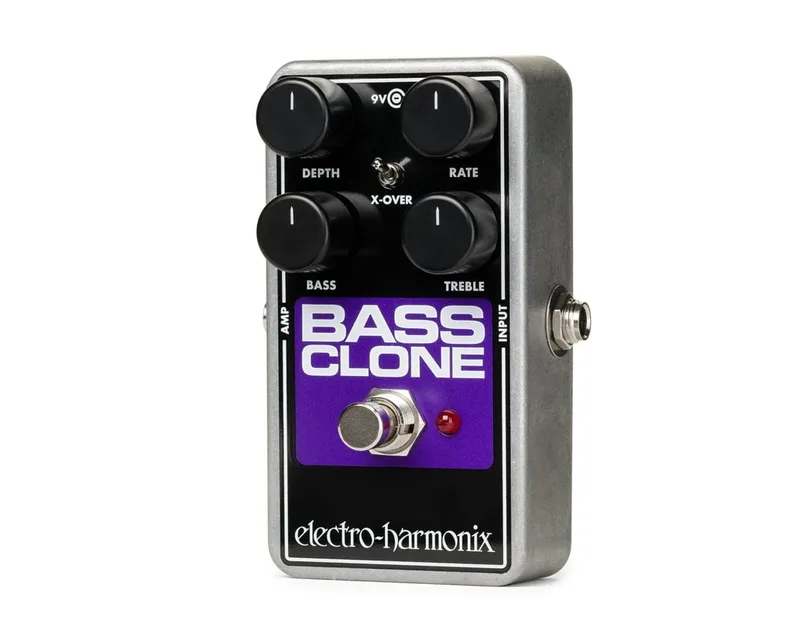


The Electro-Harmonix Bass Clone is an analog bass chorus pedal released in 2016. Electro-Harmonix describes it as "a bass chorus inspired by the legendary Small Clone, optimized for bass and low-end clarity," and says its core circuitry is nearly identical to the Small Clone chorus1. The additions for bass are a crossover switch, a Bass knob and a Treble control, all aimed at keeping the low end solid while the chorus effect does its work.
Chorus on bass has a known problem: modulating the whole signal can smear the fundamental and leave the notes undefined. The Bass Clone addresses that by splitting the signal into a dry half and a modulated half. The maker says the pedal "delivers a more accurately articulated bottom end with excellent note definition"1.
Built on the Small Clone circuit
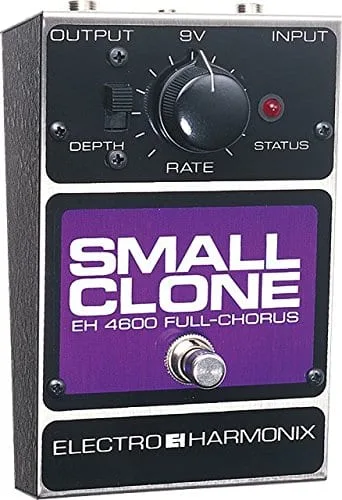
The Small Clone is Electro-Harmonix's analog chorus pedal, and the Bass Clone's core circuitry is nearly identical to it1. The original Small Clone was produced until Electro-Harmonix closed down in 1983, and Aion FX notes it "has also been used by Jonny Greenwood, The Edge and several others"4. The current Small Clone is listed by the maker as an analog chorus with true bypass and a 12mA current draw5.
The Bass Clone keeps that chorus circuit but wraps it in what the maker calls a "tough, compact die-cast package"1, a footprint the press also highlighted at launch: Guitar.com and Guitar World both noted the pedal's compact footprint26. Where the Small Clone's controls are minimal, the Bass Clone adds bass-specific shaping:
| Control | What it does |
|---|---|
| RATE | Sets the speed of the modulation (Small Clone-style rate control) |
| DEPTH | Controls the amount of modulation1 |
| BASS knob | Boosts or cuts low end from the dry half of the effect signal1 |
| TREBLE control | Affects the whole signal6 |
| X-OVER switch | Cuts low end from the modulated half of the signal when the switch is facing up1 |
The crossover switch is the heart of the bass optimization. MusicRadar's Michael Astley-Brown explained it at launch: "a new crossover switch cuts low-end from the modulated signal for increased note definition on bass frequencies"7. Guitar World added the complementary detail that "the Bass control only affects the dry half"6, so the two controls work on opposite halves of the signal: the Bass knob shapes the unmodulated low end, while the X-OVER switch thins the modulated half so the chorus sits above the fundamental rather than blurring it.
The rest of the pedal is straightforward. One footswitch toggles between effect on and true bypass mode, and a red LED illuminates when the effect is engaged1. The INPUT jack takes your instrument or the output of another pedal, and the AMP jack outputs the audio signal1. Premier Guitar's reviewer called out the "stout 1/4\" jacks and the means to power the box with either a 9V battery or adaptor"8.
How it compares with other EHX chorus pedals
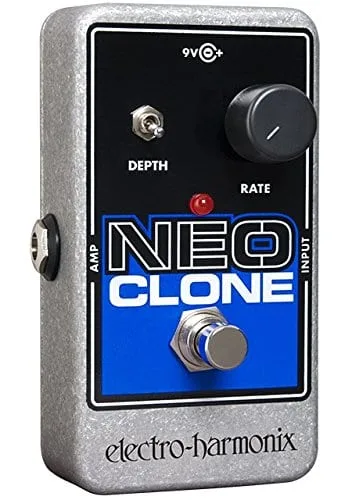
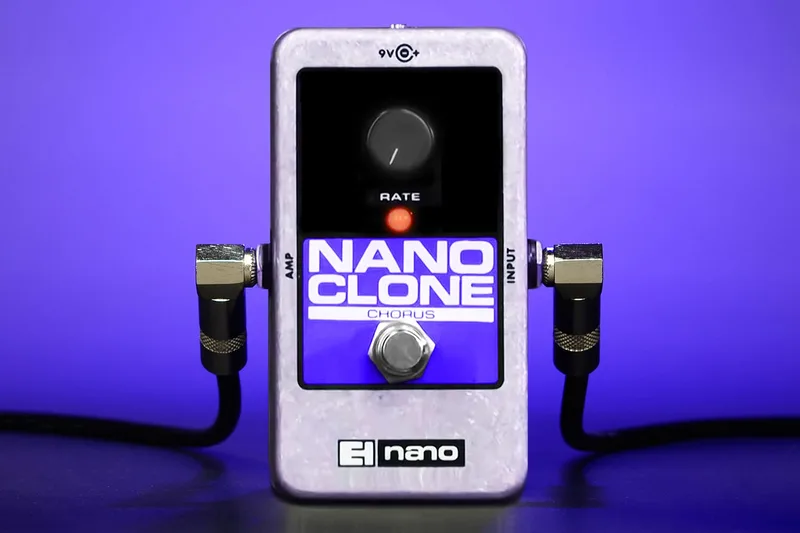
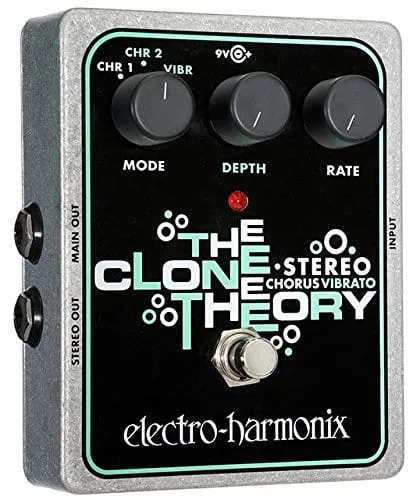
Electro-Harmonix sells several chorus pedals built on the same family of circuits, and the differences matter to a bass player choosing between them1910.
| Pedal | Circuit basis | Bypass | Current draw | Audio | Status |
|---|---|---|---|---|---|
| Bass Clone | Small Clone, with bass crossover and tone controls1 | True bypass1 | 15mA1 | Mono1 | Current |
| Small Clone | Original analog chorus5 | True bypass5 | 12mA5 | Mono | Current |
| Neo Clone | Same classic Small Clone circuit, bucket brigade chip9 | True bypass9 | 12mA9 | Mono9 | Current |
| Nano Clone | Economy version of the Small Clone10 | True bypass10 | 12mA10 | Mono | Current |
| Stereo Clone Theory | Clone Theory circuit with stereo outputs11 | Buffered bypass11 | 14mA12 | Stereo11 | Discontinued 202411 |
The practical takeaway: the Neo Clone and Nano Clone are guitar-oriented Small Clone derivatives without the crossover and Bass controls, and the Stereo Clone Theory, the only stereo option in the family, was discontinued in 2024 and uses buffered rather than true bypass11. The Bass Clone is the one in the range built specifically for low-end clarity, at the cost of drawing slightly more current (15mA versus 12mA) than its siblings15.
What reviewers said
MusicRadar reviewed the Bass Clone and gave it a positive overall verdict: "Highly recommended for any chorus-seeker." The review noted the price as "a measly 59 quid" (GBP, as stated in the review)13. Premier Guitar also reviewed the pedal, noting its stout jacks and dual battery/adapter power options8.
At launch, the pedal was announced as available now with a US list price of $90.402; the current price on Electro-Harmonix's own site is $83.503.
The Bass Clone is mono: one input, one output1. If you need stereo chorus from Electro-Harmonix, the Stereo Clone Theory had stereo outputs but was discontinued in 2024 and used buffered bypass rather than true bypass11.
Videos
Premier Guitar
EHX
The Bass Channel
Questions
What is the difference between the Bass Clone and the Small Clone?
The core circuitry is nearly identical to the Small Clone, but the Bass Clone adds features aimed at bass players: a crossover switch that cuts low end from the modulated half of the signal, a Bass knob that boosts or cuts the low end of the dry half, and a Treble control that affects the whole signal. It is a compact die-cast pedal rather than the larger original enclosure.
Is the Bass Clone true bypass?
Yes. Electro-Harmonix lists the Bass Clone as true bypass, and the single footswitch toggles between effect on and true bypass mode. A red status LED lights up when the effect is engaged.
Does the Bass Clone take a battery?
Yes. A 9V battery is included with the pedal, and it can also be powered by an optional 9.6VDC-200mA power adapter, which is not included. Premier Guitar's reviewer noted both battery and adapter power options among the pedal's features.
How much current does the Bass Clone draw?
Electro-Harmonix lists the Bass Clone's current draw as 15mA. That is slightly higher than the 12mA the company lists for the Small Clone, Neo Clone and Nano Clone chorus pedals.
Is the Bass Clone stereo?
No. Electro-Harmonix lists the Bass Clone's audio as mono, with a single INPUT jack and a single AMP output jack. Players who want stereo chorus outputs from the same family would need to look at the Stereo Clone Theory, which Electro-Harmonix discontinued in 2024.
What does the crossover switch on the Bass Clone do?
With the X-OVER switch facing up, it cuts low end from the modulated half of the signal. MusicRadar described the intent when the pedal launched: cutting low end from the modulated signal gives increased note definition on bass frequencies, so the fundamental stays solid while the chorus effect sits on top.
Sources (13)
- Bass Clone, Electro-Harmonix
- Electro-Harmonix Releases The Bass Clone Pedal, guitar.com, 2016-09-08
- Blurst! | Modulated Filter - Electro-Harmonix, Electro-Harmonix (ehx.com)
- Lithium Analog Chorus / EHX Small Clone, Aion FX, 2022-09-24
- Small Clone, Electro-Harmonix (www.ehx.com)
- Electro-Harmonix Introduces Bass Clone Chorus Pedal, Guitar World, 2016-09-12
- Electro-Harmonix debuts Bass Clone chorus effects pedal, MusicRadar, 2016-09-08
- Electro-Harmonix Bass Clone Review, Premier Guitar, 2017-07-13
- Neo Clone, Electro-Harmonix
- Nano Clone, Electro-Harmonix (www.ehx.com)
- Stereo Clone Theory, Electro-Harmonix, 2024
- Stereo Clone Theory by Electro-Harmonix, RockBoard (rockboard.de PedalPedia), 2026
- Electro-Harmonix Bass Clone review, MusicRadar, 2016-12-13