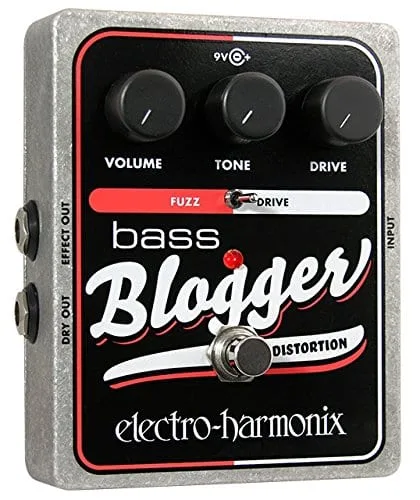


The Bass Blogger is a distortion and overdrive pedal for bass from Electro-Harmonix, released in 2008 and discontinued in 20241. What set it apart from a plain bass distortion box was its two personalities: a Fuzz/Drive switch selects either a Drive mode, which Electro-Harmonix describes as silky, smooth overdrive, or a Fuzz mode for what the maker calls volcanic, fiery fuzz1. MusicRadar described it at launch as a dual-mode pedal for changing between standard distortion and fuzz, built in the usual EHX single stompbox form2.
The other half of its design is aimed at the problem every bass player meets with distortion: losing the low end. Instead of an internal blend knob, the Bass Blogger splits your signal across two output jacks, one dry and one effected, so you can keep your clean bass underneath the grit21.
Bass drive and fuzz in one pedal
The pedal has three knobs and a mode switch. The Drive knob works in both modes: turning it clockwise increases the amount of distortion or fuzz1. The Tone knob is a filter that moves from dark to bright through a linear frequency range as you rotate it1. The Volume knob behaves differently depending on the mode: in Fuzz mode it is a master volume control placed after the gain stages, while in Drive mode it is inactive and sits at unity gain1.
| Control | What it does |
|---|---|
| Fuzz/Drive switch | Selects either the Fuzz or Drive mode1 |
| Drive knob | Increases distortion or fuzz when turned clockwise, in both modes1 |
| Tone knob | Filter that shifts the tone from dark to bright through a linear frequency range1 |
| Volume knob | Master volume after the gain stages in Fuzz mode; inactive at unity gain in Drive mode1 |
Electro-Harmonix pitches the pedal as fat bass drive and fuzz for adding layers of grunge to your low end1. When it launched, MusicRadar highlighted the same idea, noting the dual-mode switch for moving between standard distortion and fuzz2.
Power and connections: dry and effect outputs
The back panel carries one input and two outputs. The input is a standard musical instrument jack1. The effect output jack carries the distorted bass signal1. The dry output jack connects directly to the input jack, giving you access to your original, unprocessed bass signal1.
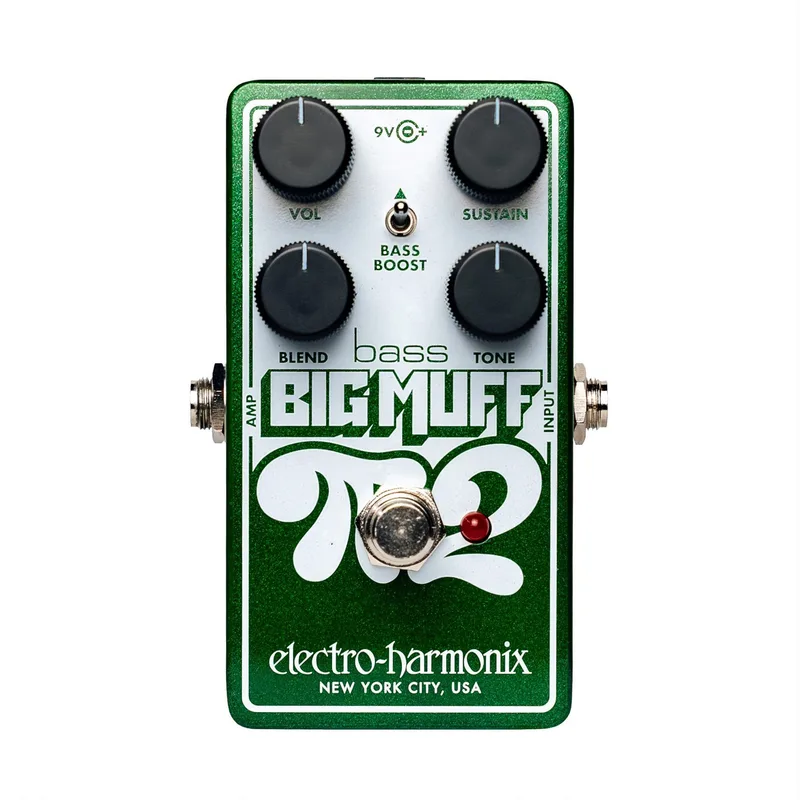
That two-output layout is how the pedal handles clean blending. MusicRadar noted at launch that the dry and distorted signals could be combined for a fuzz bass tone with no lack of sub2. In practice you would run each output into its own amplifier, or into two channels of a mixer, and balance the clean low end against the driven signal. Unlike later Electro-Harmonix bass distortions such as the Bass Big Muff Pi 2, which folds that blend into a single BLEND knob on one output, the Bass Blogger does the job in the wiring outside the pedal.
Power comes from a 9V battery, which is included, or from an optional 9.6VDC-200mA power adapter, which is not1. Current draw is 10mA1, light enough that battery use is practical. The pedal sits in a tough and compact die-cast chassis measuring 4.75 x 4 x 2.25 in1.
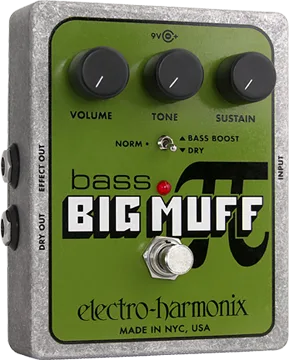
The Bass Blogger was discontinued in 20241, so it is no longer sold new by Electro-Harmonix. Players looking for a current bass drive or fuzz from the maker can compare models like the Bass Big Muff Pi or the Deluxe Bass Big Muff Pi, which build the clean blend in rather than splitting it across two outputs.
Videos
EHX
Guitar Gear
EHX
Questions
Is the Electro-Harmonix Bass Blogger discontinued?
Yes. Electro-Harmonix lists the Bass Blogger as discontinued in 2024. It was released in 2008 as a distortion and overdrive pedal for bass, and it is no longer part of the maker's current lineup. Secondhand units are the way players encounter it today.
Is the Bass Blogger true bypass?
Yes. Electro-Harmonix lists the Bass Blogger as true bypass, so with the pedal off your bass signal passes through without the circuit coloring it. The pedal is analog and mono, with a single instrument input and separate dry and effect output jacks.
How do you blend dry signal with the Bass Blogger?
The pedal has individual dry and effect output jacks. The dry output carries your original bass signal straight from the input jack, and the effect output carries the distorted signal. Run both into two amp channels or a mixer to combine them, which MusicRadar noted gave a fuzz bass tone with no loss of sub.
When did the Bass Blogger come out?
Electro-Harmonix released the Bass Blogger in 2008. MusicRadar covered its debut in June 2008, describing it as a single stompbox with a dual-mode switch for changing between standard distortion and fuzz. It was discontinued in 2024.
Is the Bass Blogger analog?
Yes. Electro-Harmonix lists the Bass Blogger's circuit as analog. It is a mono pedal with true bypass, running on a 9V battery or an optional 9.6VDC-200mA power adapter, drawing about 10mA.
Sources (2)
- Bass Blogger, Electro-Harmonix, 2024
- EHX debuts Bass Blogger distortion pedal, MusicRadar, 2008-06-18