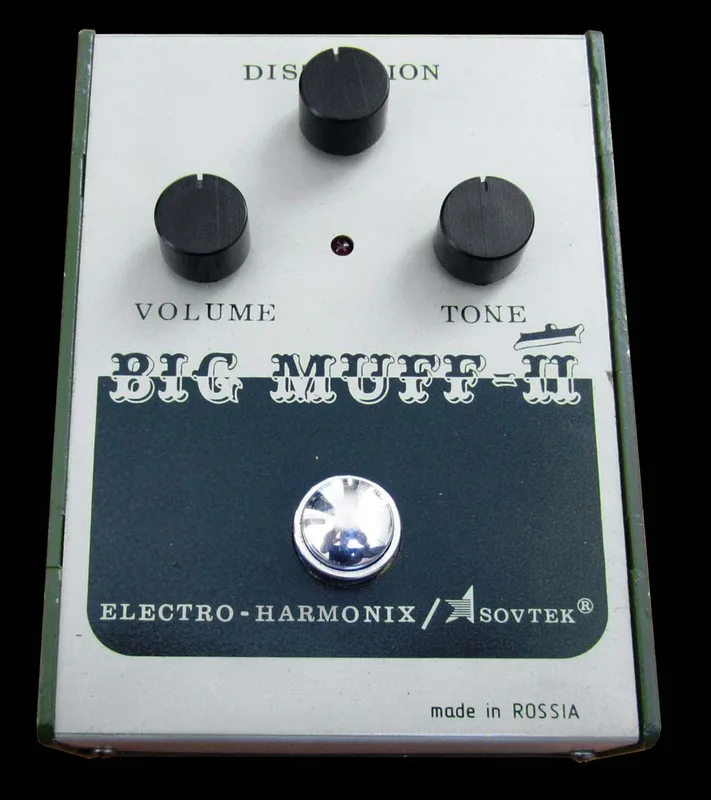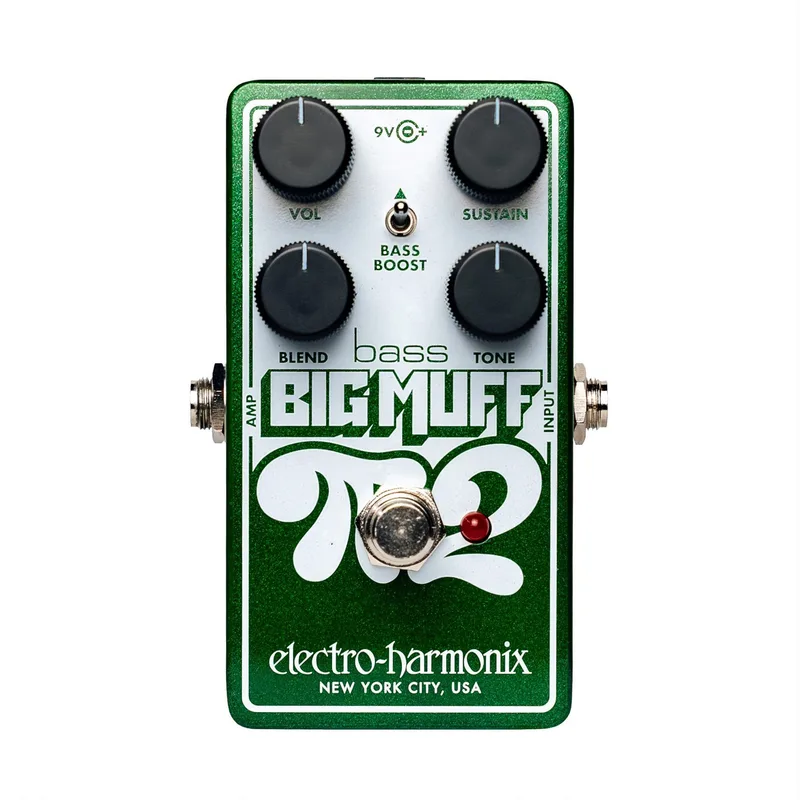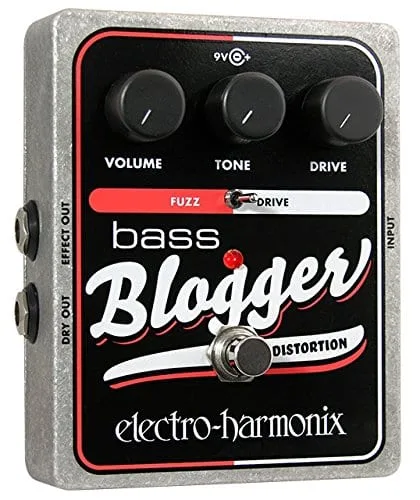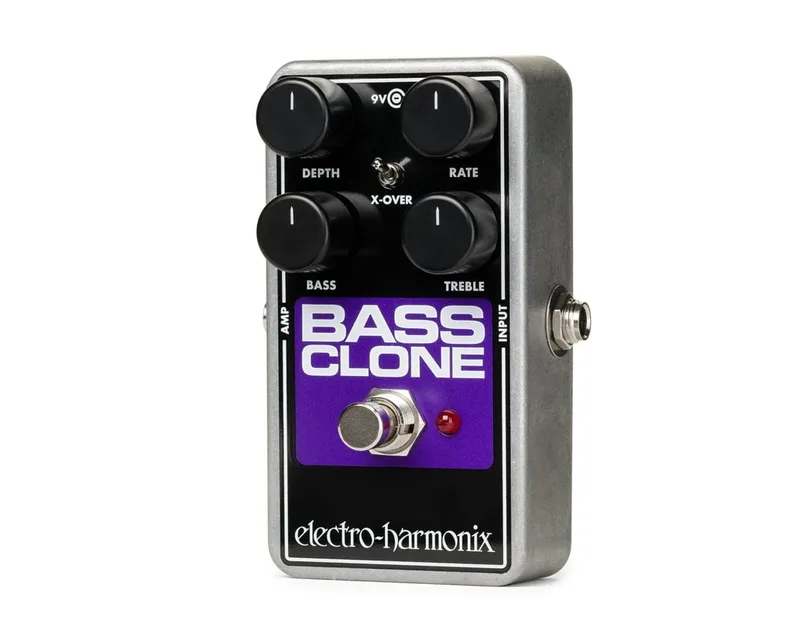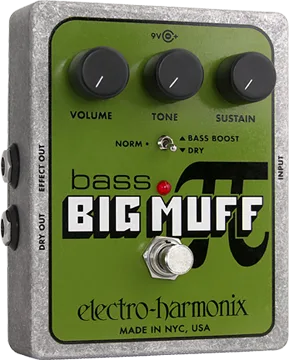


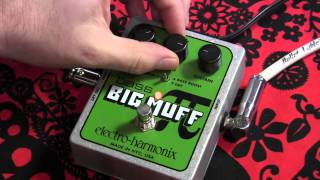
The Electro-Harmonix Bass Big Muff Pi is a bass fuzz and distortion pedal from Electro-Harmonix, released in 2008 as the company's answer for players who wanted to run a bass through a Big Muff without losing their low end12. The circuit is based on the Russian Big Muff, and Electro-Harmonix describes the result as full fuzz tone with no low-end loss, inspired by the bass response of the Black Russian Big Muffs of the 1990s1. It carries the classic Big Muff layout of Sustain, Tone and Volume knobs, plus a three-way toggle and a separate dry output jack that the guitar Big Muffs do not have314.
Controls, the Bass Boost switch and the dry output
The three knobs do what Big Muff players expect. Sustain adjusts the amount of sustain and distortion, Tone moves between high treble and deep bass, and Volume sets the output level of the distortion1.
The pedal's own feature is the three-position toggle: Bass Boost, Norm and Dry14.
| Toggle position | What it does |
|---|---|
| Bass Boost | Adds a bass frequency boost to the distortion1 |
| Norm (middle) | The pure tone of the classic Big Muff Pi1 |
| Dry | Mixes the original dry signal with the distortion circuit's output1 |
The Dry position behaves differently from a normal blend knob. The dry signal stays at unity gain at all times, and the Volume pot sets only the volume of the distortion signal, so you set the mix by ear with the Volume knob rather than a blend control4. With the Dry switch on, you can also dial the gain almost to zero with the tone high and get a light overdrive boost, and the volume knob then acts as another tone control6.
On the side of the pedal, a Dry Out jack is connected directly to the input jack, giving access to your original bass signal. You can send it to a second amplifier or a different effects chain while the main Effect Out jack carries the distortion1. The bypass footswitch toggles between effect mode and true bypass, with a status LED showing when the effect is active1.
Where the circuit came from
The Bass Big Muff Pi was designed by John Pisani, an Electro-Harmonix senior engineer, based on the original Bob Myer Big Muff circuit, and it took approximately eight months to develop and test4. It uses BC547C transistors, the same type as the last black Russian Big Muffs, and Kit Rae's history of the circuit places it in the Sovtek tone family: heavy, fat and smooth, with slightly less gain than the classic Big Muffs and therefore less noise at high sustain4. Compared with USA Big Muffs like the V9, V10 and V12, it has much less gain, a fatter bottom end and brighter mids6.
The pedal was made for basses but also works very well on guitar, with a sound similar to the Green Russian7. All three toggle settings sound good with a bass guitar, and for guitar the Norm setting is the one that sounds best6.
Nano Bass Big Muff π
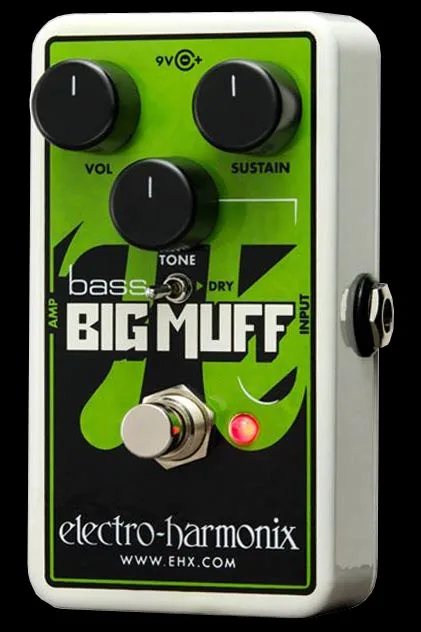
The Nano Bass Big Muff Pi, released in 2014, puts the Bass Big Muff sound in a nano-sized package: 4.5 x 2.75 x 2.1 inches, roughly half the footprint89. It keeps the familiar trio of Volume, Tone and Sustain pots and the same analog, true-bypass design, with a current draw of 4mA8.
The one thing it drops is the three-way toggle. Instead there is a single Dry switch, a mini toggle that mixes your dry bass, at unity level, with the distortion, which Premier Guitar's buying guide describes as a 50/50 wet/dry blend to assist low-end retention and clarity810. Kit Rae notes the voicing is similar to the XO-sized Bass Big Muff (version 11), based on the Russian Big Muff sound, with the bass boost mode being the only feature left out11. The circuit uses through-hole transistors, capacitors and diodes with surface-mount resistors to fit the smaller board, and it was assembled and tested in Long Island City, New York11.
Deluxe Bass Big Muff π
The Deluxe Bass Big Muff Pi, released in 2012 by Electro-Harmonix's own dating and January 2013 by Kit Rae's, expands the original with features aimed at the modern bass player1243. Its core circuit is the V11 Bass Big Muff circuit, which Kit Rae describes as a slightly lower gain, slightly less bassy version of a Green Russian Big Muff with a brighter mid range4.
The Deluxe uses buffered bypass rather than the true bypass of the standard and Nano versions, and its bypass footswitch engages the distortion circuit with a second, separate footswitch for the crossover section124.
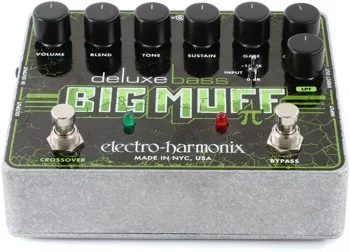
What the Deluxe adds over the original:
- A Blend control that mixes between the dry and distorted signals, replacing the fixed three-way toggle122
- An input pad switchable between 0dB and -10dB, so the pedal works equally well with passive and active pickups123
- A footswitchable crossover section: a variable high-pass filter on the distorted signal and a variable low-pass filter on the dry signal, which Premier Guitar says effectively makes the Deluxe a 2-channel pedal122
- A built-in noise gate with an adjustable threshold13
- Three outputs: a 1/4 inch effect out, a 1/4 inch buffered direct out, and an XLR DI out for plugging directly into a mixing console or recording equipment12
The crossover circuit, working with the Blend, is what lets a player keep the low end clear and focused while the high end stays bright and cutting3. Kit Rae likens the engaged crossover to a cocked wah filter that can be kicked on or off, and notes the bass-specific features work very well with guitar or bass, with a sound very similar though not identical to the original4.
Power and connections
All three versions run on a 9V battery, included, or an optional 9.6VDC-200mA power adapter, not included1128. The power jack takes a negative tip polarity and uses standard Boss-type adaptors4. Current draw differs by model: 7mA for the standard Bass Big Muff Pi, 4mA for the Nano and 15mA for the Deluxe1812. Guitar World lists the Deluxe's power requirement as 100mA at 9VDC with battery operation, a higher figure than Electro-Harmonix's own 15mA draw spec1412.
| Model | Inputs | Outputs | Bypass |
|---|---|---|---|
| Bass Big Muff Pi | Input jack1 | Effect Out, Dry Out1 | True bypass1 |
| Nano Bass Big Muff Pi | Input jack8 | Amp jack8 | True bypass8 |
| Deluxe Bass Big Muff Pi | Input jack12 | Output, Direct Out, XLR DI12 | Buffered bypass12 |
Price
Electro-Harmonix lists the Bass Big Muff Pi at $98.00 USD and the Nano Bass Big Muff Pi at $94.30 USD, both as of 2026-10-265. The Deluxe Bass Big Muff Pi is listed at $150.60 USD15. Premier Guitar gave $118 street for the Deluxe in 20212.
What reviewers said
MusicRadar's review team wrote that the Bass Big Muff Pi "has been loved by players for years," with the Deluxe taking bass distortion further13. Performer Mag's Max Monahan called it the bass counterpart to the classic Big Muff for guitar, giving a thick fuzzed-out bass tone without losing low frequencies, and concluded:
"Overall, the Bass Muff rules the old-school tones and carries a legacy that won't let you down."
Premier Guitar's Nano review praised its "Excellent sustain, Big Muff tone in small package, plenty of bang for your buck," noting the sustain "seemingly lasted for days"17. The same review found the dry-signal blending options somewhat limited without a dedicated blend knob, the trade-off for the Nano's simple toggle17. With the dry switch engaged and tone and sustain at 10 o'clock, the reviewer reported just the right taste of hair for dirty blues and classic rock, while sustain at 3 o'clock or higher with the dry switch off produced crushing distortion for metal, grindcore and stoner players without sucking the soul out of the low end17. Premier Guitar's 2024 buying guide credited the Nano with excellent low-end retention and its dry switch for wet/dry blend10.
Of the Deluxe, Guitar World's Connor Flys wrote that it is "Far from the classic Muff, it's a bigger pedal with more knobs, but you might find them very useful"18. MusicRadar's team noted the sustain and tone controls are retained from the original Big Muff but the unit is bigger and more complex, with the Gate function there to eliminate hum from mains, lighting or proximity to high-gain amps13.
A second-generation Bass Big Muff Pi 2 and a Deluxe Bass Big Muff 2 have since been released, covered on their own pages: Electro-Harmonix Bass Big Muff Pi 2 and Electro-Harmonix Deluxe Bass Big Muff 2.
Videos
EHX
THE MUSICIAN NETWORK (TMNtv)
gearmanndude
Questions
What does the Bass Boost switch do?
The three-way toggle on the Bass Big Muff Pi has three settings. In Bass Boost mode, a bass frequency boost is added to the distortion. In Norm, the middle position, you get the pure tone of the classic Big Muff Pi. In Dry mode, the original dry signal is mixed with the output of the distortion circuit, with the dry signal staying at unity level no matter where the Volume knob is set.
What is the difference between the Bass Big Muff and the Deluxe Bass Big Muff?
The Deluxe keeps the Sustain and Tone controls but adds a Blend knob instead of the fixed three-way toggle, an input pad switchable between 0dB and -10dB for passive or active basses, a footswitchable crossover section with high-pass and low-pass filters, a noise gate, and three outputs: effect out, buffered direct out and an XLR DI out for plugging straight into a mixing console.
Can you use the Bass Big Muff on guitar?
Yes. The pedal was made for basses but also works very well on guitar, and its normal setting is described as very close to the black Russian Big Muff tone for guitar. All three toggle settings sound good with a bass guitar, but for guitar the normal setting is the one generally preferred.
Sources (18)
- Bass Big Muff Pi, Electro-Harmonix (ehx.com)
- Electro-Harmonix Deluxe Bass Big Muff Pi Pedal Review, Premier Guitar, 2013-02-25
- Electro-Harmonix Releases the Deluxe Bass Big Muff Pi, Premier Guitar, 2012-11-20
- The Big Muff History of All Versions 3, kitrae.net, 2017-03
- Big Muff Pi, Electro-Harmonix (www.ehx.com)
- Big Muff Versions_Quick Identifier, Kit Rae (kitrae.net), 2026
- The history of the big muff over time, anasounds.com, 2022-06-08
- Nano Bass Big Muff Pi, Electro-Harmonix
- Electro-Harmonix unleashes two new Big Muffs, MusicRadar, 2014-05-21
- Killer Pedals Under $100, Premier Guitar, 2021-03-08
- The Big Muff History of All Versions 3, Kit Rae (kitrae.net), 2017-09
- Deluxe Bass Big Muff Pi, Electro-Harmonix (ehx.com)
- Electro-Harmonix Deluxe Bass Big Muff Pi review, MusicRadar, 2013-03-25
- Best bass effects pedals: best pedals for every style, Guitar World, 2021-12-20
- Op Amp Big Muff Pi, Electro-Harmonix
- 5 Best Bass Distortion Pedals of All Time, Performer Mag, 2017-06-07
- Electro-Harmonix Nano Bass Big Muff Review, Premier Guitar, 2015-02-10
- Electro-Harmonix Nano Bass Big Muff Pi 2 review, Guitar World, 2026-03-26