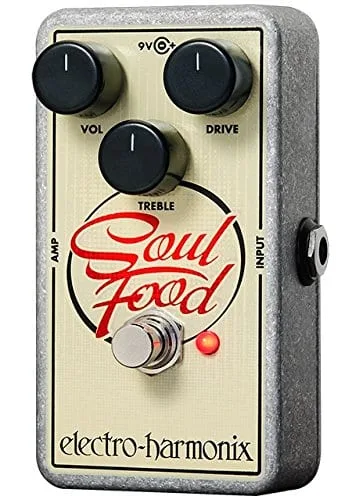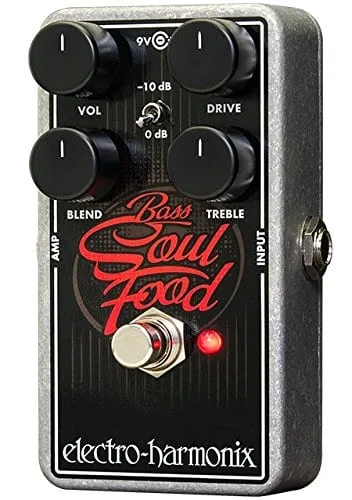


The Electro-Harmonix Bass Soul Food is an analog overdrive and clean boost pedal for bass, released by Electro-Harmonix in 2015. It is the bass-voiced version of the company's Soul Food, a 2013 pedal that put a Klon-style "transparent" overdrive circuit into an affordable box. Where the original Soul Food was built for guitar, the Bass Soul Food keeps more of the low end: Electro-Harmonix says it "dives deeper than the original Soul Food, retaining even more low frequecies while adding warmth and growl to your original tone"1.
The key difference for a bass player is the BLEND knob, which mixes your untouched clean signal with the driven sound so the fundamental stays articulate. The maker describes the result as "Natural bass overdrive and clean boost for the tone conscious!"1
A Klon-style overdrive voiced for bass
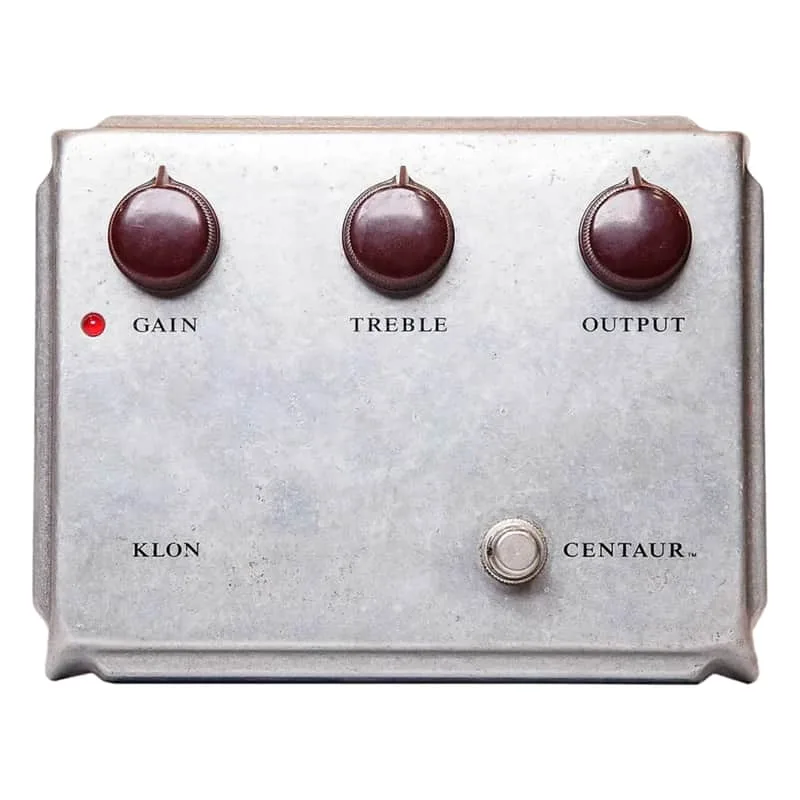
The circuit traces back to the Klon Centaur, the 1990s overdrive whose used prices pushed it out of reach for most players. Electro-Harmonix founder Mike Matthews says the original Soul Food "put 'Klon-like' transparent overdrive into the hands of players at an unprecedented price point"1. MusicRadar's Trevor Curwen likewise describes the Soul Food as "EHX's take on the transparent overdrive of the Klon Centaur"4.
"Transparent" here means the pedal is meant to push your amp and add gain without heavily recoloring your core tone. Electro-Harmonix calls the Soul Food's sound "Transparent overdrive with great touch and response"5. For the bass version, the company added a clean blend and raised the internal power rails: "An adjustable clean blend assures an articulate, full tone while boosted power rails deliver extended headroom"1. Extended headroom means the pedal is less likely to clip or compress on the hot, low-frequency output of a bass.
A technical analysis of Klon-derived circuits by Coda Effects notes that "The Bass Soul Food actually uses this mod," referring to a separated gain and blend modification that Klon owners commonly apply to their own pedals6. In other words, the feature bass players were adding to Klon circuits by hand is built into this pedal from the factory.
The controls: Vol, Drive, Treble, Blend and the pad switch
The front panel carries four knobs and one switch, matching the control list in Guitar World's bass overdrive buying guide: "Vol, Drive, Treble, Blend, -10dB/0dB input gain switch"3.
| Control | What it does |
|---|---|
| DRIVE | Controls the amount of input gain1 |
| VOL | Sets the master output level1 |
| TREBLE | Acts as a tone control1 |
| BLEND | Sets the mix between your clean bass signal and the effect1 |
| PAD switch (-10dB/0dB) | Sets the initial input level of your bass signal1 |
The pad switch is the practical detail for anyone playing an active bass. Electro-Harmonix describes it as "a switchable -10dB pad for active instruments"1: dropping the input by 10dB keeps a hot preamp from overloading the drive circuit, so the DRIVE knob works over a useful range instead of jumping from clean to saturated.
A single footswitch selects whether the pedal is engaged or in bypass mode, with an LED lit when the effect is on1.
Power and connections
Connection is simple: one 1/4" input jack for your bass and one 1/4" AMP output jack to your amp1. Guitar World's guide lists the full set as "9v DC in, ¼" instrument in, ¼" amplifier out"3.
For power, the pedal runs on a 9V battery and ships with an EHX9.6DC-200 power supply2; the current maker listing specifies a 9.6VDC-200mA adapter included1. Current draw is 22mA1, light enough that the pedal is easy to accommodate on a shared power supply.
The Bass Soul Food lets you choose its bypass behavior: selectable true or buffered bypass modes1. On the original Soul Food, Premier Guitar notes this is "a small internal switch to select between true bypass mode (the default) and buffer bypass mode"7. True bypass keeps the pedal out of the signal path entirely when off; buffered mode keeps a buffer in line, which can help preserve high end over long cable runs.
How it differs from the Soul Food
The original Soul Food arrived in 2013 as an entirely brand-new pedal, not a reissue, with selectable true-bypass or buffered-bypass modes5. Its controls are Volume, Drive and Tone8, with no blend knob. The Bass Soul Food keeps the same circuit family but revoices it for bass, swaps Tone for Treble, and adds the BLEND knob and the -10dB pad13.
The two also sit at different prices: the Soul Food is listed at $89.00 USD at authorized EHX dealers5, while the Bass Soul Food is listed at $114.30 USD on the maker's current page1. At launch in January 2015, the Bass Soul Food carried a US list price of $117.792; MusicRadar's NAMM 2015 coverage rounded that to "$117 (£76)"9, so the two launch figures differ slightly between publications.
What reviewers said
Published verdicts on the Bass Soul Food itself are sparse, but Guitar World's 2026 guide to overdrive pedals for bass describes it as "Inexpensive but has everything you need," calling it a "nice, versatile medium-gain overdrive" while cautioning that "there are better options for more modern sounds"3.
Reviews of the guitar version fill in the picture of the shared circuit. Guitar World's Chris Gill found that "Soul Food serves up clean boost that preserves your guitar's natural tone but widens its dynamic range and makes its overall sound bigger and bolder"10. Trevor Curwen at MusicRadar called it "an excellent complement to a valve amp"4, and Pedal of the Day's Mike B said it was "created to bring great-sounding tone to musicians everywhere…at an VERY affordable price"11.
Mike Matthews' own description of the bass version: "The Bass Soul Food delivers a wide range of overdrive and clean boost sounds, and has plenty of volume to assert your pl"1.
Videos
ProGuitarShopDemos
EHX
The Bass Channel
Questions
Is the Bass Soul Food true bypass or buffered?
Both. The pedal has selectable true or buffered bypass modes, chosen with a switch. Electro-Harmonix's original Soul Food works the same way, using a small internal switch to select between true bypass (the default) and buffer bypass.
What is the difference between the Soul Food and the Bass Soul Food?
The Bass Soul Food is the bass-voiced version of the 2013 Soul Food. Electro-Harmonix says it retains more low frequencies and adds warmth and growl, and it adds a BLEND knob that mixes your clean bass signal with the effect. A technical analysis notes it uses a separated gain and blend approach. The original Soul Food has Volume, Drive and Tone controls instead.
Can you use the Bass Soul Food as a clean boost?
Yes. Electro-Harmonix describes it as a natural bass overdrive and clean boost, and Mike Matthews says it delivers a wide range of overdrive and clean boost sounds with plenty of volume. Reviewers of the original Soul Food found its clean boost preserves the instrument's natural tone while making the sound bigger.
Where is the Bass Soul Food made?
Guitar World's bass overdrive buying guide lists the Bass Soul Food as made in the USA. Electro-Harmonix is a New York-based effects maker.
Sources (11)
- Bass Soul Food, Electro-Harmonix (ehx.com)
- Electro-Harmonix Announces the Bass Soul Food, Premier Guitar, 2015-01-05
- Best overdrive pedals for bass 2026: The ultimate in bass saturation at all price points, Guitar World, 2026-06-01
- Electro-Harmonix Soul Food review, MusicRadar, 2014-05-08
- Soul Food, Electro-Harmonix
- Coda Effects, Coda Effects, 2015-09
- Klon vs Klone: Top 5 Budget Pedals Compared, Premier Guitar, 2020-04-17
- Electro-Harmonix Releases the Soul Food Overdrive, Premier Guitar, 2013-12-16
- NAMM 2015: Electro-Harmonix reveals Bass Soul Food overdrive pedal, MusicRadar, 2015-01-15
- Review: Electro-Harmonix Hot Tubes Overdrive, Nano Big Muff π and Soul Food Pedals, Guitar World, 2014-02-27
- Electro-Harmonix Soul Food Overdrive (JHS Pedals 'Meat & 3' Mod), Pedal of the Day, 2014-05-06