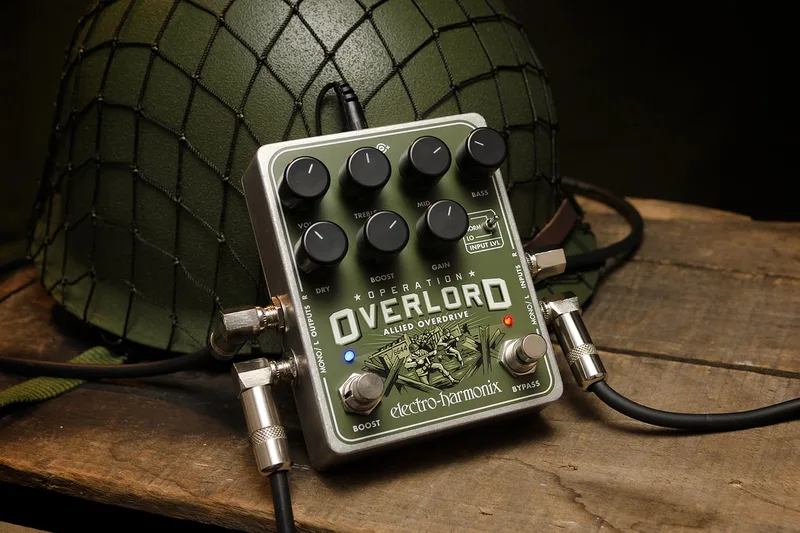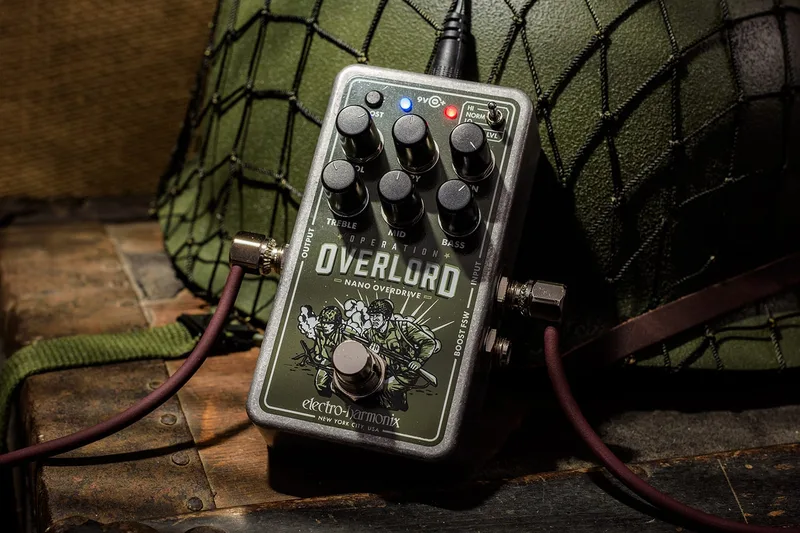


The Electro-Harmonix Operation Overlord, sold as the Operation Overlord Allied Overdrive, is a stereo analog overdrive and distortion pedal built around three JFET gain stages. JFETs, or junction field-effect transistors, are often used in drive circuits because they clip in a way that resembles a tube amplifier, and Electro-Harmonix describes Normal mode as delivering "tube amp-style response and tone"1. The pedal was announced at NAMM in January 2017 and released that year, and it is now discontinued: the maker's product page marks it discontinued in 202512.
What set the Overlord apart from most overdrive pedals was its instrument-agnostic design. Electro-Harmonix pitched it at players of "guitar, bass, keyboards or pretty much any electronic instrument," with a three-position input level switch to match whatever you plug in1. It is also fully stereo, with left and right quarter-inch input and output jacks, so it can sit in a stereo rig or run mono in and stereo out13.
How it works: JFET stages and two modes
The drive sound comes from three JFET gain stages in series. In Normal mode those stages alone carry the signal, which Electro-Harmonix says provides low to medium gain sounds1. Boost mode adds a classic pedal-type overdrive circuit in front of the JFET stages, increasing the overall distortion and pushing the pedal into heavier territory1. The two modes are foot-switchable silently, and the maker says the range runs from mild to saturated2.
MusicRadar's reviewer Trevor Curwen described the result as "amp-like from a touch of grit through to cranked stack," and called the pedal "a practical overdrive/distortion suitable for both guitar and studio applications"3.
The pedal has two footswitches. The BYPASS footswitch engages or bypasses the effect, with a red LED lit when engaged, and the BOOST footswitch toggles Boost mode, with a blue LED lit when Boost is active1.
The controls
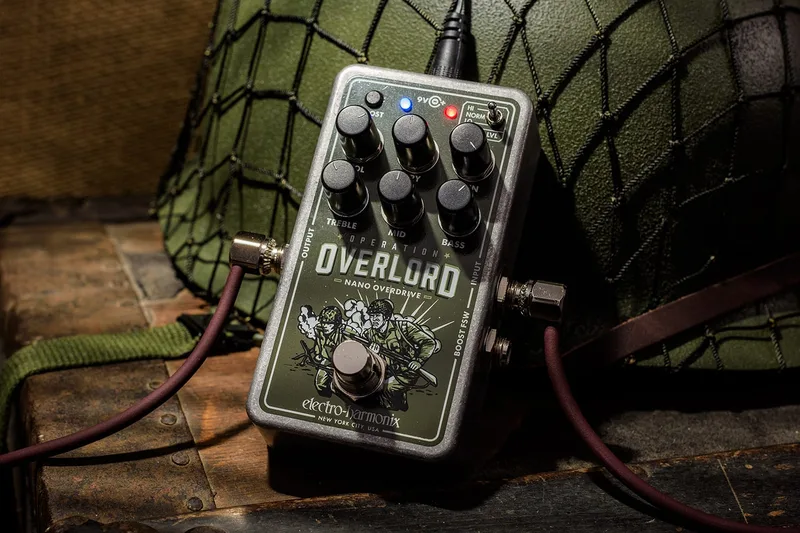
The Overlord gives you six knobs, a boost button and an input level switch. The EQ is active rather than passive, which means the treble, mid and bass controls cut and boost rather than only cutting, and the dry blend lets you keep your clean signal underneath the drive452.
| Control | What it does |
|---|---|
| VOL | Sets the overall volume output1 |
| TREBLE | Active treble control for tone shaping2 |
| MID | Active mid control6 |
| BASS | Active control of the level of the bass frequency range1 |
| DRY | Mixes a clean unaltered signal with the distortion1 |
| BOOST | Controls the amount of extra gain fed into the main circuit when Boost and Normal modes are engaged1 |
| INPUT LVL switch | Controls the overall input level of your instrument1 |
The input level switch is the key to the pedal's multi-instrument design. Premier Guitar's launch coverage described it as "a three-position switch which lets the user select the proper input level for their instrument," ensuring compatibility with guitar, keyboards, bass and most electronic instruments6. For bass players, the active bass control plus the dry blend give two ways to keep low end intact under gain.
Power and connections
The Overlord runs on the standard EHX 9.6DC200mA power supply, which is included, and draws 90mA12. There is no battery option in the listed power specification. The audio path is fully stereo: left and right quarter-inch inputs accept mono or stereo sources, and left and right quarter-inch outputs carry the effected signal1. MusicRadar noted it supports "full stereo operation plus mono in/stereo out (besides standard mono)"3.
The 9.6VDC power requirement means the Overlord does not run on a standard 9V battery, and its 90mA draw is worth accounting for on a crowded pedalboard power supply1.
The Nano Operation Overlord
In 2019 Electro-Harmonix released the Nano Operation Overlord, a smaller mono version of the same circuit. The maker describes it as "a nano-sized version of the Operation Overlord with the same great overdrive and distortion tones, but in mono"7. It keeps the input level switch, the Normal and Boost modes, the active three-band EQ and the dry blend, but drops the stereo jacks. Guitar World's reviewer Trevor Curwen summed it up: "This one keeps the input level option but loses the stereo"4. It draws 50mA, compared with the original's 90mA41.
What reviewers said
Reviews of both versions were positive. Guitar Player's reviewer found the Nano delivered "amp-like tone and feel, powerful EQ, tiny footprint" with "no reasons to avoid," and concluded it was "an amp-style overdrive that offers great versatility for guitar, bass and beyond"5. Guitar World gave the Nano 8/10, calling it "an affordable and versatile drive/distortion packed into a practical space-saving footprint"4. Of the original stereo pedal, MusicRadar's verdict highlighted its versatility3.
At the original pedal's NAMM 2017 debut, Gearnews wrote: "It sounds like a neat idea and if the character of the drive is good then I think it could be very popular indeed"8.
Videos
EHX
EHX
Reverb
Questions
Is the Operation Overlord true bypass?
No. Electro-Harmonix lists the Operation Overlord as buffered bypass, so when the effect is switched off the signal still passes through the pedal's buffer rather than a true bypass path. The smaller Nano Operation Overlord uses the same buffered bypass design.
Can the Operation Overlord be used on bass or keyboards?
Yes. Electro-Harmonix designed it for guitar, bass, keyboards and pretty much any electronic instrument. A three-position input level switch lets you match the pedal to the instrument's output level, and the active bass control and dry blend help low-end instruments keep their body under gain.
What is the difference between the Operation Overlord and the Nano Operation Overlord?
The Nano, released in 2019, is a smaller mono version of the original. It keeps the same overdrive and distortion tones, the input level switch and the Normal and Boost modes, but drops the stereo input and output jacks. The original runs in full stereo with left and right quarter-inch jacks.
Is the Electro-Harmonix Operation Overlord discontinued?
Yes. Electro-Harmonix marks the Operation Overlord Allied Overdrive as discontinued in 2025. It was released in 2017 with a US list price of $197.10, and the mono Nano version followed in 2019.
Sources (8)
- Operation Overlord, Electro-Harmonix, 2025
- Electro-Harmonix Launches Blurst & Operation Overload, Premier Guitar, 2017-02-09
- Electro-Harmonix Operation Overlord Allied Overdrive review, MusicRadar, 2018-01-11
- Electro-Harmonix Mod 11, Nano Operation Overlord and Bass9 Bass Machine, Guitar World, 2020-03-20
- Electro-Harmonix Nano Operation Overlord Allied Overdrive Review, GuitarPlayer (www.guitarplayer.com), 2020-04-27
- Electro-Harmonix Launches the Nano Operation Overlord, Premier Guitar, 2019-10-07
- Nano Operation Overlord, Electro-Harmonix
- NAMM 2017: Electro Harmonix Operation Overlord stereo distortion, gearnews.com, 2017-01-20