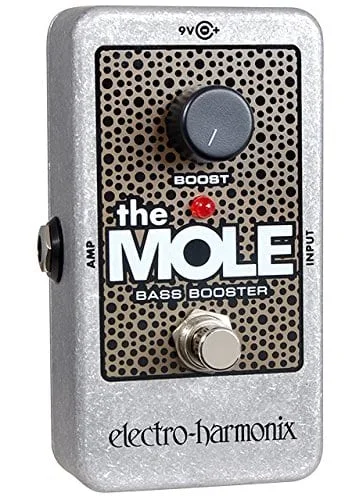


The Mole is a bass booster from Electro-Harmonix, aimed at both bassists and guitarists who want more low end. The maker describes it as a pedal that helps players "unearth a sound that is positively subterranean," and the updated version adds a 20dB boost to the signal alongside the same rich, low-end bottom as the classic design1. It was discontinued in 20201.
What it does to your sound
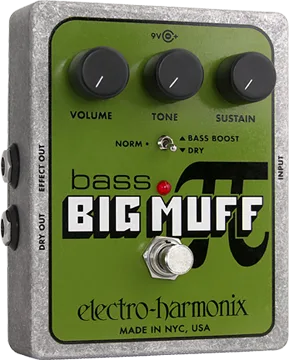
Electro-Harmonix positions the Mole as a low-end tool with two working ranges: cranked, it delivers what the maker calls "deep, ground-shaking drive," and dialed back, the knob adds texture to your existing tone1. Because it is a booster rather than a fuzz or overdrive, the character comes from pushing the low end of the signal harder, not from a clipping stage of its own. Players looking for a bass fuzz in the same maker's range can compare the Bass Big Muff Pi or the Deluxe Bass Big Muff Pi, which are distortion pedals rather than boosts.
An LPB-1 variant with raised capacitors
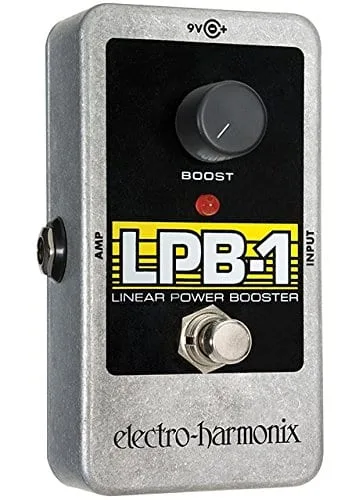
The Mole's circuit traces back to the Electro-Harmonix LPB-1 Linear Power Booster2. On the JHS Pedals channel, Josh describes the family line plainly: the LPB-1 became the basis for other boosts, and "then we had uh the mole base boost which raised those capacitors"2. Raising the capacitor values in the LPB-1's circuit shifts its response toward the bass frequencies, which is what turns a linear boost into a bass boost.
The LPB-1 itself is a simple circuit. In another JHS Pedals video, the LPB-1 is described as having "turned into a one transistor common emitter topology overdrive pedal"3. Its history runs through some of Electro-Harmonix's best known work: Guitar World reports that the LPB-1 "was developed while working on the debut Big Muff Pi"4, and Kit Rae's Big Muff history records that the small volume-boosting pre-amp it grew from was built by Bob Myer, originally as a pre-amp boost for the prototype of the E-H Black Finger compressor5.
"then we had uh the mole base boost which raised those capacitors"
Power, bypass and build
The Mole runs on a 9-volt battery, which was included in the box, and Electro-Harmonix also offered its 96DC-200BI power supply as an option1. It is true bypass, so the signal passes unbuffered when the pedal is off1. The enclosure is a tough and compact die-cast chassis measuring 2.75 inches wide, 4.5 inches long and 2.1 inches high1, a footprint that fits easily on a small bass pedalboard.
The Mole was discontinued in 20201. It is no longer made, so it is generally found on the secondhand market rather than new.
Videos
EHX
Maelin PTY
Dj Nick a.k.a Son Of a Pitch
Questions
Is the Electro-Harmonix Mole discontinued?
Yes. Electro-Harmonix lists the Mole as discontinued in 2020. It is no longer part of the maker's current lineup, so it is found secondhand rather than new from the maker.
Does the Electro-Harmonix Mole take a battery?
Yes. The pedal shipped with a 9-volt battery included, and it runs on that battery. Electro-Harmonix also offered an optional 96DC-200BI power supply for players who prefer to run it from a supply.
Is the Electro-Harmonix Mole true bypass?
Yes. Electro-Harmonix lists true bypass among the Mole's features, so with the pedal switched off the signal passes through without buffering.
What power supply does the Electro-Harmonix Mole use?
It runs on the included 9-volt battery, or on the optional 96DC-200BI power supply that Electro-Harmonix made available for it.
Sources (5)
- Mole | DISCONTINUED 2020 | Bass Booster - Electro-Harmonix, Electro-Harmonix
- EPISODE 1: How To Breadboard An Electro Harmonix LPB-1 Boost Pedal, JHS Pedals (YouTube), 2024-05-01
- EPISODE 2: Modifying An Electro Harmonix LPB1 Boost Into A Fuzz, JHS Pedals (YouTube channel), 2024-05-09
- The Electro-Harmonix LPB-3 reimagines its first-ever effect, Guitar World, 2024-05-10
- The Big Muff History of All Versions Part 1, Kit Rae (kitrae.net), 2020-03