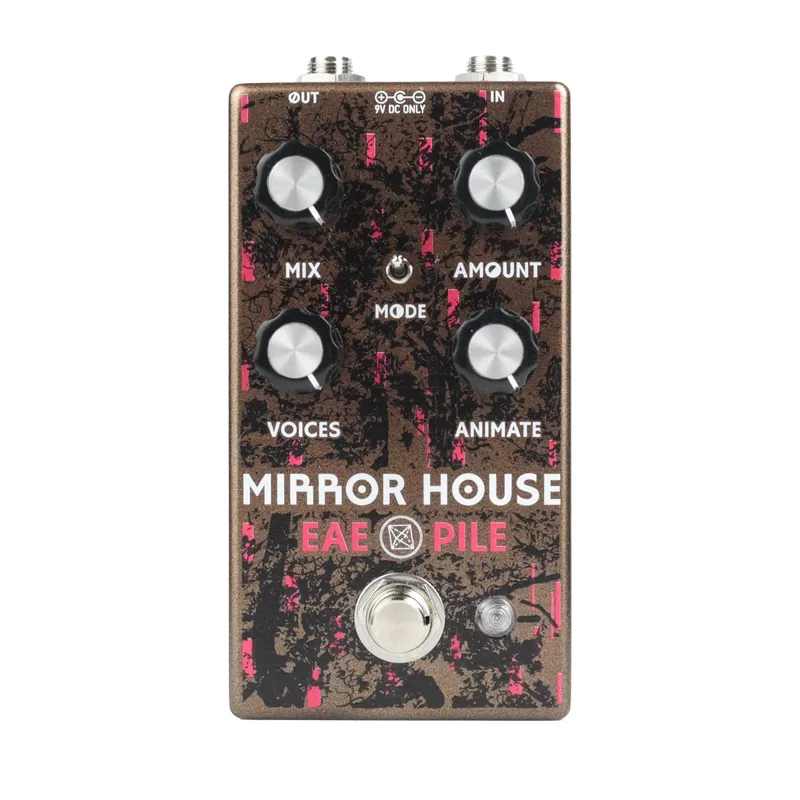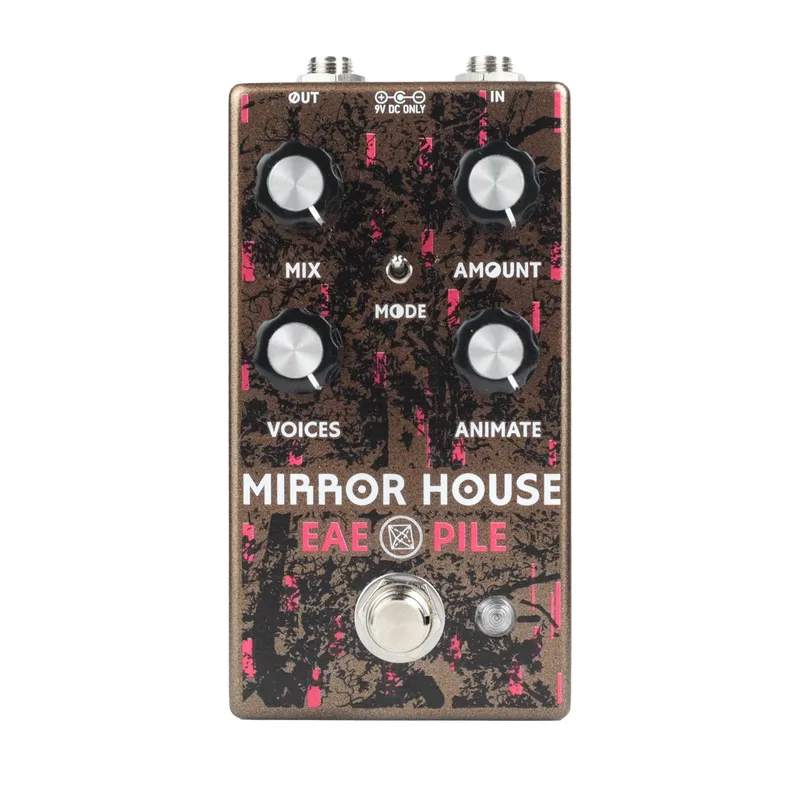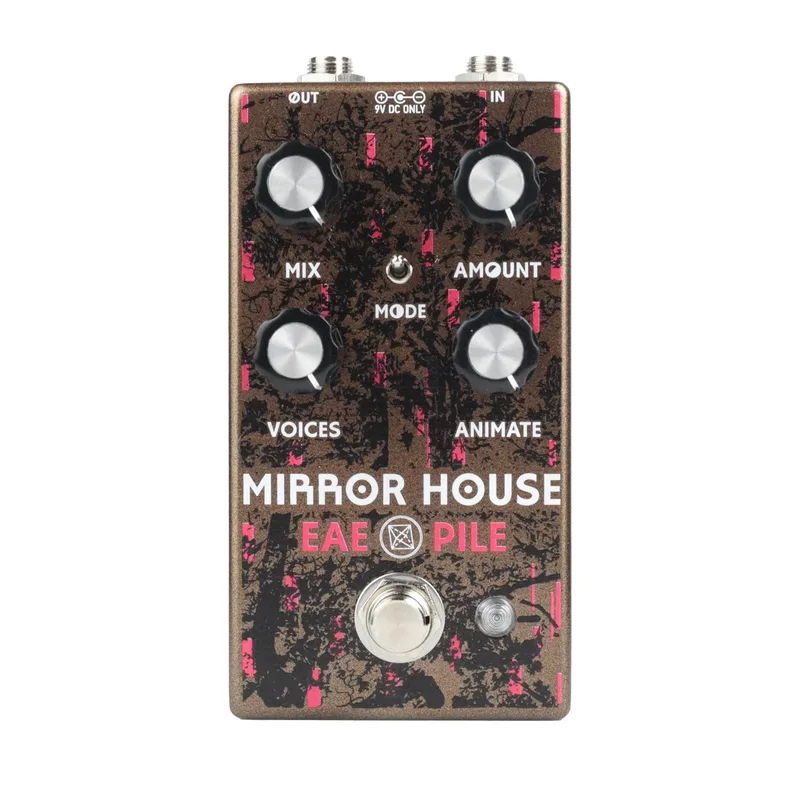


The EAE x Pile Mirror House is a pitch-shifting pedal from Electronic Audio Experiments, originally developed in collaboration with the Boston band Pile. Instead of shifting your whole signal up or down by one interval, it creates two pitch-shifted copies of the incoming signal that veer off in equal and opposite directions: one voice climbs while the other drops1. Delicious Audio describes the result as two pitch-shifted versions of your input signal "moving in opposite directions for unique sonic results"2.
That diametric approach gives the pedal a wide spread of sounds. Electronic Audio Experiments says it is capable of "weird detuning, disorienting microtonal clusters, chords of parallel harmony, or ugly, strange dissonance. (It can also be a chorus.)"1 As of Version 2, released in 2025, the Mirror House is a steady offering in the EAE product catalog, priced at $249.001.
Two pitch-shifted voices from one signal
Most pitch shifters move your entire signal by a set interval. The Mirror House splits the work between two voices: the Amount knob moves them symmetrically away from the original signal, with the upper voice going up and the lower voice going down1. The Voices knob then sets the balance between those two pitch-shifted voices, with an equal mix at the center, more of the higher voice as you turn clockwise and more of the lower voice counterclockwise. The maker notes that this also influences the directionality of the envelope response1.
The pedal has three modes, set by a toggle:
| Mode (toggle position) | What it does |
|---|---|
| Shift (up) | Amount knob sets pitch shifting in quantized semitone steps, up to an octave1 |
| Flutter (middle) | Works like Detune mode, but Animate controls a random LFO; good for chorus and vibrato sounds1 |
| Detune (down) | Amount knob shifts each voice from unison up to a semitone1 |
The remaining controls shape how those voices behave:
- Amount: Static pitch shifting. Clockwise moves the two voices symmetrically away from the original signal1.
- Animate: Additive modulation applied to the Amount control. Clockwise increases the modulation. It is envelope-based in Shift and Detune modes and driven by a random LFO in Flutter mode1.
- Mix: Relative level between dry and effected signal. At maximum, no dry signal is present1.
- Voices: Mix between the higher and lower pitch voices, also influencing envelope directionality1.
The envelope control is what sets the pedal apart from a conventional detune or pitch-shift box. Electronic Audio Experiments says envelope-controlled pitch shifting creates dynamic vibrato, glissando and divebomb effects as the voices are pulled apart, so your picking dynamics can drive the pitch movement itself1. Guitar Pedal X lists the Animate control as the pedal's additive modulation and oscillation control3.
Power and switching
The Mirror House runs on 9V DC through a 2.1 mm center negative barrel plug, with a current draw of 95 mA. Electronic Audio Experiments recommends a regulated, isolated power supply rated for 100 mA minimum1.
The Mirror House does not take a battery, and EAE states plainly that its pedals do not accept batteries. Plan on a proper 9V DC supply, not a daisy chain shared with other pedals1.
Version 2 uses relay switching with true bypass, an update Electronic Audio Experiments made in the 2025 revision1. The pedal measures 121mm x 66mm x 40mm and weighs 0.4 kg1.
Version 1, Version 2 and the collaboration with Pile
The Mirror House was originally developed in collaboration with the band Pile, and the relationship continued into the second generation. Delicious Audio reported the Mirror House V2 in May 2025 as a collaboration between Electronic Audio Experiments and the Boston indie band Pile2. Guitar Pedal X covered the V2 Signature edition the same month, calling it the V2 Signature Mirror House Slippery Pitch-Shifter and Oscillator, a collaboration with Pile priced at $2493.
The two versions differ in a few ways. According to Electronic Audio Experiments, Version 2 (2025) updated the bypass to use a relay, added the new Flutter mode, improved envelope sensitivity and reduced the noise floor compared to Version 1, the original release1. The V2 is also offered in two finishes, Bronze Acid Etch and Bronze1.
"This new version features the new Flutter mode, improved envelope sensitivity, and a reduced noise floor compared to Version 1."
For players comparing the generations, the practical differences are the relay true bypass, the quieter DSP noise floor, the more responsive envelope and the Flutter mode for chorus and vibrato textures. The core two-voice, opposite-direction pitch shifting is the design that carries through both versions1.
Videos
Electronic Audio Experiments
ambienttrash
SpiralCasterPlaysPedals
Questions
Does the Mirror House take a battery?
No. Electronic Audio Experiments states that its pedals do not accept batteries. The Mirror House runs on a 9V DC power supply with a 2.1 mm center negative barrel plug, and the maker recommends a regulated, isolated supply rated for 100 mA minimum.
Is the Mirror House true bypass?
Yes. Version 2 uses relay switching with true bypass, an update Electronic Audio Experiments made when it revised the pedal in 2025. The original Version 1 did not use a relay for its bypass.
Can the Mirror House do chorus and vibrato?
Yes. In Flutter mode the pedal works much like Detune mode, but the Animate knob controls a random LFO, which the maker describes as good for chorus and vibrato sounds. Envelope-controlled pitch shifting can also create dynamic vibrato, glissando and divebomb effects.
How far can the Mirror House shift pitch?
It depends on the mode. In Shift mode the Amount knob sets pitch shifting in quantized semitone steps up to an octave. In Detune mode each voice shifts from unison up to a semitone, and the two voices move in opposite directions.
Sources (3)
- EAE x Pile Mirror House, Electronic Audio Experiments, 2025
- New Pedal: Electronic Audio Experiments Mirror House V2, Delicious Audio, 2025-05-27
- Guitar Pedal X, Guitar Pedal X, 2025-05-28