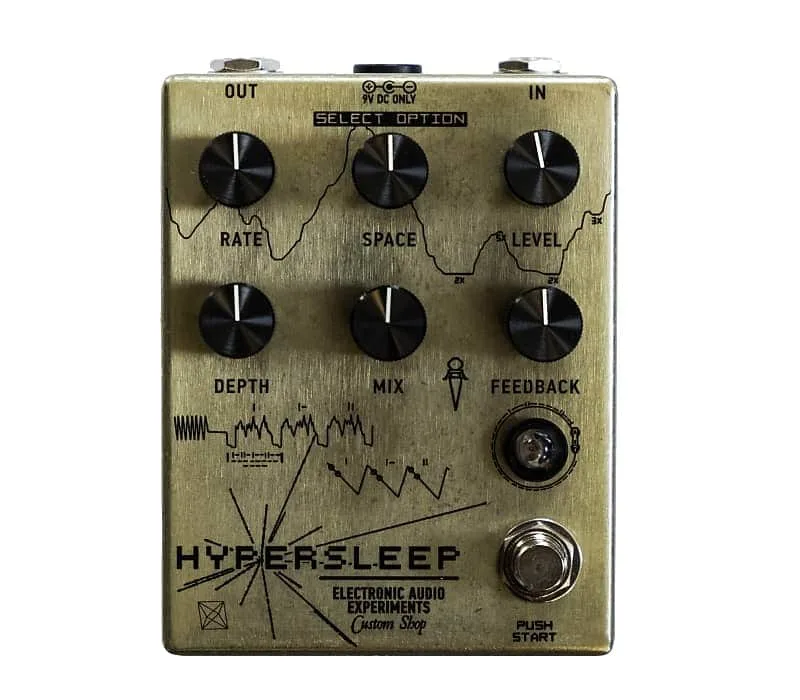


The Electronic Audio Experiments Hypersleep is a solid-state analog reverb pedal built around the MN3011 bucket brigade device, an unusual and long-obsolete delay chip1. Instead of the digital processing most reverb pedals use, the MN3011's array of staggered delay outputs produces a smeared-out echo, and feeding that echo back upon itself produces the reverberant texture1. The maker describes the result as evoking the immediate acoustic reflections of metal and tile, with a gritty timbre and a ringing, fluttering decay, forgoing epic atmospherics in favor of liminality1.
Hypersleep production was suspended indefinitely after the Fall 2021 batch, because new old stock MN3011 chips are no longer available1. The pedal is no longer being made.
How it works
Most analog delay pedals use a bucket brigade device (BBD) with a single input and a single output: a chain of capacitors that hands the signal along one stage at a time, delaying it. The MN3011 is different. It uses an array of staggered delay outputs, so several delayed copies of the signal come off the same delay line at once, producing what the maker calls a smeared-out echo1. Feeding that echo back upon itself produces the reverberant texture, which is why the Hypersleep counts as a reverb rather than a delay1.
The Space control sets the delay time of the BBD, simultaneously controlling six taps on a single delay line1. An onboard LFO can modulate the reverb length, which the maker says yields chorus and vibrato effects1. Delicious Audio describes this as capable of atypical chorus and vibrato, or the sound of a room changing size in real time2.
The controls
The Hypersleep has six knobs. Version 2 carries the same core set with the addition of the modulation controls, which the maker's page lists for the pedal as a whole12.
| Control | What it does |
|---|---|
| Level | Overall effect level; gracefully overloads at higher settings1 |
| Mix | Blend of clean and effected signals, from full dry to full wet1 |
| Feedback | Increases the decay time of the reverb; will self-oscillate at extreme settings1 |
| Space | Delay time of the BBD, simultaneously controlling six taps on a single delay line1 |
| Rate | Modulation rate, from imperceptibly slow to nearly audio rates1 |
| Depth | Modulation depth, from subtle vibrato to warped pitch bending1 |
Two controls deserve a note for players new to this kind of pedal. Feedback at extreme settings will self-oscillate, meaning the pedal generates its own sound without input, useful for drones and textures1. And Level is designed to overload gracefully at higher settings, so pushing it is part of the pedal's character rather than a fault1.
Power: 9V, center negative
The Hypersleep runs on 9V DC through a 2.1mm center negative barrel jack1. It does not take a battery: the maker states plainly that its pedals do not accept batteries, and recommends a regulated, isolated power supply rated for 100mA minimum1.
The DC input is protected against reverse polarity and over-voltage up to 24V, so a wiring mistake or a wrong supply will not damage the pedal1.
Current draw is 60mA, though the maker notes that earlier units draw up to 200mA1. Delicious Audio lists 180mA for Version 22. If you are powering one from a shared supply, budget for the higher figure rather than the lower one.
Version 1, Version 2 and the retrofit mod
The Hypersleep went through two versions. Version 1 arrived in 2020, and Version 2 followed in Fall 20211. Delicious Audio summarizes the differences: Hypersleep V2 offers upgraded silent switching, power and filter scheme improvements, and a more finely tuned feedback control compared to V12.
The maker's own account of the changes centers on an updated filter scheme for improved bandwidth and clock suppression1. Where V1's sound is described as having a gritty timbre, Delicious Audio describes V2 as having a darker timbre, with the same ringing, fluttering decay and the same forgoing of epic atmospherics in favor of liminality2.
For Version 1 owners, Electronic Audio Experiments offered a retrofit mod that upgrades the filters to V2 specification1. The maker is candid about what it does and does not do:
"This will not make your unit identical to Version 2, but it will confer an overall brighter sound which makes the reverberation more present"1
Other Version 2 details from Delicious Audio include top-mounted jacks, careful signal conditioning that makes the pedal friendly to any instrument or line level signal source, and a lifetime warranty tied to the original owner2.
What reviewers said
Delicious Audio's take on the pedal, from its coverage of Version 2, is that it is a character piece rather than a workhorse room simulator2:
"The Electronic Audio Experiments Hypersleep is probably not the right reverb for those looking for a realistic space emulator, but the niche of character seekers should find something quite unique in this device."2
That matches the maker's own framing of the pedal as one that forgoes epic atmospherics in favor of liminality1. Players shopping for a realistic plate or hall emulation are pointed elsewhere; players after a gritty, metallic, modulatable reverb that can self-oscillate are the audience both maker and reviewer describe.
Videos
collector//emitter
Sound Isles
Ambient Endeavors
Questions
Is the Hypersleep still in production?
No. Electronic Audio Experiments suspended Hypersleep production indefinitely after the Fall 2021 batch, because new old stock MN3011 bucket brigade chips are no longer available. Version 2 was the final version, released in Fall 2021.
Does the Hypersleep take a battery?
No. The maker states that its pedals do not accept batteries. The Hypersleep runs on a 9V DC, 2.1mm center negative barrel supply, and Electronic Audio Experiments recommends a regulated, isolated supply rated for at least 100mA.
Is the Hypersleep true bypass?
Version 1 uses electronic switching with a FET-input op amp bypass buffer. Version 2 upgraded to buffered bypass with soft-touch relay switching, which Delicious Audio listed among its improvements over the original.
Can the Hypersleep self-oscillate?
Yes. The Feedback control increases the reverb's decay time, and at extreme settings the pedal will self-oscillate, producing sound on its own. This makes it usable for drones and experimental textures.
What chip does the Hypersleep use?
The MN3011 bucket brigade device, an unusual and long-obsolete delay chip. Unlike most BBDs with one input and one output, the MN3011 has an array of staggered delay outputs that produce a smeared-out echo, which is fed back on itself to create reverb.
Sources (2)
- Hypersleep, Electronic Audio Experiments, 2021
- Electronic Audio Experiments Hypersleep V2 Analog Reverb + Modulation, Delicious Audio, 2022-02-14