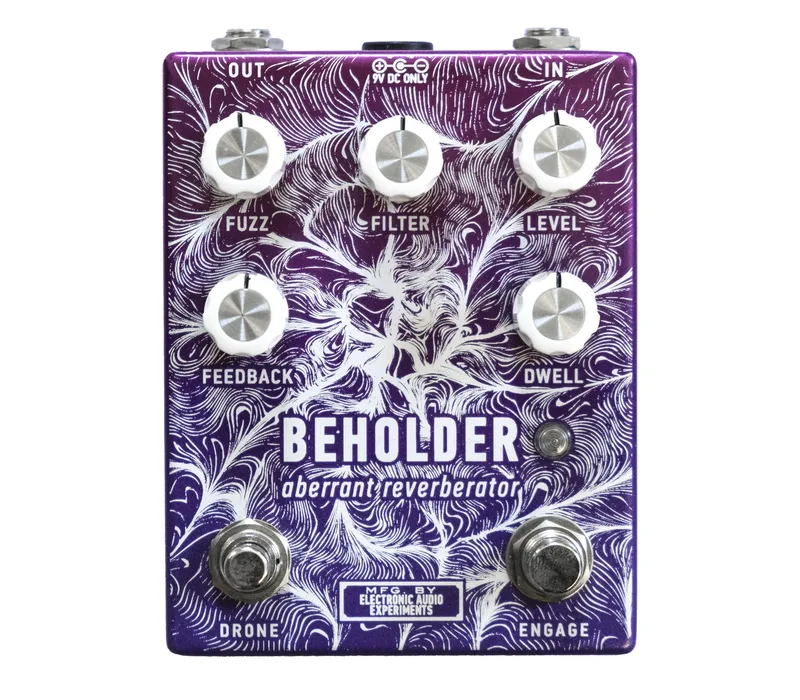


The Electronic Audio Experiments Beholder is a fuzzed-out, droning reverb pedal, first released in 2018 and discontinued in 2021. Its maker describes its sound as "the slow-moving sound of massive, mangled spaces." Where a conventional pedal puts reverb after distortion, the Beholder works the other way round: a mostly wet reverb circuit goes into a dark, high-gain fuzz circuit1.
The controls
The Beholder's faceplate carries four knobs and one internal trimpot, each shaping a different stage of the reverb-into-fuzz chain1.
| Control | What it does |
|---|---|
| Level | Master volume of the pedal |
| Dwell | Drives the input of the reverb circuit |
| Feedback | Routes the reverb back into itself to increase sustain or achieve self-oscillation |
| Filter | Morph from dark low pass to bright high pass |
| Fuzz | Sets the gain of the fuzz circuit |
| Dry Mix (trimpot) | Blends in some dry input signal "around" the reverberation circuit, to preserve pick attack going into the fuzz |
The Feedback control is the one to watch for experimental playing: pushed far enough, the reverb feeds back on itself and the pedal self-oscillates, which pairs with the fuzz stage for the droning character the pedal is named for1. The Dry Mix trimpot is internal, set with a screwdriver rather than a knob, and exists to keep pick attack intact where the mostly wet reverb circuit would otherwise soften it before the fuzz1.
Power and build
The Beholder runs on a standard center-negative power supply and accepts 9V DC1. RockBoard's PedalPedia lists its current draw at 120mA2, which is worth checking against whatever supply or daisy chain feeds it.
At 120mA2, the Beholder asks more current than many small multi-output supplies dedicate per outlet. Give it its own outlet on a supply rated to deliver that current.
Other build details from the maker: true bypass switching, top-mounted jacks, and a powder-coated 1590BB sized enclosure. All Beholders came with the standard limited warranty1.
Discontinued, but buildable
Electronic Audio Experiments retired the Beholder in 2021 and keeps its product page online for archival purposes, noting that "you can build your own with a PCB available through our DIY portal"1. The company sells a do-it-yourself PCB for the discontinued Beholder reverb/fuzz that includes a 3PDT daughterboard for the footswitch wiring3.
The company positions these as builds for someone who has already worked from scratch and can trace a fault with test gear, rather than a first solder project3.
Where it sits in the lineup
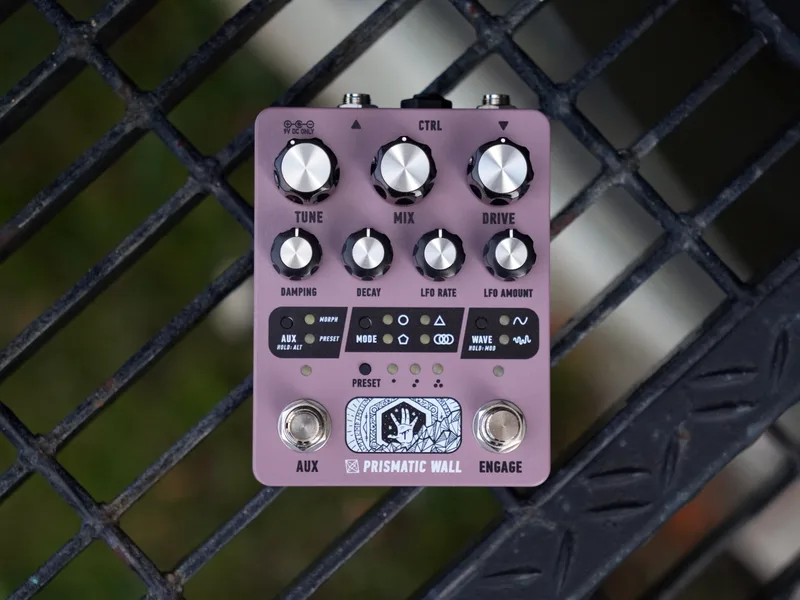
The Beholder was an early, experimental entry in Electronic Audio Experiments' reverb range. The company's current catalog runs in a similar direction with the Prismatic Wall, a resonator/synthesizer/reverberator, and the Scattering, a stereo multi-tap reverb pedal4. For more on the effect type itself, see Reverb Pedals, and for the fuzz half of the circuit, Fuzz Pedals.
Videos
Reverb
aBunchOfPedals
Questions
Is the Electronic Audio Experiments Beholder analog?
Yes. RockBoard's PedalPedia lists the Beholder's circuit type as analog. The pedal chains a mostly wet reverb circuit into a dark, high-gain fuzz circuit, which Electronic Audio Experiments notes is the opposite of the conventional order of reverb after distortion.
Does the Beholder have true bypass?
Yes. Electronic Audio Experiments lists true bypass switching among the Beholder's additional features, alongside top-mounted jacks and a powder-coated 1590BB sized enclosure.
Is the Beholder discontinued?
Yes. The Beholder was originally released in 2018 and discontinued in 2021. Electronic Audio Experiments keeps its product page online for archival purposes and points builders to a DIY PCB available through its DIY portal.
Can you build a Beholder yourself?
Yes. Electronic Audio Experiments sells a do-it-yourself PCB for the discontinued Beholder reverb/fuzz that includes a 3PDT daughterboard. The maker cautions that builders should have a working knowledge of building from scratch and at least a rudimentary ability to troubleshoot problems with a meter and an oscilloscope.
What is the Beholder's power polarity?
The Beholder runs on a standard center-negative power supply and accepts 9V DC. RockBoard's PedalPedia lists its current draw as 120mA, so a supply with enough current on tap is worth having.
Sources (4)
- Beholder, Electronic Audio Experiments
- Beholder by Electronic Audio Experiments, RockBoard PedalPedia, 2026
- Beholder PCB, Electronic Audio Experiments
- Scattering, Electronic Audio Experiments