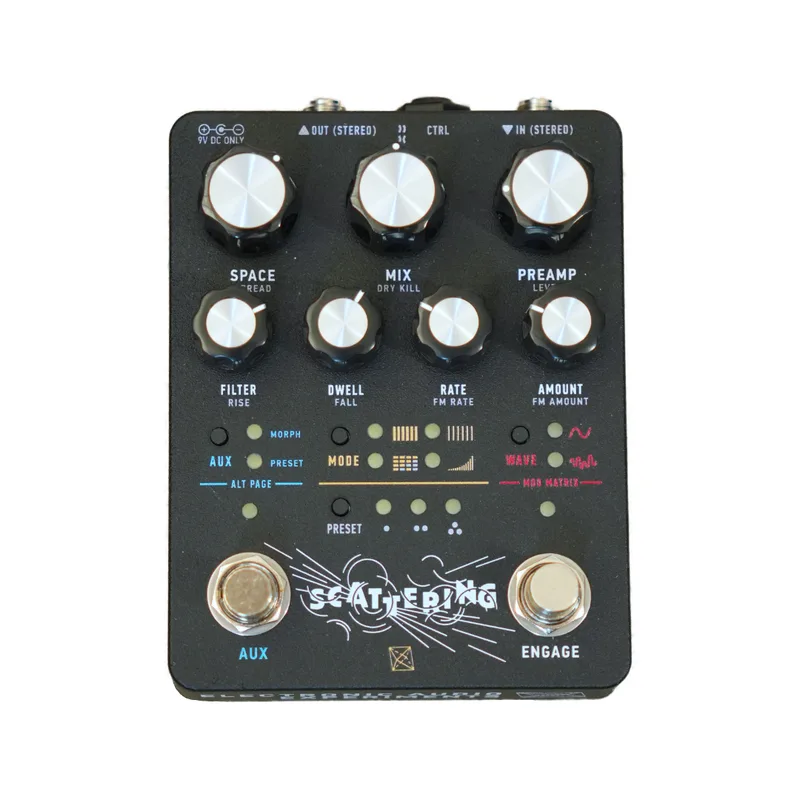


The Scattering is a multi-tap stereo reverb pedal from Electronic Audio Experiments's own catalog, built around networks of tapped delay lines. Rather than a smooth, conventional reverb tail, the maker describes it as creating "a lively dance of fluttering echoes strewn into space," with a core timbre that "can be harsh and ringing, or murky and saturated"1. It is the maker's first pedal with true stereo I/O and processing: the input and output are TRS stereo, and both the analog and digital paths are stereo throughout1.
The pedal is currently listed as Temporarily Unavailable on the maker's site, at a sale price of $320.00 USD against an original list price of $399.00 USD1.
What it does and how it works
The Scattering generates its reverb from networks of tapped delay lines. Its four modes are based on the tap ratios of the MN3011 bucket brigade device, a discontinued delay chip, and each mode represents a different permutation of that chip's taps, offering what the maker calls branching paths into different reverb characters1.
The signal processing is a hybrid: 24 bit conversion at a variable sample rate, paired with analog filtering and emphasis. The dry path and mixer are analog with high headroom, so your dry signal stays in the analog domain, and the Mix control is an analog VCA mixer that sweeps from full dry to full wet1.
Controls
| Control | What it does |
|---|---|
| Space | Turn clockwise to increase the reverb time and separation of delay taps. Will produce artifacts at longer settings. |
| Dwell | Feeds the reverb back onto itself. In some modes, high settings will oscillate. |
| Mix | Analog VCA mixer, full dry to full wet. |
| Filter | Controls a stereo, analog, two-pole low pass filter at the reverb output. |
| Mode button | Selects between the four reverb modes based on the MN3011 tap ratios. |
| Engage footswitch | Activates the pedal. Long press toggles trails/standard bypass modes. |
All from the maker's product page1.
Two behaviors are worth knowing before you dial it in. Space will produce artifacts at longer settings, which the maker treats as part of the pedal's character rather than a fault, and Dwell can oscillate at high settings in some modes1.
MIDI, presets, and control
The Scattering has full MIDI implementation, with CCs and presets for all parameters, both analog and digital. There are 16 preset slots: 3 are accessible from the front panel, and the rest via MIDI1.
A CTRL jack accepts MIDI, expression, and CV input, so the pedal can be swept with an expression pedal or control voltage as well as over MIDI1.
Power and physical details
The pedal runs on 9V DC through a 2.1mm center negative barrel jack, and is protected against reverse polarity and over-voltage up to 24V. Current draw is 120mA typical, with a 200mA surge at startup, so plan a power supply with headroom above the typical figure1.
It is built in a Hammond 1590BB2 enclosure, 121mm × 94mm × 38mm, in a standard finish of textured black with multicolor print1.
The 200mA startup surge means an isolated output rated close to 120mA may not be enough. Give the pedal an output with margin above the surge figure.
Where it came from
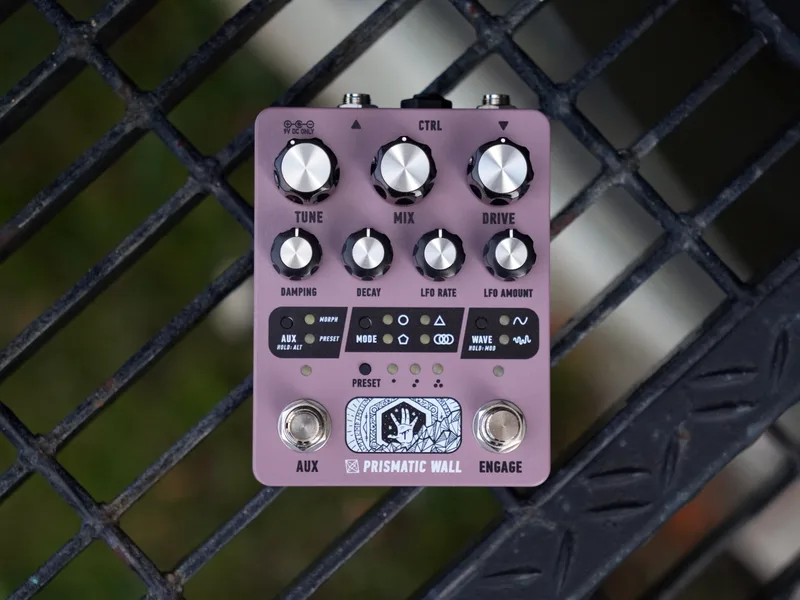
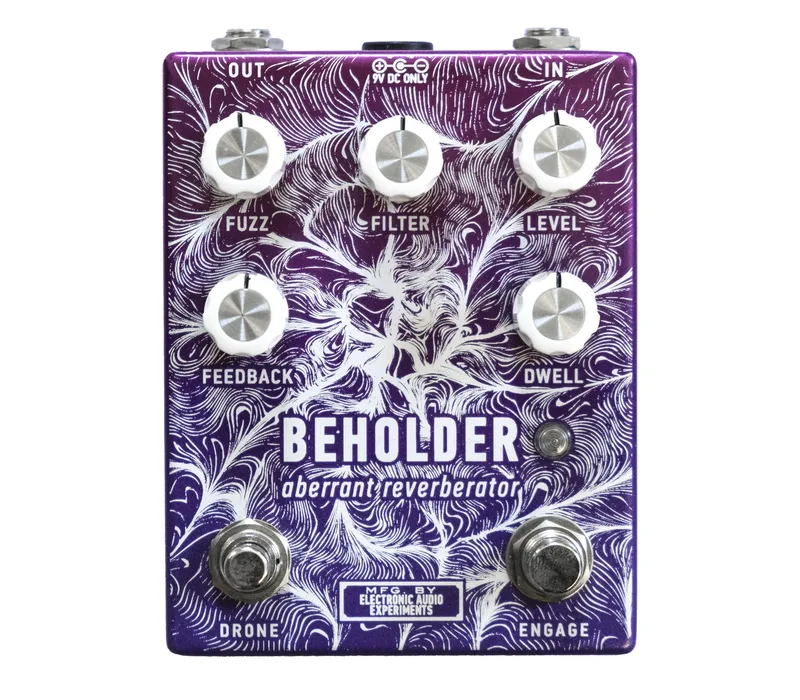
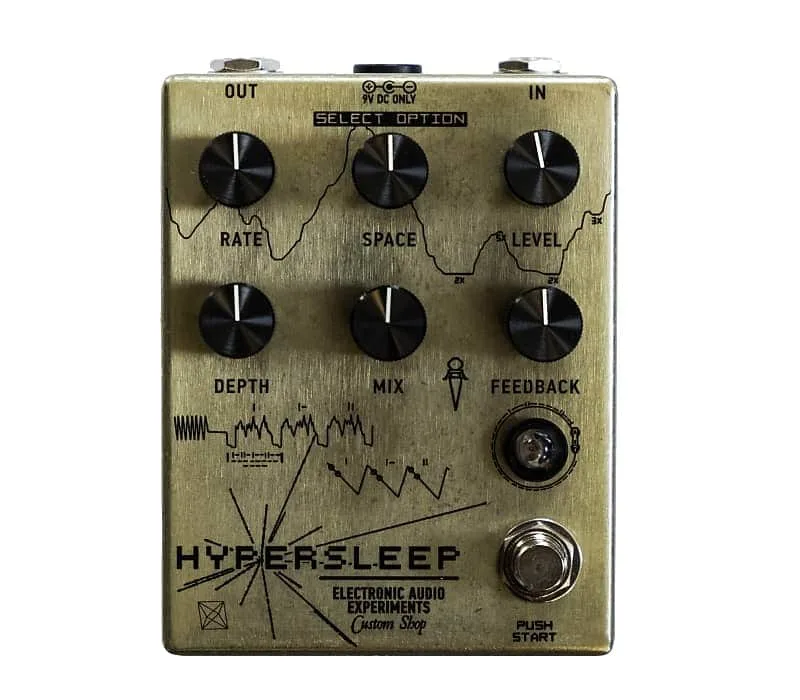
The Scattering joins a catalog that includes the Prismatic Wall resonator/synthesizer/reverberator, the Beholder, and the Hypersleep, and it is the maker's first pedal with true stereo I/O and processing1.
Videos
Electronic Audio Experiments
Harp Lady
Mark Johnston
Questions
Is the Electronic Audio Experiments Scattering analog or digital?
It is a hybrid. The signal processing is analog/digital, running 24 bit at a variable sample rate, paired with analog filtering and emphasis. The dry path and mixer are analog with high headroom, and the Mix control is an analog VCA mixer that goes from full dry to full wet.
Does the Scattering have MIDI and presets?
Yes. It has full MIDI implementation, with CCs and presets for all parameters, both analog and digital. There are 16 preset slots: 3 are accessible from the front panel, and the rest are reachable via MIDI.
Can the Scattering take CV or an expression pedal?
Yes. The CTRL jack accepts MIDI, expression, and CV input, so you can sweep parameters with an expression pedal or control voltage as well as over MIDI.
Does the Scattering have reverb trails?
Yes. The bypass is electronic, with buffered or Trails modes. You toggle between trails and standard bypass with a long press of the Engage footswitch.
Sources (1)
- Scattering, Electronic Audio Experiments, 2026