

The Prismatic Wall is a sympathetic resonator pedal from Electronic Audio Experiments that takes your incoming sound and transmutes it into the vibrations of a modeled bank of strings. The maker describes it as part reverb and part synthesizer, with "metallic yet warm timbres" that "span from the subtle harmonic aura of a third bridge to the rich chromatic suspensions of a grand piano"1. Where a reverb pedal recreates a space, the Prismatic Wall recreates strings: it listens to what you play and answers with tuned resonances, the way the sympathetic strings of a sitar or a Hardanger fiddle ring behind the notes you actually play.
Under the hood it is an analog/digital hybrid. The digital side uses a physical string model built from tuned delay lines, with tuning achieved by varying the sample rate of the system, running at 24 bit resolution. That is paired with analog filtering and emphasis, and a high headroom analog dry path and mixer keeps your original signal in the analog domain1. Guitar Pedal X called it "a really unique and rare variety of Modulator - a Sympathetic Strings / Resonator / Synthesizer / Reverberator" in its 2024 round-up of the year's best new modulation and utility pedals2.
How it works
The core idea is sympathetic resonance. Instead of processing your signal with a reverb algorithm or a delay line, the pedal drives a bank of virtual strings that are tuned to a musical structure you choose. Your dry signal stays analog, and the resonator bank responds to it, so chords bloom into ringing harmonic clouds and single notes acquire a metallic halo behind them. The Drive control sets how hard your signal pushes the resonator, and at higher settings it overloads, which changes the character of the excitation rather than simply making it louder1.
Because tuning is done by varying the sample rate of the digital system, the pitch of the whole string bank can move continuously across a four octave range with the Tune control1. This is also what makes the tuning modes possible: the same string model can be retuned to different interval structures, from a single fundamental with harmonic overtones to a fully chromatic spread.
The controls and tuning modes
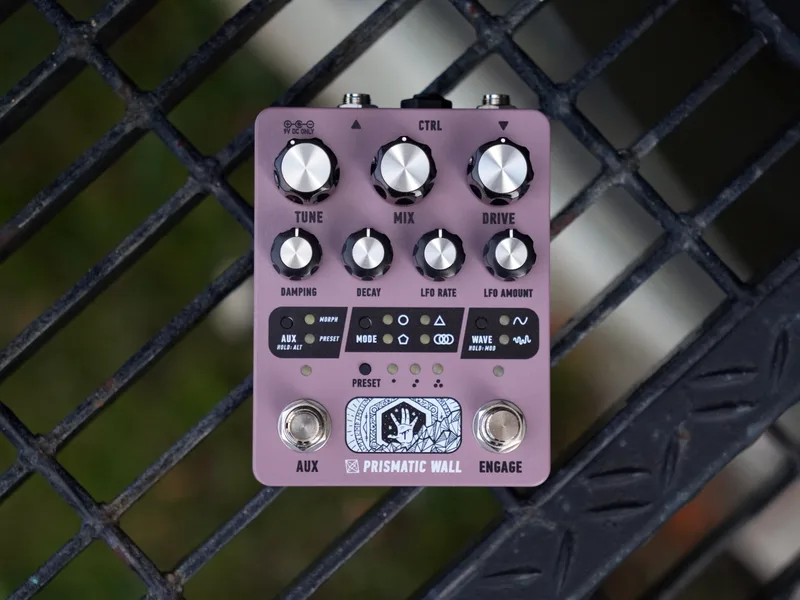
The front panel keeps things compact, with a small set of knobs and buttons doing a lot of work. A long press on the Wave Button reaches the Mod page, and the Mode Button selects between four string spacing modes1.
| Control | What it does |
|---|---|
| Tune | Adjusts the pitch of the resonators across a four octave range1 |
| Drive | Sets the signal level driving the resonator, with overload at higher settings1 |
| Damping | Sets the high frequency decay of the resonators1 |
| LFO Amount | Sets the LFO amplitude1 |
| Mode Button | Selects between four string spacing modes1 |
| Wave Button | Selects the LFO waveform between periodic and random modes; long press to access the Mod page1 |
The four string spacing modes, selected with the Mode Button, are1:
- Single, with harmonic overtones
- Stacked neutral thirds
- Stacked fifths
- Chromatic
Guitar Pedal X listed the same set at the unveiling as the Tuning Mode switch: Single + Overtone, Stacked Natural Thirds, Stacked Fifths, and Chromatic x123. The single mode with overtones behaves like one string's harmonic series ringing behind your playing, while the chromatic mode spreads resonances across all twelve pitches, which the maker likens to the suspensions of a grand piano1. Two footswitches handle the rest: an Engage Footswitch and an Aux Footswitch3.
Power
The Prismatic Wall runs on 9V DC through a 2.1mm center negative barrel jack, with a maximum current draw of 120mA1. Electronic Audio Experiments recommends a regulated, isolated supply rated for at least 200mA minimum to accommodate startup surges, so it is worth giving it its own tap rather than sharing a daisy chain3.
The pedal does not accept batteries1, and the DC input is protected against reverse polarity and over-voltage up to 24V3.
MIDI, presets and the CTRL jack
For a compact pedal, the Prismatic Wall has full MIDI implementation, with CCs and presets available for all parameters, both analog and digital1. There are 16 preset slots in total: 3 are accessible from the front panel, and the rest via MIDI1.
The CTRL jack handles MIDI, expression, and CV input3, which opens up real-time control of parameters from an expression pedal or an external control voltage. For MIDI over this jack there is a detail worth knowing: the Prismatic Wall uses what Electronic Audio Experiments calls a "Tip Active" jack configuration, so you must use a MIDI Box, a device that converts standard DIN MIDI to TRS format4.
Versions, firmware and finishes
The Prismatic Wall was originally released as Version 1 during June 20241. At the unveiling it was available for preorder from the Electronic Audio Experiments webstore, with a handful of units remaining in the first batch at the time of writing3.
Firmware V1.1 followed on 2024-08-01, starting at serial number 326, and fixed a bug that could cause the panel to load improperly on startup1. The product page also lists a V1.0 dated July 2024, and the two entries are not reconciled, so units before serial 326 may carry either designation depending on the record you consult1.
The pedal has shipped in three finishes1:
- Standard: light pink with black and white print, updated in late 2025
- Shadowfell: black texture with purple print
- Acid Etch: hand-finished using hydrochloric acid with a toner transfer mask, with application and technique varying between batches and individual units
The Acid Etch finish in particular means no two enclosures look alike, since the etching process varies from unit to unit1. All Electronic Audio Experiments pedals come with a warranty tied to the original owner1.
What reviewers said
Guitar Pedal X covered the Prismatic Wall twice in 2024. At the June unveiling, Stefan Karlsson and John Snyder presented it as "a really unique and innovative" sympathetic strings resonator, synthesizer and reverberator, priced at $399 in the US and £429 at Joe's Pedals in the UK3. In December, the site named it in its round-up of the year's best new modulation and utility pedals, calling it "a really unique and rare variety of Modulator"2.
"A really unique and rare variety of Modulator - a Sympathetic Strings / Resonator / Synthesizer / Reverberator"
Videos
Electronic Audio Experiments
Electronic Audio Experiments
Electronic Audio Experiments
Questions
Does the Prismatic Wall run on batteries?
No. Electronic Audio Experiments states plainly that its pedals do not accept batteries. The Prismatic Wall runs only from a 9V DC power supply with a 2.1mm center negative barrel plug, drawing up to 120mA, and the maker recommends a regulated, isolated supply rated for at least 200mA to cover startup surges.
Is the Prismatic Wall true bypass?
No. It uses electronic bypass switching with selectable buffered or Trails modes. That means the signal path stays active when the pedal is disengaged, with a choice between a buffered bypass or a trails mode that lets the resonator's tails ring out after you switch it off.
Who designed the Prismatic Wall?
The Prismatic Wall is made by Electronic Audio Experiments and was presented by John Snyder, whom Guitar Pedal X credits for taking players down the pedal's intriguing tangent. Snyder also designed the Eidolon delay reverb boost pedal that Frost Giant Electronics re-released with Dave Davidson of Revocation in 2024.
How much does the Prismatic Wall cost?
The list price is $399 in the US, as reported by Guitar Pedal X at the June 2024 unveiling and again in its December 2024 round-up of the year's new modulation and utility pedals. In the UK, Guitar Pedal X listed it at £429 through the retailer Joe's Pedals.
What power supply does the Prismatic Wall need?
It needs 9V DC through a 2.1mm center negative barrel plug, with a maximum current draw of 120mA. Electronic Audio Experiments recommends a regulated, isolated supply rated for at least 200mA to accommodate startup surges. The DC input is protected against reverse polarity and over-voltage up to 24V.
Sources (4)
- Prismatic Wall, Electronic Audio Experiments
- Guitar Pedal X, Guitar Pedal X, 2024-12-19
- Guitar Pedal X, Guitar Pedal X, 2024-06-27
- Firmware Portal, Electronic Audio Experiments