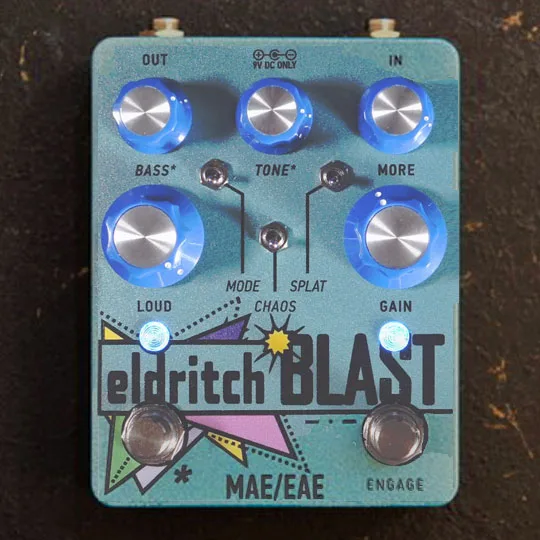


The Eldritch Blast is an octave fuzz pedal made as a collaboration between Electronic Audio Experiments and Mask Audio Electronics. Delicious Audio's Paolo De Gregorio describes the result as "a heavy, yet complex fuzz with a unique octave up texture and an active EQ voiced for aggressive, harsh tones," built around what he calls "a powerful, touch-sensitive octave/intermodulation generator"1.
Where the circuit came from
The pedal is an expanded take on the Magic Missile Fuzz, an early Electronic Audio Experiments design, significantly diverged from in collaboration with Mask Audio Electronics. De Gregorio notes the lineage as "an homage to the modern classic fuzzes of Devi Ever, Tim Escobedo, and all of the circuit-bending weirdos on ilovefuzz.com," placing it in the circuit-bending tradition of deliberately unstable, experimental fuzz design1.
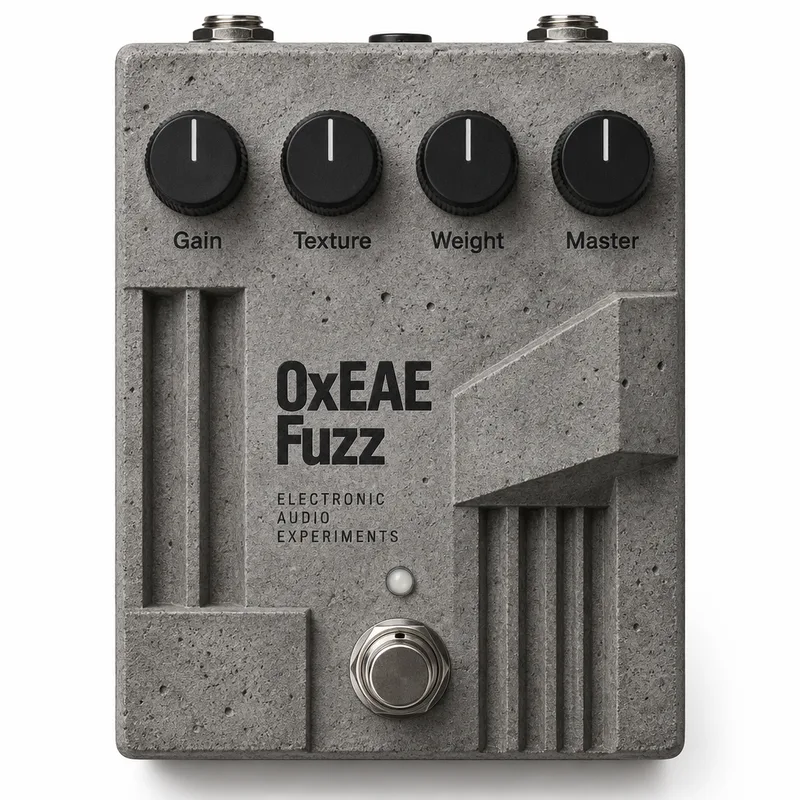
Electronic Audio Experiments has continued exploring octave fuzz since: the company later released the Glaive, an opamp octave fuzz, and discontinued the 0xEAE Fuzz in spring 2025.
The controls and footswitches
The Eldritch Blast carries five knobs and two footswitches, which is unusual for a fuzz and reflects the active EQ built into the circuit1.
| Control | What it does |
|---|---|
| Gain | Controls amount of gain and low frequencies at input |
| Splat | Shifts the dynamics and gating of the transistor stages |
| Chaos | Adds uncertainty, gating and other artifacts to the fuzz |
| Bass | Active peaking filter centered around 100 Hz |
| Volume | Loudness amount |
| Footswitch | Function |
|---|---|
| Left footswitch | EQ on/off |
| Engage | Master bypass |
The two-footswitch layout lets you kick the EQ section in and out while leaving the fuzz itself untouched, which changes how the pedal sits in a mix without losing your base fuzz setting. The Bass control is an active peaking filter rather than a simple cut, centered around 100 Hz1.
As of the June 2021 coverage, the pedal was still current, and De Gregorio observed that "it seems to be keeping evolving with new features," so units may differ depending on when they were made1.
Power and practical details
The Eldritch Blast runs on 9V center negative power, the standard pedalboard supply, with true bypass switching and top-mounted jacks for tidy board routing1. All units come with the standard warranty1.
Videos
Electronic Audio Experiments
Noise Generator
collector//emitter
Questions
Is the Eldritch Blast true bypass?
Yes. The pedal uses true bypass switching, so when it is off your guitar's signal passes straight through without loading or coloring. It also has top-mounted jacks, which helps it fit on crowded pedalboards, and it runs on 9V center negative power.
What does the Splat knob do?
Splat shifts the dynamics and gating of the transistor stages. In practice it changes how the fuzz responds to your playing and where the gate closes, working alongside the Chaos control, which adds uncertainty, gating and other artifacts to the fuzz.
What does the Mode switch do on the Eldritch Blast?
The Mode switch changes the transistors used in the octave generator. Since the octave and intermodulation texture is the heart of the pedal, this switch alters the character of the octave-up content you hear.
What power does the Eldritch Blast use?
The Eldritch Blast runs on 9V center negative power, the standard for effects pedals, with true bypass switching and top-mounted jacks.
Who designed the Eldritch Blast?
Electronic Audio Experiments designed the pedal, teaming up with Alec from Mask Audio Electronics to fine-tune the design. It is an expanded take on the Magic Missile Fuzz, an early Electronic Audio Experiments design, significantly diverged from in collaboration with Mask Audio.
Sources (1)
- Electronic Audio Experiments & Mask Audio Electronics Eldritch Blast Octave Fuzz, Delicious Audio, 2021-06-04