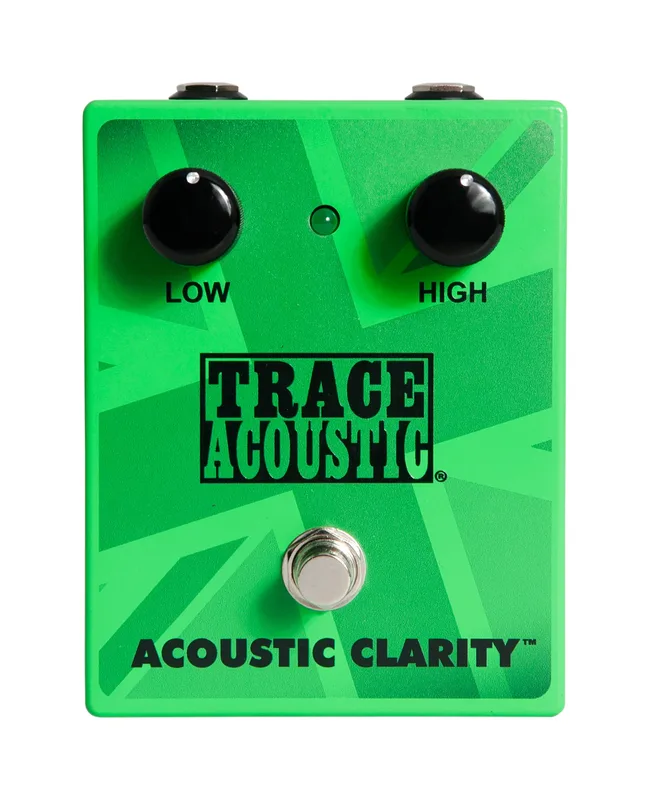


The Trace Acoustic Clarity is a frequency expansion pedal from Trace Elliot's Trace Acoustic line, built for acoustic-electric instruments. Instead of adding an effect on top of your sound, it works on what your pickup already captures: two variable filters enhance the harmonically rich undertones at the low and high extremes of the spectrum, which Trace Elliot says adds depth, richness and dimension without changing the core voice of the instrument1.
The circuit is based on Peavey's proprietary Kosmos technology, the same family of processing Peavey uses in its own gear, adapted here for acoustic instruments1. Trace Elliot says frequency expansion can enhance the sound of most acoustic-electric instruments, including guitar, bass, ukulele, violin and cello1. Premier Guitar reported the pedal as available worldwide through online and local retailers at a street price of $199.99 USD2.
A frequency expansion pedal, not an EQ or preamp
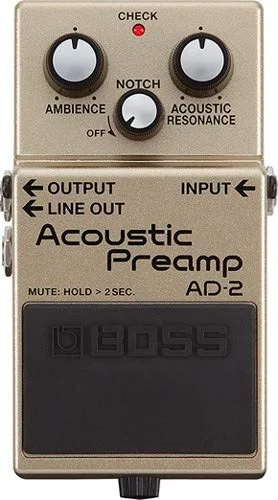
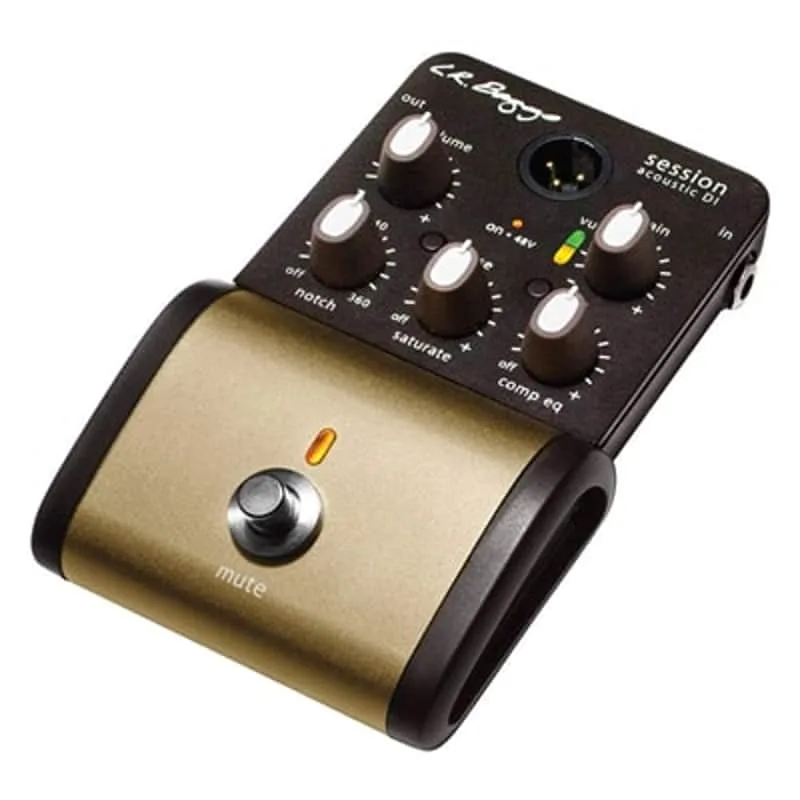
Most pedals in the acoustic pedals category are preamps, EQs or DI boxes: units like the Boss AD-2 Acoustic Preamp or LR Baggs Session DI shape the frequency balance of a pickup or add body to a thin signal. The Clarity takes a different route. It does not cut or boost bands the way an EQ pedal does, and it does not add gain the way a preamp does. Its input and output are fixed at unity, so your level comes out the same as it went in2.
What it does instead is expand the extremes of the spectrum. Trace Elliot describes the result as added richness and dimension around a core voice that stays intact1. For a player whose piezo pickup sounds narrow or flat, that is the problem this pedal is aimed at: filling out the bottom and top without revoicing the middle.
The controls
The front panel keeps it to two knobs:
| Control | What it does |
|---|---|
| LOW | Varies the low-frequency filter, enhancing undertones at the bottom end of the spectrum3 |
| HIGH | Varies the high-frequency filter, enhancing undertones at the top end of the spectrum3 |
The two filters are proprietary designs, one for low frequencies and one for high, each enhancing undertones that already exist in the instrument's signal rather than synthesizing new content3. Premier Guitar described the arrangement as "two proprietary variable filters, controlled by separate LOW and HIGH pots, to enhance the existing undertones" of the instrument2. Because both input and output sit at unity, turning the knobs changes the spectral balance, not your volume2.
Power and connections
The pedal runs from a standard 9VDC supply or a battery2. Internally it builds a bipolar 18V supply from that 9V input, giving the active devices plus and minus 9VDC rails1. That internal voltage doubling is what lets a small pedal handle the wide dynamic range an acoustic pickup can produce without running out of headroom.
Connections are simple: one 1/4" TRS input at 2.2M impedance and one 1/4" TRS output at 1k impedance3. The 2.2M input is high enough that piezo pickups, which prefer a very light load, feed it directly without the boxiness a low-impedance input can cause. Trace Elliot positions the pedal for use with any PA system, instrument amplifier, or signal processor and pedalboard setup3, and its unity-gain design means it can sit anywhere in a chain without changing levels2.
The bipolar 18V internal supply is generated from a single 9VDC input or battery1. The pedal does not need an 18V power supply to get its 18V rails.
Where it came from
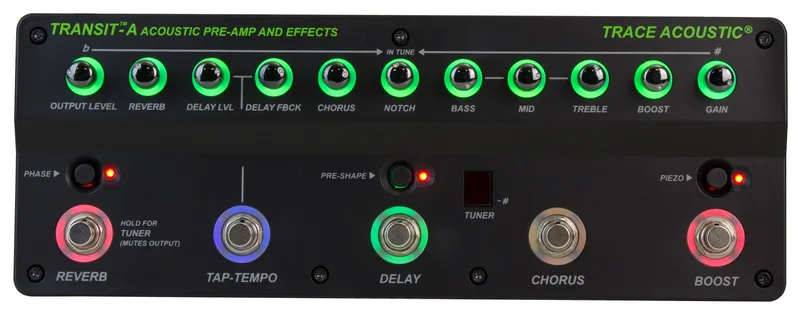
Trace Elliot is a British amplification brand now owned by Peavey, and the Clarity sits in its Trace Acoustic line alongside preamp pedals such as the Trace Elliot Transit A. The Clarity was announced in November 2025 and, per Premier Guitar, is available worldwide through online and local retailers at a street price of $199.99 USD2. Its frequency expansion processing comes from Peavey's Kosmos technology, brought across from the parent company's own product line1.
Videos
Matt Dunn
No Fear Guitar Gear
News
Questions
What does the Trace Elliot Acoustic Clarity pedal do?
It is a frequency expansion device for acoustic-electric instruments. Two variable filters, one at each end of the spectrum, enhance the harmonically rich undertones already in your pickup's signal, adding depth, richness and dimension. Trace Elliot says it works with most acoustic-electric instruments, including guitar, bass, ukulele, violin and cello.
Is the Trace Acoustic Clarity an EQ?
No. An EQ cuts or boosts specific frequency bands to reshape your tone. The Clarity instead uses two proprietary variable filters that enhance the undertones already present at the extremes of the spectrum, and Trace Elliot says it does this without changing the core voice of the instrument.
Can the Trace Acoustic Clarity run on a battery?
Yes. It runs from a standard 9VDC supply or a battery. Internally it generates a bipolar 18V supply from that 9V input, which gives the active circuitry plus and minus 9V rails to work with.
Does the Trace Acoustic Clarity change my volume?
No. The input and output gains are fixed at unity, so the pedal passes your signal at the same level it receives it. What changes is the balance of undertones at the low and high ends of the spectrum, not the overall level.
What is the input impedance of the Trace Acoustic Clarity?
The 1/4 inch TRS input has a 2.2M (2.2 megohm) impedance, which is high enough to load piezo pickups lightly. The output impedance is 1k, also on a 1/4 inch TRS jack.
Can I use the Trace Acoustic Clarity with a PA system?
Yes. Trace Elliot describes it as suitable for any PA system, instrument amplifier, or signal processor and pedalboard setup. Its unity-gain input and output mean it slots into a chain without changing levels.
Sources (3)
- Trace Elliot Acoustic® Clarity™ Pedal, Peavey (peavey.com)
- Trace Acoustic Debuts New Clarity Pedal, Premier Guitar, 2025-11-04
- Trace Elliot Acoustic® Clarity™ Pedal, Peavey (peavey.com)