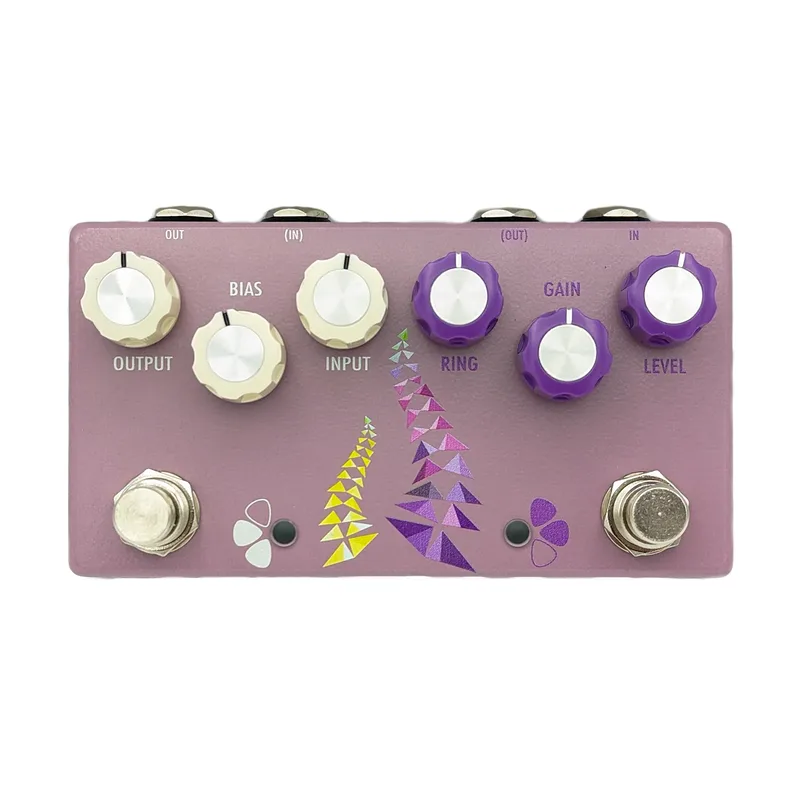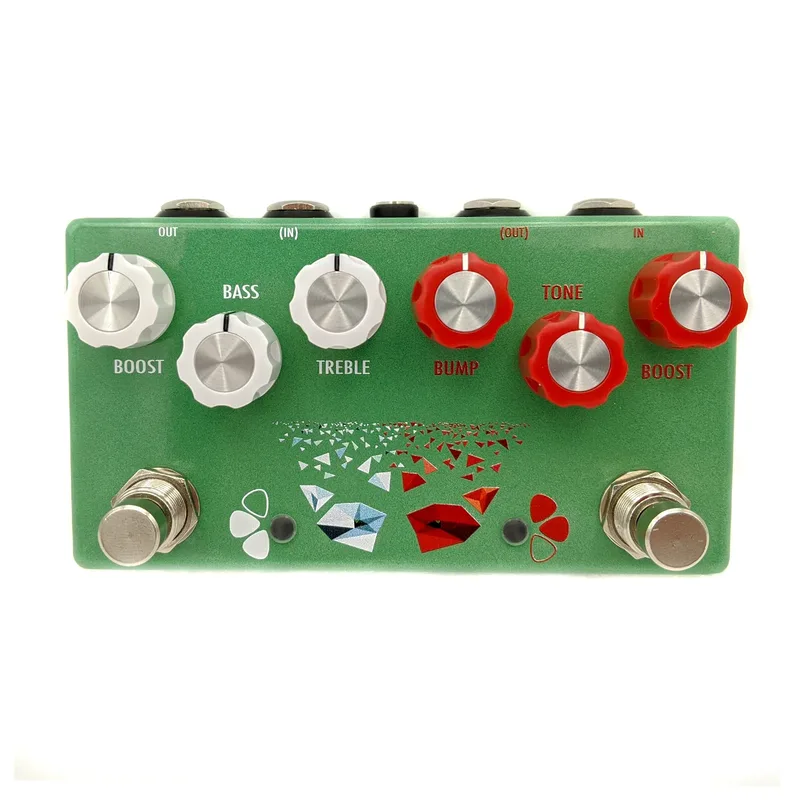


The Flower Pedals Poppy Dual Boost is a boost pedal with two independent boost circuits in a single 125B enclosure, each built around a different circuit topology: an op-amp boost on the Red side and a JFET boost on the White side1. Premier Guitar, covering its unveiling in September 2020, put it simply: "It is essentially two boosts housed in a single 125B enclosure"2. Flower Pedals positions it for tone shaping, driving a tube amp or pedal, or adding extra level for a solo3.
Two boost circuits in one pedal
The point of the Poppy is that the two sides are not the same circuit twice. The Red side is an op-amp boost, and Premier Guitar reports it is the same op-amp based boost circuit from the original mini Poppy pedal2. The White side is a new circuit that uses JFET transistors and a Baxandall tone circuit, which Premier Guitar describes as aiming for a more tube amp-like tonal character2. Flower Pedals echoes that, saying the White side uses JFET transistors for a warmer, more amp-like feel1.
Having two different boost topologies in one box means you can use one side as a transparent level lift and the other as a tone shaper, or stack them for more level and EQ control than a single boost pedal offers. Flower Pedals describes the Red side as clean, transparent boost with a sweepable frequency bump for surgical tone shaping1.
The controls on each side
| Side | Circuit | Controls |
|---|---|---|
| Red | Op-amp boost | Boost, Tone, Bump1 |
| White | JFET boost | Boost, Bass, Treble (Baxandall EQ)1 |
On the Red side, the Bump control adds emphasis to a specific frequency band, and the Tone knob selects which frequency gets the boost1. That combination is what makes the bump sweepable: you pick the frequency with Tone and dial in how much it is emphasized with Bump.
On the White side, the Baxandall-style Bass and Treble controls provide what Flower Pedals calls smooth, musical EQ shaping without harsh resonant peaks1. A Baxandall EQ is a bass and treble shelving arrangement, so the two knobs work independently rather than interacting the way a single tone control would.
One control is shared by both circuits. Paolo De Gregorio at Delicious Audio explains: "Both circuits utilize a boost control which is a bias control, which allows for as much clean headroom as possible."3 On the Red side, Premier Guitar adds that the Boost control sets the over boost level you're getting2.
Power and connections: 9V in, 18V inside
The Poppy runs from a 9V DC center negative supply drawing less than 100mA, and the pedal boosts that internally to 18V for the audio circuits1. The 18V internal rail is a common way to give boost and preamp circuits more headroom, and here it happens inside the pedal so a standard 9V supply is all that is needed at the jack.
The pedal has no battery option in its specification: power is 9V DC center negative at <100mA1. Make sure your supply or daisy chain can cover the current draw.
The connections are where the Poppy differs from most dual pedals. It has two inputs and two outputs, and Flower Pedals says the extra input and output jacks are for placing each side at different points in your chain1. That means the Red boost can sit before your overdrive or distortion pedals while the White boost sits after them, or any other split you want. If you do not plug anything into the auxiliary ins and outs, Delicious Audio reports that the two circuits are stacked on top of each other, so the pedal behaves as one series chain with a single in and out3.
Where it came from and how it compares
Flower Pedals unveiled the Poppy Dual Boost in late September 2020, and Premier Guitar reported at the time that it was available for purchase on the Flower Pedals website and Reverb.com2. The pedal remains listed by the maker at $199.00 USD1.
The Poppy shares its extra I/O approach with the Flower Pedals Lupine Dual Fuzz: Flower Pedals notes that like the Lupine, the Poppy includes extra I/O jacks so each circuit can sit at a different point in the signal chain1. The Lupine, a fuzz pedal, takes a wider 9 to 18V DC center negative supply at <100mA4, while the Poppy is fixed at 9V in with the 18V rail generated internally.
Videos
Flower Pedals
AndyDemos
Eirik Stordrange
News
Questions
What is the difference between the Red and White sides of the Poppy Dual Boost?
The Red side is an op-amp boost with Boost, Tone and Bump controls, described by Flower Pedals as a clean, transparent boost with a sweepable frequency bump for tone shaping. The White side is a JFET boost with Boost, Bass and Treble controls in a Baxandall arrangement, which the maker says gives a warmer, more amp-like feel. Premier Guitar notes the Red side is the same op-amp circuit from the original mini Poppy, while the White side is a new circuit.
Can I use the two sides of the Poppy Dual Boost at different points in my signal chain?
Yes. The pedal has two inputs and two outputs, and Flower Pedals says the extra jacks are for placing each side at a different point in your signal chain. If you leave the auxiliary jacks unplugged, Delicious Audio reports that the two circuits are stacked on top of each other instead.
What happens if nothing is plugged into the auxiliary jacks?
According to Paolo De Gregorio at Delicious Audio, if you do not plug anything into the auxiliary ins and outs, the two circuits are stacked on top of each other, so the pedal works as a single series dual boost with one input and one output.
Can the Poppy Dual Boost run on a battery?
The maker specifies a 9V DC center negative power supply drawing less than 100mA, with the internal voltage boosted to 18V. No battery option is given, so plan to use a supply that can handle the pedal's current draw.
Is the Poppy Dual Boost a clean boost?
Both circuits use a boost control that Paolo De Gregorio of Delicious Audio describes as a bias control, which allows for as much clean headroom as possible. The Red side is described by Flower Pedals as clean and transparent, while the White side aims for a warmer, more amp-like feel, so each side can be pushed differently depending on the settings.
Sources (4)
- Poppy Dual Boost, Flower Pedals
- Flower Pedals Unveils the Poppy Dual Boost, Premier Guitar, 2020-09-29
- Flower Pedals Poppy Dual Boost, Delicious Audio, 2020-12-08
- Lupine Dual Fuzz, Flower Pedals