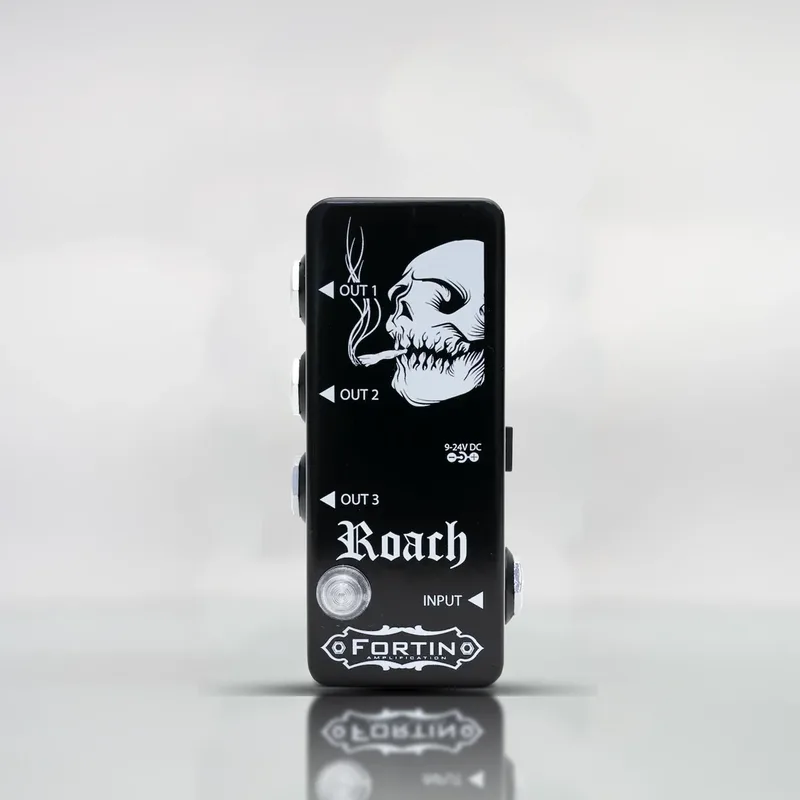


The Fortin Amps Fortin Roach is a 3-way signal splitter with discrete Class-A buffers: one input, three buffered outputs, in a small enclosure with no knobs or switches. Fortin positions it as a fix for the top end loss that builds up on a pedalboard full of true bypass pedals, and as a low-current companion for its Zuul switching products. It lists at $99.99 USD as of the maker's product page dated 25 October 20261.
A three-way splitter with Class-A buffers
The Roach takes one guitar signal and feeds three buffered outputs. Fortin describes the circuit as discrete Class-A buffers, the simple transistor-based design used in dedicated buffer pedals to keep the signal intact while driving long cable runs1. RockBoard's PedalPedia entry describes the same unit as "an exceptionally low-current circuit" and notes that with 3 outputs, the Roach is positioned as a companion for the Mini Zuul or Zuul+2.
Because the outputs are buffered rather than a bare passive split, the Roach can sit at the front of a board feeding multiple destinations, for example an amp rig and a tuner or effects loop, without each connection loading down the guitar's signal12.
What it does for a board of true bypass pedals
True bypass pedals pass the guitar's signal untouched when off, but a long chain of them, plus the cable between them, adds capacitance that rolls off high frequencies before the signal reaches the amp. Fortin's stated remedy is to use two Roaches:
"Putting the Roach before and after your pedal board reinstates your tone and removes all the top end loss (capacitance)"
In other words, one unit buffers the guitar at the board's input, and a second buffers the signal again at the output, so the cable to the amp is driven by the buffer rather than by the pickups1.
Power and connections
The Roach has no controls to set, so the practical details are its power and jack specifications:
| Specification | Value |
|---|---|
| Power input | 9 to 24V DC via the DC inlet, external supply only1 |
| Polarity | Center-pin negative, fully regulated1 |
| Power supply | External adapter or power supply, not included1 |
| Current draw | 4mA1 |
| Input impedance | ~1M1 |
| Output load | ~10k min load, 3 outputs1 |
| Dimensions (W/D/H) | 3.6" x 1.5" x 1.2" (92mm x 38mm x 31mm), excluding knobs and switches1 |
| Shipping weight | 360g1 |
At 4mA, the Roach draws very little current, which RockBoard describes as an exceptionally low-current circuit2. That makes it easy to accommodate on almost any pedalboard power supply.
Fortin states the Roach "can only be run via external power supply" through the DC inlet1. RockBoard's PedalPedia entry, however, says it "can be run on a 9vdc battery for the longest time"2. The two maker-published descriptions disagree on battery operation; the maker's own product page allows external power only.
Where it is built and what is included
Fortin states the Roach is built in the U.S.A.1, and RockBoard's PedalPedia describes it as "Proudly made in North America"2. The unit includes Fortin's limited 1-year warranty1. The power supply is not included1.
Videos
FortinAmps
Phillip Hagenau
Questions
Does the Fortin Roach take a battery?
The two published descriptions disagree. Fortin Amps' own product page says the Roach can only be run via an external power supply through its DC inlet, with no battery option. RockBoard's PedalPedia entry says it can be run on a 9V DC battery. If battery operation matters to you, the maker's own page is the stricter of the two statements and allows external power only.
How much current does the Fortin Roach draw?
Fortin Amps lists the power draw at 4mA, and RockBoard's PedalPedia also gives 4mA. That is an exceptionally low-current circuit by pedal standards, so it puts very little demand on a power supply or daisy chain.
What does the Fortin Roach do for a board of true bypass pedals?
Fortin says that putting the Roach before and after your pedalboard reinstates your tone and removes all the top end loss, or capacitance, that a long chain of true bypass pedals causes. The buffers drive the cable capacitance at each end of the board so the high frequencies are not rolled off.
Where is the Fortin Roach made?
Fortin Amps states the Roach is built in the U.S.A. RockBoard's PedalPedia describes it as proudly made in North America, which is consistent with that.
What is the Fortin Roach warranty?
The Roach includes Fortin's limited 1-year warranty, according to the maker's product page.
Sources (2)
- ROACH® - Fortin Amps, Fortin Amps
- Roach by Fortin Amplification, RockBoard PedalPedia, 2026