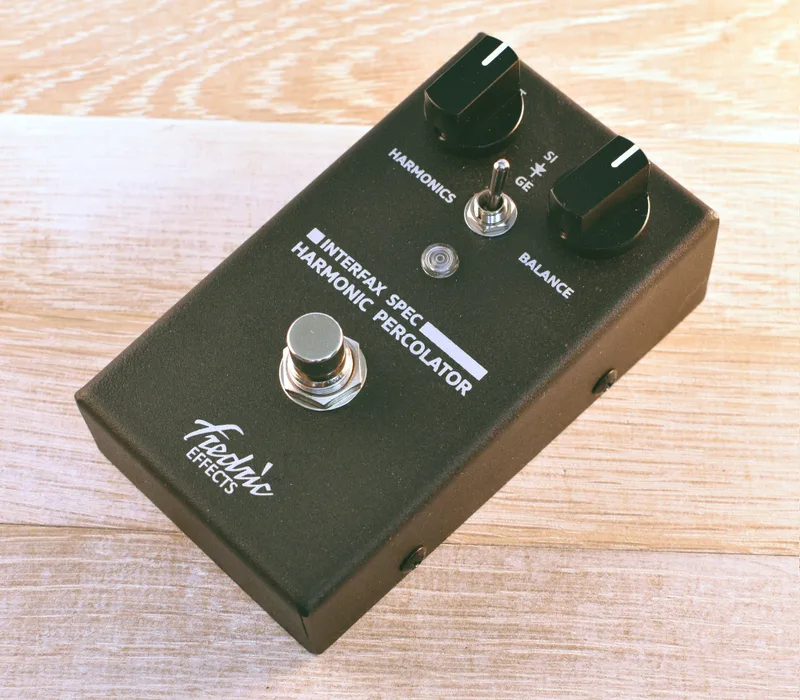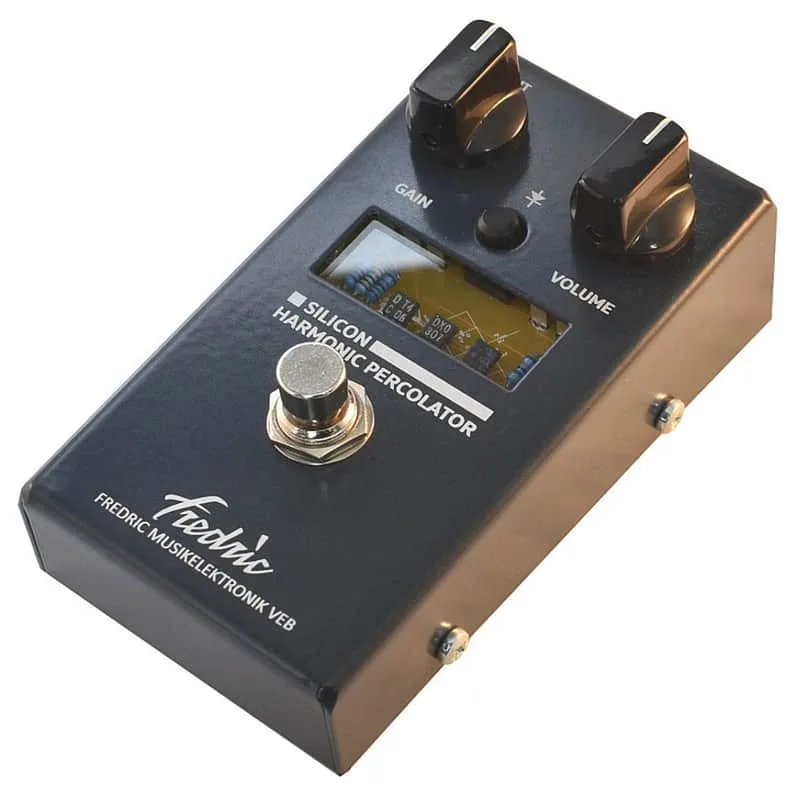


The Fredric Effects Silicon Harmonic Percolator is a hand-built effects pedal that recreates the original 1970s Interfax Harmonic Percolator, the fabled HP-1 circuit built by Ed Giese, using entirely silicon transistors manufactured 40 years ago in the former East Germany1. Where the original and most other clones lean on germanium parts, this version clips the signal using what the maker calls "a weirdo East German diode array"1. It sits somewhere between fuzz and distortion: Guitar Pedal X's reviewer, Stefan Karlsson, described it as "clearer and more defined than a traditional" fuzz2.
Controls and the clipping switch
The control set is deliberately simple. Delicious Audio's Paolo De Gregorio described "The simplified control set features Volume, Harmonics (tone shaping), and Drive knobs"3, while Guitar Pedal X listed the same panel as "Controls - Gain, Volume, Diode On/Off"2. The two accounts name the same three knobs differently: the tone control is labeled Harmonics, and the drive control is Gain.
| Control | What it does |
|---|---|
| Gain (Drive) | Sets the amount of drive and compression23 |
| Volume | Sets output level3 |
| Harmonics | Tone shaping3 |
| Diode On/Off | Engages or bypasses the East German diode clipping array2 |
The Diode switch is the pedal's main character control. On Guitar Pedal X, Karlsson found that "Clipping Off gives more volume, warmth and an open, blooming classic fuzz. Clipping On produces a tighter, wiry, angular" and more defined sound2. He also noted that "diming both Gain and Volume sounds superb - and you can then roll-off some of th" e gain from the guitar's volume control, with compression at maximum gain2.
East German silicon parts
The pedal's identity comes from its parts. Fredric Effects states that it "uses entirely silicon transistors manufactured 40 years ago in the former East Germany"1, and that it "clips the signal using a weirdo East German diode array"1. A backlit viewing port lets you see the electronics inside while it runs2. The maker's view is that "The Harmonic Percolator circuit is simple and versatile, and careful component selection can yield fascinating results"1, and the silicon parts here are that component selection taken to its conclusion.
"The hand-built construction uses through-hole components where possible, with each unit individually tested."
Where it came from
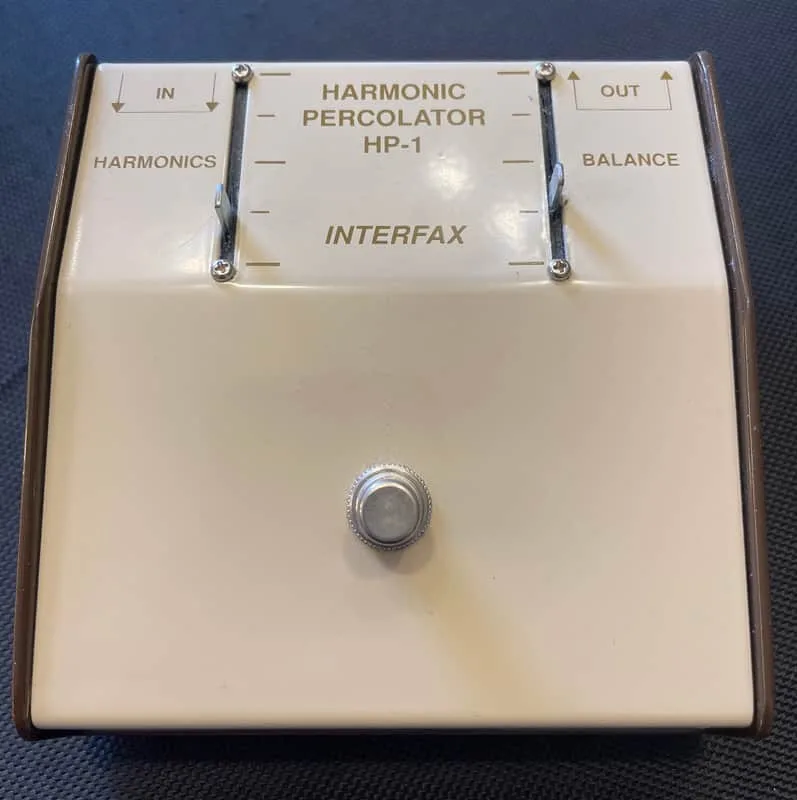
The Harmonic Percolator itself dates to the 1970s: the original was the Ed Giese built Interfax HP-141. Premier Guitar called it "a simple yet fascinating circuit which readily lends itself to tweaking and improvement"5, and the design has inspired a whole family of clones. Fredric Effects had been building a part-for-part clone of the original 1970s Interfax Harmonic Percolator1, and the company's Harmonic Percolator Interfax Spec covers that faithful side of the family.
The Silicon Harmonic Percolator was on soft release for a while before its official launch on 21 July 2025, accompanied by a full overview and demo by Phil at Pedal Experiments2.
How it differs from the Utility Perkolator
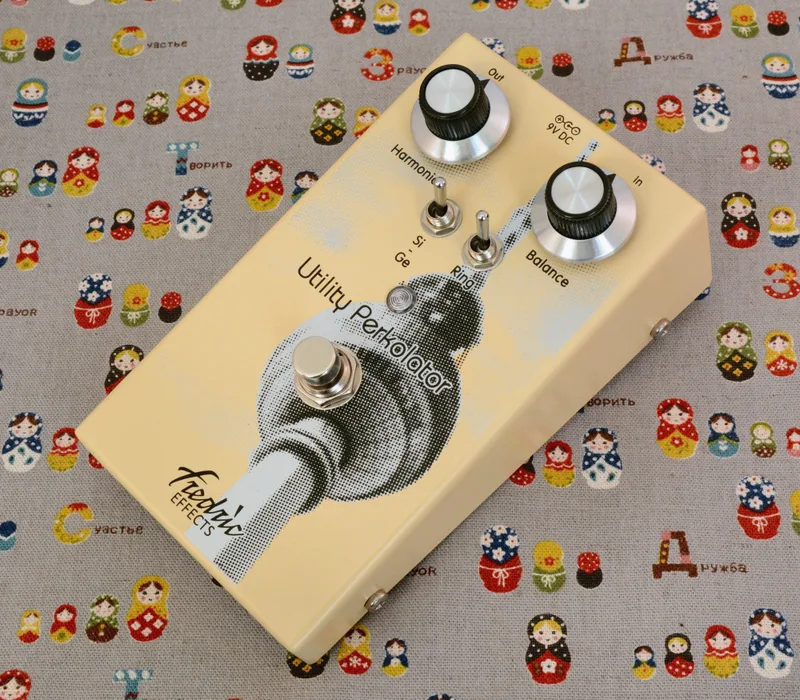
Fredric Effects describes the Silicon Harmonic Percolator as "an improved version of that hybrid Silicon/Germanium circuit as the Utility Perkolator"1. The Utility Perkolator, first released in 2014, is the company's modified take on the same Interfax circuit: it uses "higher gain, lower leakage Russian Germanium transistors" and a low pass filter that removes high-end hiss5, a combination carried into the MkII in 20196. Its control set is larger too, with "Harmonics, Balance, Clipping : Si / Ge, Ring Mod : On/Off"7, and a toggle switch to choose between Silicon and Germanium diodes8.
| Silicon Harmonic Percolator | Utility Perkolator | |
|---|---|---|
| Transistors | East German silicon1 | Russian germanium5 |
| Clipping | East German diode array, on/off1 | Silicon/Germanium toggle8 |
| Extra features | Backlit viewing port2 | Low pass filter, Ring Mod switch267 |
| Controls | Gain, Volume, Diode On/Off2 | Harmonics, Balance, Clipping, Ring Mod7 |
In short: the Utility Perkolator keeps the germanium character and adds options, while the Silicon Harmonic Percolator commits fully to silicon, simplifies the controls, and puts the parts on display132.
Videos
Pedal Experiments
maruhachi08
Questions
What is the Fredric Effects Silicon Harmonic Percolator based on?
It is a part-for-part clone of the original 1970s Interfax Harmonic Percolator, the HP-1 built by Ed Giese. Where the original used germanium parts, this version uses entirely silicon transistors manufactured around 40 years ago in the former East Germany, and clips the signal with an East German diode array. Fredric Effects describes the circuit as simple and versatile, with careful component selection yielding fascinating results.
What does the Clipping switch do on the Silicon Harmonic Percolator?
The Diode On/Off switch engages or bypasses the East German diode array. With clipping off, Guitar Pedal X's reviewer found more volume and warmth and an open, blooming classic fuzz. With clipping on, the sound becomes tighter, wirier, more angular and more defined. The pedal can also be run with both Gain and Volume dimed, rolling gain back from the guitar's volume control.
Is the Silicon Harmonic Percolator a fuzz or a distortion?
It sits between the two. Guitar Pedal X's reviewer described it as clearer and more defined than a traditional fuzz, but with the open, blooming character of a classic fuzz when the diode clipping is switched off. It is best thought of as a hybrid in the way the original Interfax Harmonic Percolator always was.
Is the Silicon Harmonic Percolator hand-built?
Yes. According to Delicious Audio, the hand-built construction uses through-hole components where possible, and each unit is individually tested before it leaves the workshop.
How is it different from the Utility Perkolator?
The Utility Perkolator is Fredric Effects' earlier, modified take on the same Interfax circuit, using higher gain, lower leakage Russian germanium transistors and a low pass filter that removes high-end hiss. It also carries more controls, including a Silicon/Germanium clipping toggle and a Ring Mod switch. The Silicon Harmonic Percolator replaces the germanium side entirely with East German silicon parts and simplifies the control set.
Sources (8)
- Silicon Harmonic Percolator, fredric.co.uk
- Guitar Pedal X, Guitar Pedal X, 2025-07-21
- New Pedal: Fredric Effects Silicon Harmonic Percolator, Delicious Audio, 2025-07-15
- Latent Lemon Audio Hurts Fuzz V2, Delicious Audio, 2022-11-28
- Fredric Effects Releases the Utility Perkolator, Premier Guitar, 2014-09-09
- Fredric Effects Verzerrer, Utility Perkolator MkII & Dresden Synth Fuzz MkII, gearnews.com, 2019-03-10
- Guitar Pedal X, Guitar Pedal X, 2024-05-13
- 9 Best Harmonic Percolator Fuzz Clones & Evolutions In 2023, Delicious Audio, 2023-05-03