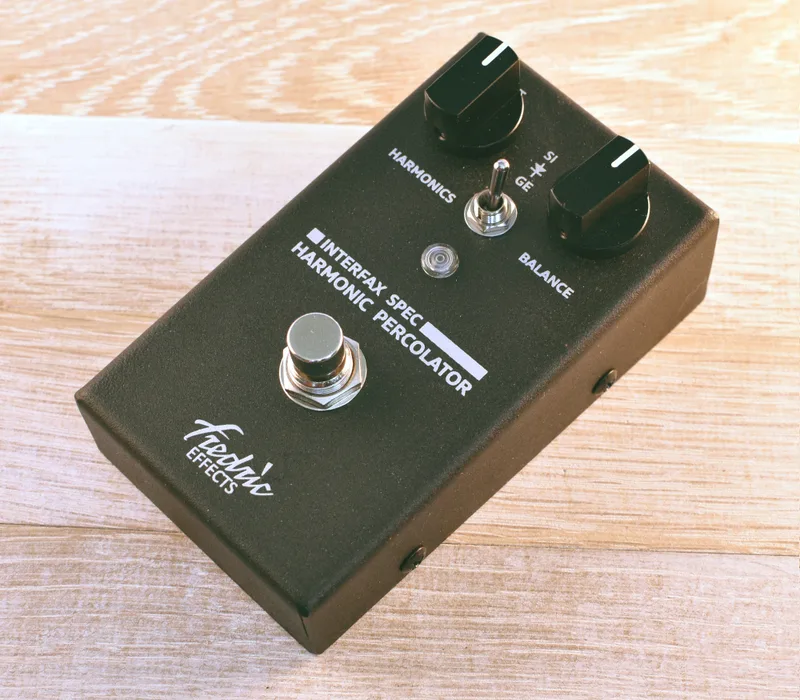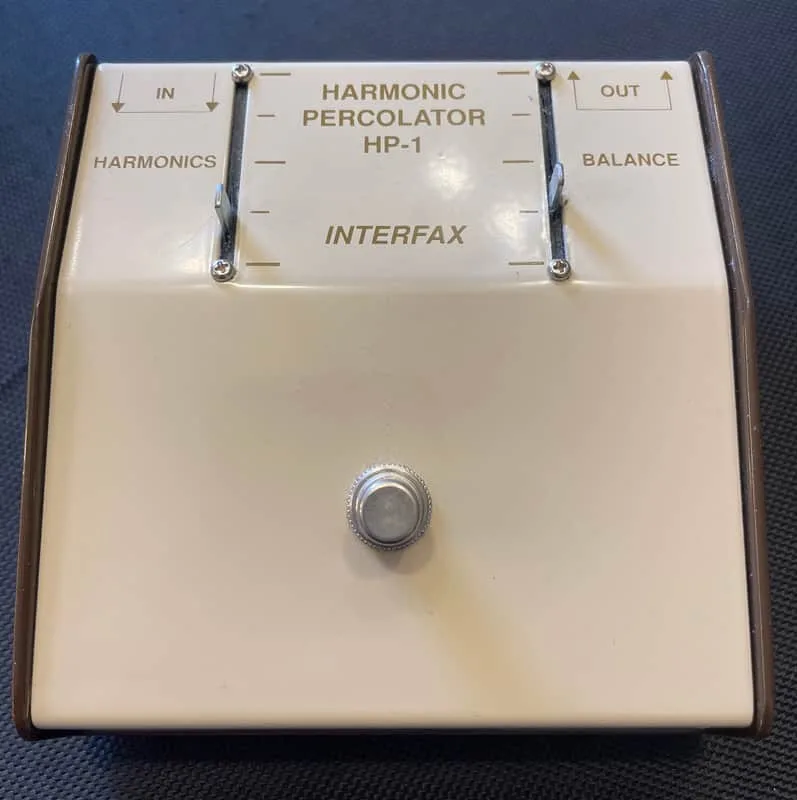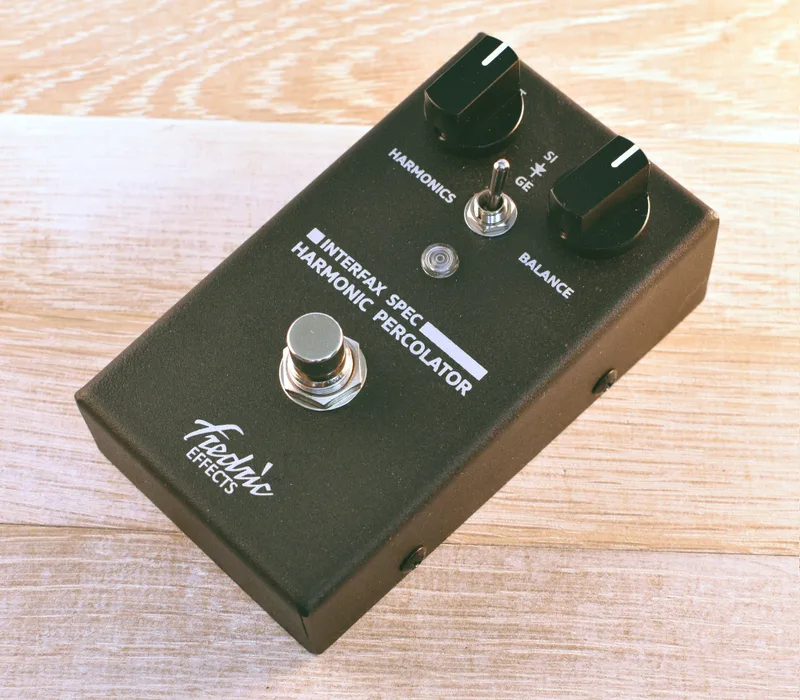

The Fredric Effects Harmonic Percolator Interfax Spec is an exact clone of the Interfax Harmonic Percolator, an oddball overdrive/distortion pedal from the 1970s that has become one of the rarest and most sought-after vintage effects. Fredric Effects builds it to the verified correct schematic, calling it "a 100% accurate clone of the sought-after original", with one addition: a switch offering three different clipping options, which the maker says "greatly adds to the versatility of the effect"1.
The original Interfax HP-1 was a fuzz/overdrive from the mid-1970s that Aion FX describes as "an extremely rare and highly sought-after fuzz/overdrive", noting that the transistors and some components were gooped or obscured in the original units2. Guitar Pedal X counts around 40 regularly available variants of the circuit, mostly from small boutique builders3.
What the original Interfax Harmonic Percolator was
The Harmonic Percolator is a two-transistor fuzz circuit that uses a PNP germanium transistor paired with an NPN silicon, letting it run in a standard negative-ground configuration. That pairing was unusual: most germanium fuzzes of the era were all-germanium, and the Percolator also differs from them by using clipping diodes rather than relying on the transistors alone to clip the signal2. Gearnews describes the original as "a unique circuit using a rare mix of silicon and germanium transistors"4.
The original carried just two slider controls, Harmonics and Balance, with no dedicated gain or tone control5. Not many production units were made during its short life-span, and Aion FX notes there were several circuit changes throughout the run, with two known versions traced: a "stock" version and an "Albini" version, the latter referring to Steve Albini's own unit, which used several different component values from any other traced example2.
The controls and the clipping switch
The Interfax Spec keeps the circuit intact but moves to normal rotary pots instead of the original sliders, and adds DC power and an LED indicator in what the maker calls a modern pedalboard-friendly package1.
The headline addition is the three-position clipping switch. On the original, the diode clipping character was fixed; here a player can move between three clipping options from the top of the pedal. Fredric Effects says this "greatly adds to the versatility of the effect"1. The maker does not specify which diode types each position uses, only that the pedal carries 1N695 diodes, "all the hard-to-find parts of the originals"1.
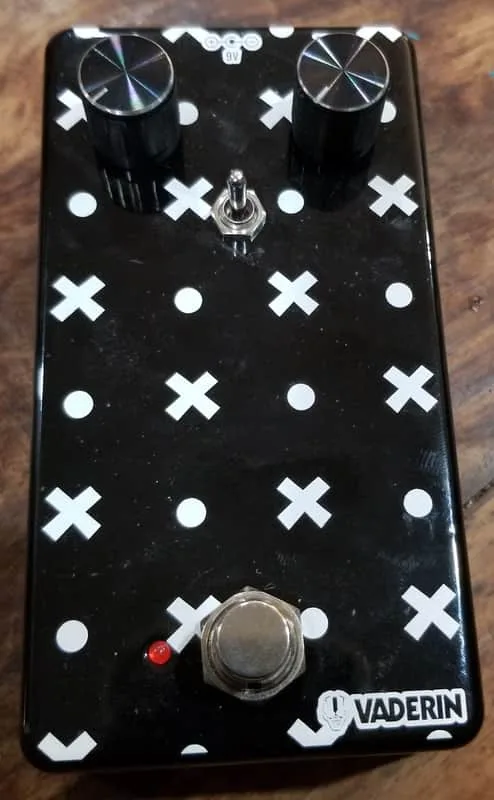
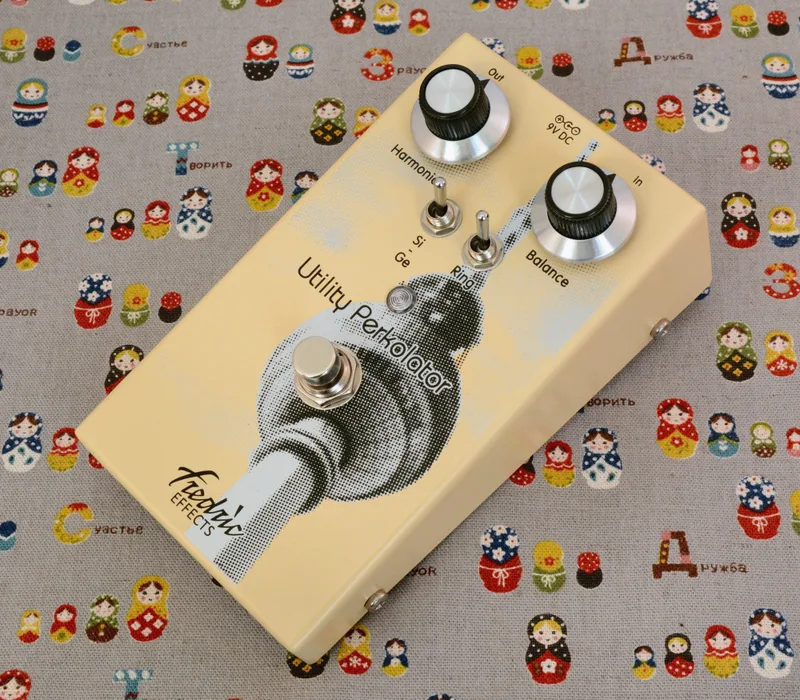
For comparison, other builders have approached the same idea differently. Vaderin Pedals' HP-X offers three diode clipping options: symmetrical silicon, asymmetrical germanium, or a diode lift for all-transistor distortion6. Fredric Effects' own Utility Perkolator MkII uses a simpler toggle that chooses between silicon and germanium diodes7.
Germanium and silicon transistors, 1N695 diodes
The Interfax Spec uses the correct vintage transistors for the circuit: NOS 2N404 germanium and 2N3565 silicon, along with 1N695 diodes. Fredric Effects describes these as "all the hard-to-find parts of the originals"1. Guitar Pedal X confirms the original Interfax HP-1 featured 2N404 germanium and 2N3565 silicon transistors3.
The hybrid topology is what sets the circuit apart from both all-germanium fuzzes and all-silicon distortions. The germanium transistor in the PNP position contributes the character players associate with vintage germanium fuzz, while the silicon transistor in the NPN position lets the pedal run on a standard negative-ground configuration rather than the positive ground many germanium fuzzes require2.
How the Interfax Spec differs from the original
The circuit is unchanged: Fredric Effects states the pedals are built to the verified correct schematic and are a 100 percent accurate clone of the original1. What differs is the packaging and one control:
| Original Interfax HP-1 | Interfax Spec | |
|---|---|---|
| Controls | Two sliders, Harmonics and Balance18 | Rotary pots1 |
| Clipping | Fixed diode clipping1 | Three-position clipping switch1 |
| Power | Original 1970s arrangement | DC power with LED indicator1 |
| Transistors | 2N404 germanium, 2N3565 silicon3 | NOS 2N404 germanium, 2N3565 silicon1 |
| Availability | Extremely rare2 | In production, £160 GBP1 |
Versions: the Interfax original and the Silicon Harmonic Percolator
Fredric Effects builds several pedals around this circuit. Alongside the Interfax Spec, the company has long offered the Utility Perkolator, an improved version of the hybrid silicon/germanium circuit, and later the Utility Perkolator MkII, which uses higher-gain, lower-leakage Russian germanium transistors9.
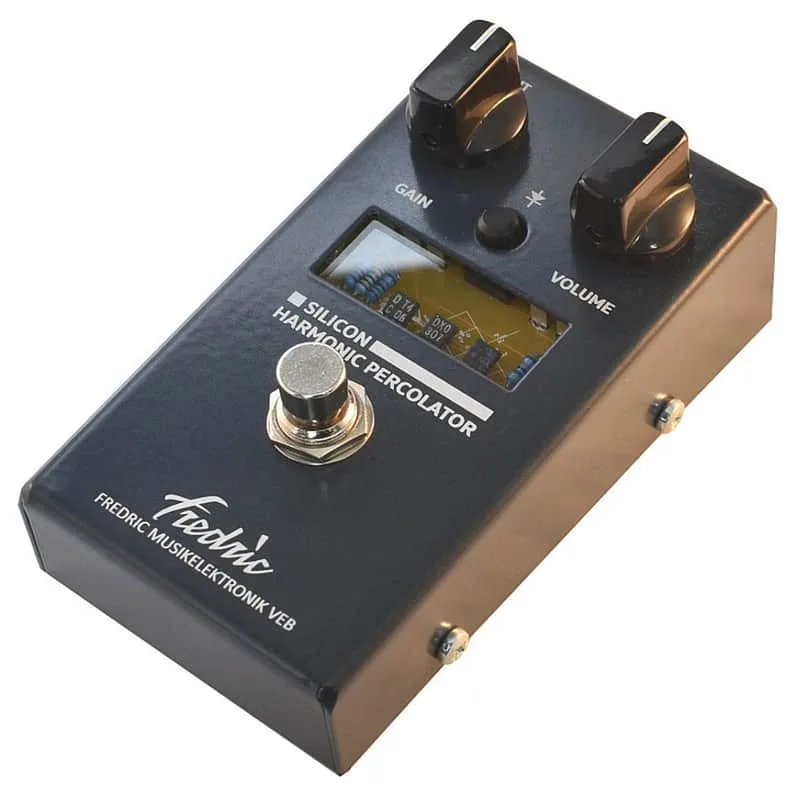
The newest sibling is the Fredric Effects Silicon Harmonic Percolator, announced in July 2025. It is a part-for-part clone of the original 1970s Interfax Harmonic Percolator but uses entirely silicon transistors manufactured 40 years ago in the former East Germany, clipping the signal with what the maker calls "a weirdo East German diode array"10. Delicious Audio reported that these components produce "a raw, articulate distortion with enhanced midrange presence and tighter low-end response" compared to the original hybrid design11. Guitar Pedal X places the Silicon version "somewhere between fuzz and distortion", clearer and more defined than a traditional fuzz, and notes its backlit viewing port for looking at the electronics12.
"The Silicon Harmonic Percolator sits somewhere between fuzz and distortion - clearer and more defined than a traditional [fuzz]"
For players weighing the two Fredric Effects takes on the circuit: the Interfax Spec is the vintage-correct route, with the original's germanium/silicon hybrid and NOS parts, while the Silicon Harmonic Percolator trades the germanium for selected East German silicon. A player who wants the original circuit exactly as designed, with the convenience of a clipping switch, is who the Interfax Spec is built for110.
Videos
Magnetic Effects
Questions
What is the Interfax Harmonic Percolator?
A very rare fuzz and overdrive unit from the mid-1970s, built by Ed Giese as the Interfax HP-1. It used a rare mix of germanium and silicon transistors in a two-transistor circuit with clipping diodes, and only a small number of production units were made. Its rarity and distinctive sound have made it one of the most sought-after vintage effects.
What does the clipping switch do on the Fredric Effects Harmonic Percolator?
The Interfax Spec adds a switch offering three different clipping options, which Fredric Effects says greatly adds to the versatility of the effect. The original Interfax had no such switch, so its diode clipping character was fixed. The switch lets a player move between clipping flavors without opening the pedal or swapping diodes.
Does the Interfax Spec use germanium or silicon transistors?
Both. Fredric Effects builds the Interfax Spec with NOS 2N404 germanium and 2N3565 silicon transistors, matching the original Interfax circuit, which paired a PNP germanium transistor with an NPN silicon in a negative-ground configuration.
How is the Interfax Spec different from the original Interfax Harmonic Percolator?
It is built to the verified correct schematic and is a 100 percent accurate clone of the circuit, but the parts are arranged for modern pedalboards: DC power, an LED indicator, normal rotary pots instead of the original sliders, and a three-position clipping switch the original did not have.
What is the Fredric Effects Silicon Harmonic Percolator?
A sibling pedal from Fredric Effects that replaces the original germanium transistors with silicon transistors manufactured 40 years ago in the former East Germany, and clips the signal with an East German diode array. Delicious Audio described it as raw and articulate, with enhanced mids and tighter low end compared to the hybrid design.
Sources (12)
- Interfax Spec Harmonic Percolator, Fredric Effects
- Particle Vintage Fuzz / Interfax Harmonic Percolator, Aion FX, 2021-02-19
- Guitar Pedal X, Guitar Pedal X, 2024-05-13
- EHX Percolator: Based on '70s Harmonic Percolator, gearnews.com, 2026-06-17
- Electro-Harmonix EHX Percolator Review, Premier Guitar, 2026-09-19
- Vaderin Pedals HP-X Harmonic Percolator, Pedal of the Day, 2021-10-21
- 9 Best Harmonic Percolator Fuzz Clones & Evolutions In 2023, Delicious Audio, 2023-05-03
- DS Custom Audio Electronics Harmonious Perc, Pedal of the Day, 2025-02-16
- Utility Perkolator, an improved Harmonic Percolator, Fredric Effects
- Silicon Harmonic Percolator, fredric.co.uk
- New Pedal: Fredric Effects Silicon Harmonic Percolator, Delicious Audio, 2025-07-15
- Guitar Pedal X, Guitar Pedal X, 2025-07-21