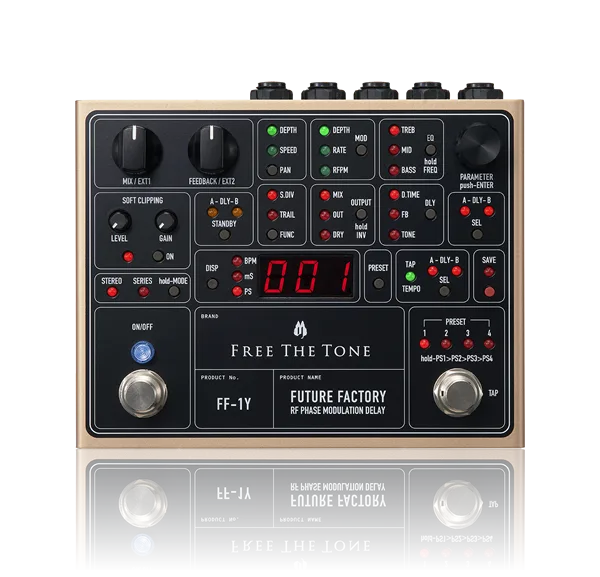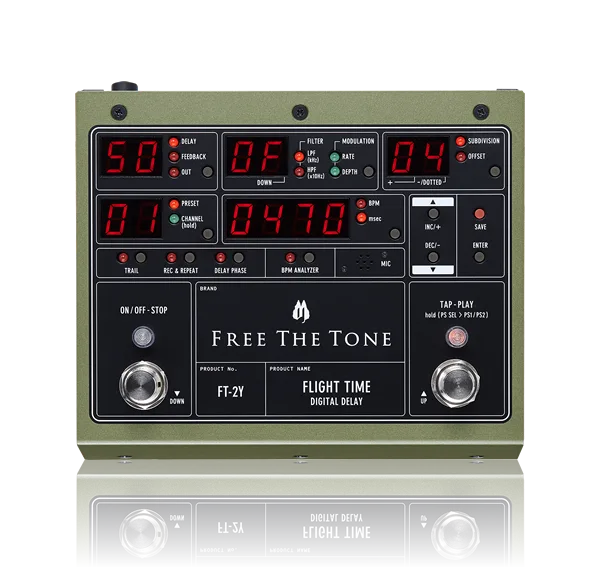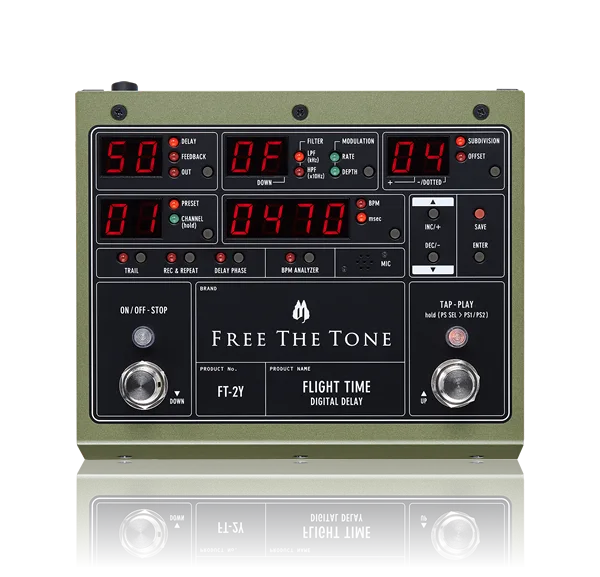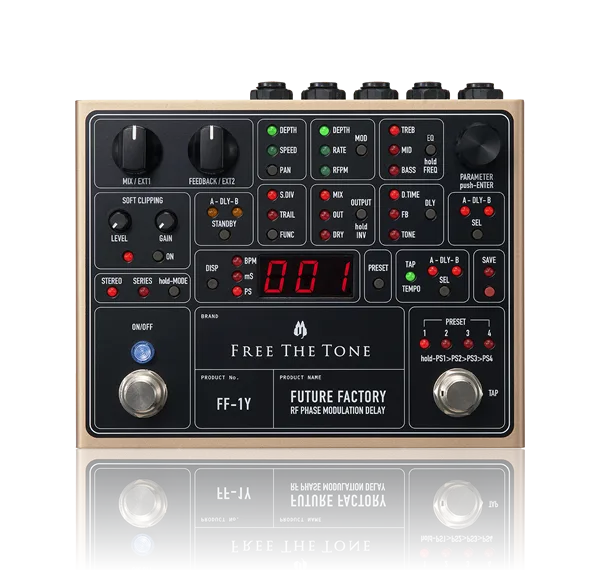


The Free The Tone Future Factory FF-1Y is a digital delay pedal from Japanese maker Free The Tone, subtitled the RF Phase Modulation Delay. It carries two independent digital delay lines, A and B, with various options to combine them, and both lines have optional modulation1. What sets it apart is the phase modulation at its core: Free The Tone describes the result as an effect in which "a fluctuating spacious sound seems to float in the air"2.
The pedal is built around a 32-bit DSP and offers 128 presets, MIDI support, tap tempo and a trails function3. It became available in the United States after March 21, 2019, through North American dealers, at a suggested retail price of $420.002.
Two delay lines with random phase modulation
The FF-1Y's full product description from the maker is "Random Fluctuating Phase Modulation Delay"3. The name comes from how the modulation works: rather than a standard chorus-style modulation on the repeats, the pedal applies random phase modulation, which Free The Tone says creates its floating, spacious character2. Gearnews described the results at its NAMM 2019 introduction as "beautiful sounding delays with modulations and subtle phase shifts. Super pleasing to the ear and very musical"4.
The two delay lines can be combined in several ways:
- Series: delay A feeding delay B, for chained repeats1
- Parallel: the two lines running side by side1
- Stereo: the two delays used as a stereo delay, with adjustable panning Depth and Speed14
- Mono with soft clipping: a monaural mode that puts a soft clipping circuit on one channel of the delay4
In series mode, the panning Depth and Speed controls change jobs and instead apply a tremolo to the delay signal. MusicRadar's reviewer noted that with the delay time at minimum and the dry sound off, pure tremolo is possible1.
The delay time range runs from one millisecond up to 10 seconds, which MusicRadar's reviewer Trevor Curwen highlighted as a "huge range of delay times" from two delay lines in one box. At the short end of that range you can dial in chorus, vibrato and flanging effects rather than conventional repeats1.
The pedal also gives the delay sound its own three-band EQ, with selectable frequencies so you can match the equipment you are playing through3. Pedal of the Day described this as a dedicated 3-band EQ section for adjusting the tonal properties of the delay effect to taste5.
The controls, presets and footswitches
Most tweaks on the FF-1Y are selected by a series of small buttons and carried out by a turn-and-push parameter knob. Mix and Feedback can be adjusted directly, and alternative functions can be assigned to those two knobs if you wish. The repeats also have a Tone control that applies a low- or high-pass filter1.
| Control | What it does |
|---|---|
| Parameter knob | Turn-and-push editing, used with small selector buttons1 |
| Mix knob | Direct control of dry/wet mix, assignable to other functions1 |
| Feedback knob | Direct control of repeats, assignable to other functions1 |
| Tone control | Low- or high-pass filter on the repeats1 |
| 3-band EQ | Dedicated EQ for the delay sound, selectable frequencies3 |
| Panning Depth and Speed | Stereo panning, or tremolo on the delay in series mode1 |
The pedal stores 128 presets3, and Free The Tone has programmed the first 100 preset slots with what MusicRadar's reviewer called "some very useful and inspirational variations"1. Four instant presets, tap tempo and expression pedal control of a chosen parameter make it, in his view, a practical stage performer1.
The Tap Tempo footswitch gives instant access to quick delay-time changes, and you can choose whether it applies to delay A, delay B, or both together1. Pedal of the Day also lists delay phase invert, a trails function, tap input and MIDI connectivity among the pedal's features5.
On the editing workflow, Curwen found the parameter-knob approach does not lend itself to quick onstage edits, though the display always clearly shows what is going on1.
"Two delay lines in one box; huge range of delay times."
Power and connections
The FF-1Y runs on a DC9V AC adapter, sold separately, and draws approximately 350mA3.
At around 350mA, the FF-1Y needs a dedicated 9V power supply output. It cannot run on a battery, and its draw is high enough that a shared daisy-chain output may not keep up.
Connections are on 1/4-inch standard phone jacks: A-IN and B-IN on the input side, with an input impedance of 500KΩ or more and a maximum input level of INST +3.5dBu / LINE +11dBu, and A-OUT and B-OUT on the output side, with an output load impedance of 10kΩ or more3. The pedal offers stereo operation besides mono1.
MIDI support covers the 128 presets2, and firmware version 1.3 is available as a download from Free The Tone3.
Where it came from and what reviewers said
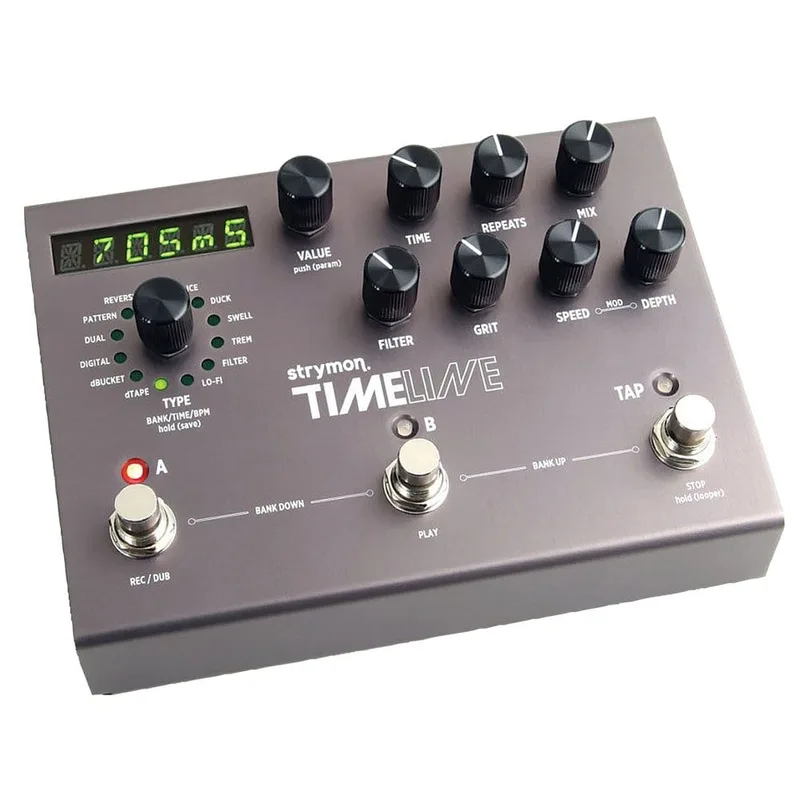
MusicRadar's review summed up the FF-1Y as "a very versatile pedal," crediting its comprehensive set of parameters, easily accessible presets, two delay lines in one box, and the soft clipping function, which the reviewer counted as a reason to buy1. Gearnews called the delays "super pleasing to the ear and very musical"4, and Pedal of the Day found it "a complicated-looking but relatively easy-to-use effects pedal"5. That Pedal Show also covered the FF-1Y in its 2020 video comparing delay pedals against the Strymon Timeline6.
Videos
Leon Todd
Pedal of the Day
Brett Kingman
Questions
What is the maximum delay time on the Future Factory FF-1Y?
The delay time range runs from one millisecond up to 10 seconds, according to MusicRadar's review. That range covers everything from chorus, vibrato and flanging effects at the short end through to long ambient repeats at the far end, using the two delay lines in one box.
Does the Free The Tone Future Factory have MIDI?
Yes. The FF-1Y has MIDI support with 128 presets, along with a tap input and a trails function. MIDI connectivity lets you switch presets and control the pedal remotely from a MIDI controller rather than tapping the footswitches.
Can the FF-1Y run in stereo?
Yes. The pedal offers stereo operation besides mono, using its two delay lines as a stereo delay. In stereo mode the Depth and Speed of panning are adjustable, and the pedal has separate A and B output jacks.
Can the two delay lines run in series?
Yes. The two delay lines, A and B, can be set to run in series, with A feeding B, or in parallel. In series mode the panning Depth and Speed controls instead apply a tremolo to the delay signal.
Does the Future Factory FF-1Y take a battery?
No. The pedal runs on a DC9V AC adapter, sold separately, and draws approximately 350mA. That current draw is well beyond what a battery can supply, so it needs a dedicated 9V power supply on the pedalboard.
Sources (6)
- Free The Tone Future Factory FF-1Y delay review, MusicRadar, 2019-09-19
- Future Factory FF-1Y: Top RF Phase Modulation Delay, Premier Guitar, 2019-01-24
- FUTURE FACTORY / FF-1Y|Products 商品紹介|Free The Tone, Free The Tone
- NAMM 2019:Free The Tone FF-1Y RF Phase Modulation Delay Future Factory, gearnews.com, 2019-01-24
- Free The Tone Future Factory FF-1Y RF Phase Modulation Delay, Pedal of the Day, 2019-04-10
- Strymon TimeLine, That Pedal Show, 2020-11-13