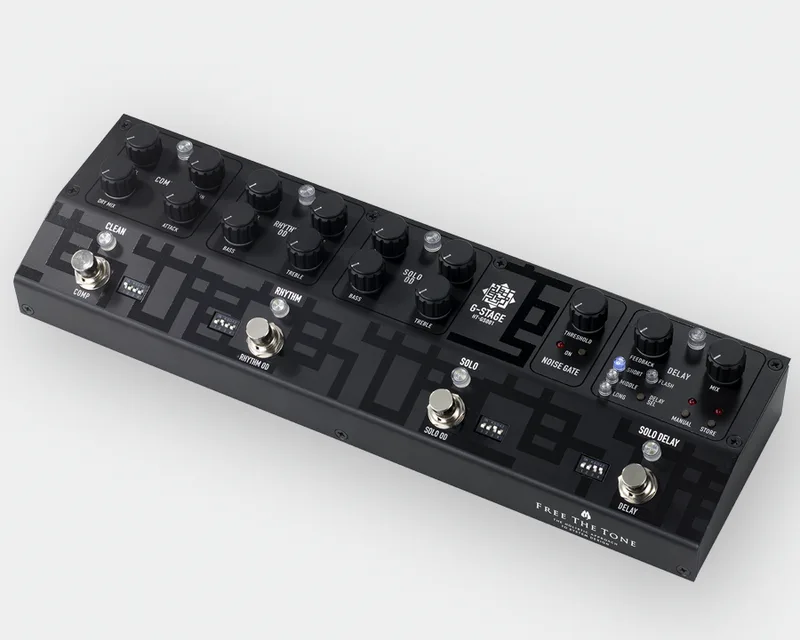


The Free The Tone HOTEI Signature G-STAGE Multi-effects System (model HT-GS001) is a limited-production multi-effects unit built as a joint project between the company and guitarist Tomoyasu Hotei, whose guitar system Free The Tone has handled since 2005. It packs a compressor, a rhythm overdrive, a solo overdrive, a FLASH feedback effect and a tuned delay section into a single foot-operated unit, with the sounds shaped around Hotei's own rig1.
The G-STAGE was a made-to-order limited edition of at most 300 units, and the website lottery sale sold out. It is not a standard catalog product, and it runs on a dedicated 9V AC adapter rather than a battery or generic pedal supply.
A five-year project, built in limited numbers
Development started in 2019 as a joint project between Hotei and Free The Tone and ran about five years. The unit was sold as a limited made-to-order production with a maximum of 300 units1.
Sales ran in stages. A fan club pre-sale shipped sequentially from late June 2023, limited to one order per person. A lottery sale through the Free The Tone website followed and sold out: winners were announced on July 3, 2023 at 18:00, with a deposit payment window from July 3 at 18:00 to July 10 at 23:55, and shipping from late September to early October 20231.
What is inside
The G-STAGE gathers several effect blocks that mirror the sections of Hotei's own system, in the spirit of a multi-effects pedal but built around a fixed, tuned signal path1.
- Compressor, with a DRY MIX knob: fully left removes the dry signal, and turning right adds dry signal back into the compressed sound1
- Rhythm overdrive: Free The Tone says finalizing this sound took about a year and a half, with NOS semiconductors decisive for the sound1
- Solo overdrive: described by the maker as sitting on the extension of the rhythm overdrive sound, with ample sustain, tuned for Hotei's open, thick solo tone1
- FLASH, a feedback effect1
- Delay with three tuned presets1
The NOS (NEW OLD STOCK) parts, meaning discontinued components from old stock, appear in the compressor, rhythm OD and solo OD circuits. Free The Tone ties them directly to both the sound and the production limit: they are part of why only 300 units could be built1.
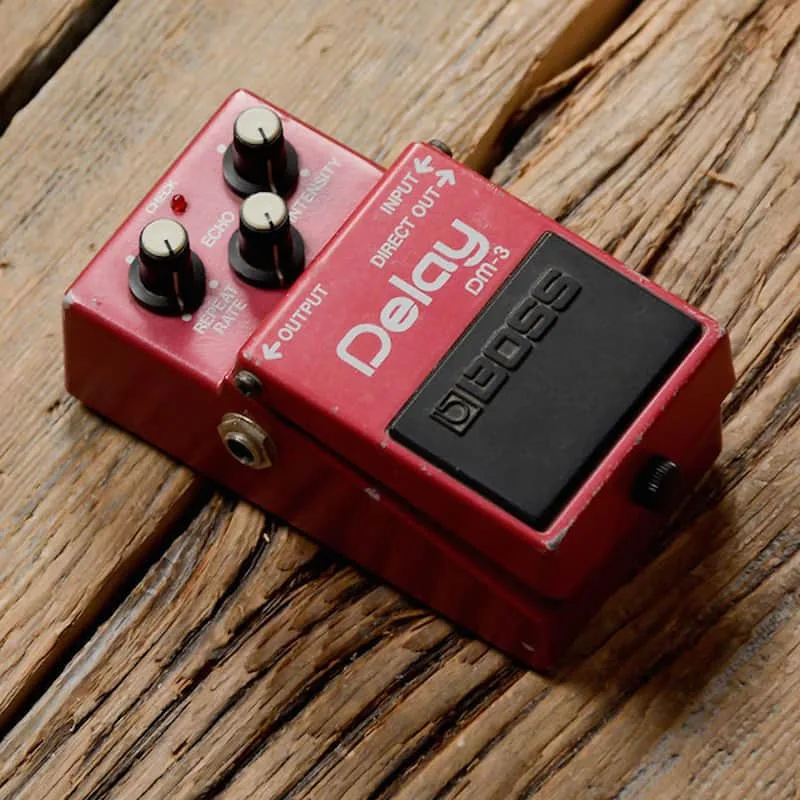
FLASH and the BOSS DM-3
FLASH was developed to approach and exceed the oscillation sound of Hotei's own BOSS DM-3 delay. As the maker describes it, that unit's feedback peaks around 1.3kHz, with other frequency bands changing as the oscillation runs1.
The delay section
The delay carries three presets, SHORT, MIDDLE and LONG, each with different frequency characteristics and filters tuned to sit with the dry sound. The MIDDLE preset's 358msec delay time is one Hotei uses frequently. The presets incorporate delay times used in songs including "Bambina", "CLOUDY HEART", "MARIONETTE" and "BATTLE WITHOUT HONOR OR HUMANITY"1. For context on how delay presets like these shape a sound, see Delay Pedals.
Controls and operation
The G-STAGE runs in two modes. DIRECT mode switches individual effects on and off by footswitch, while PRESET mode calls up preset combinations of effects from the footswitches1.
Connections and power
| Item | Detail |
|---|---|
| Input | 1/4-inch standard phone jack1 |
| Output | 1/4-inch standard phone jack1 |
| Delay control jacks | Three 1/4-inch control terminals for delay1 |
| External footswitch | DIN 7-pin connector (EXTERNAL FOOTSWITCH)1 |
| Power input | DC9V jack for the dedicated AC adapter1 |
| Power supply | DC9V dedicated AC adapter, FA-W0905D-JA1 |
| Current draw | 230mA1 |
| Output load impedance | 10k ohms or more1 |
The 230mA draw and the dedicated FA-W0905D-JA adapter mean the G-STAGE is powered from its own supply rather than a battery or a shared daisy chain1.
Size and construction
Getting the effects into one enclosure took a three-board internal circuit construction for miniaturization. The maker notes the internal circuits are packed tight, but the design succeeded in fitting everything into a 270mm-wide chassis. The main unit measures 103(D) x 320(W) x 51(H)mm including protrusions such as footswitches and jacks, and weighs about 1.2kg1.
Videos
FreeTheToneMovie
パンサー450
Questions
How many HOTEI Signature G-STAGE units were made?
The G-STAGE was a made-to-order limited production with a maximum of 300 units. Free The Tone ran a fan club pre-sale with shipping starting sequentially from late June 2023, limited to one order per person, followed by a lottery sale on the Free The Tone website. That lottery sold out, with winners announced on July 3, 2023 and shipping from late September to early October 2023.
What power supply does the G-STAGE use?
The G-STAGE runs on DC9V from a dedicated AC adapter, the Free The Tone FA-W0905D-JA, plugged into a DC9V input jack on the unit. It draws 230mA of current. Because it requires this dedicated adapter rather than a standard battery or generic supply, plan your pedalboard power accordingly.
What are the three delay presets on the G-STAGE?
The delay section has three presets: SHORT, MIDDLE and LONG. Each has different frequency characteristics and filters tuned to sit with the dry sound. The MIDDLE preset's 358msec delay time is one Hotei uses frequently, and the presets carry delay times used in songs including Bambina, CLOUDY HEART, MARIONETTE and BATTLE WITHOUT HONOR OR HUMANITY.
What is the FLASH effect on the G-STAGE?
FLASH is a feedback effect developed to approach and exceed the oscillation sound of Hotei's own BOSS DM-3 delay. That unit's feedback peaks around 1.3kHz, with other frequency bands changing as it runs. During development the effect was called DM FEEDBACK, and the name FLASH came from Hotei himself.
What is the G-STAGE's model number?
The model number is HT-GS001. The full product name is the HOTEI Signature G-STAGE Multi-effects System, made by Free The Tone as a joint project with Tomoyasu Hotei, whose guitar system the company has handled since 2005.
Why does the G-STAGE use NOS parts?
Some of the parts in the compressor, rhythm overdrive and solo overdrive circuits are NOS, meaning NEW OLD STOCK: discontinued components from old inventory. Free The Tone says these parts were decisive for the sound, and because they are finite, they are also what limits the production quantity to 300 units.