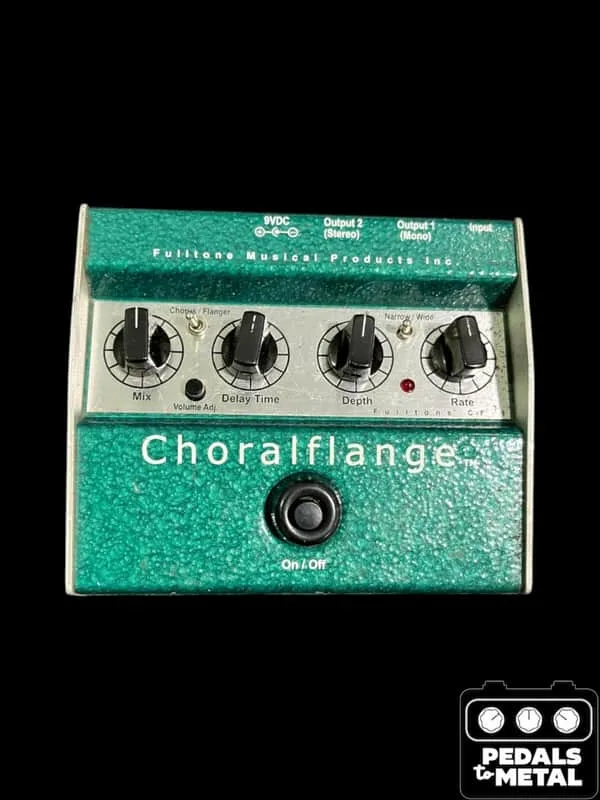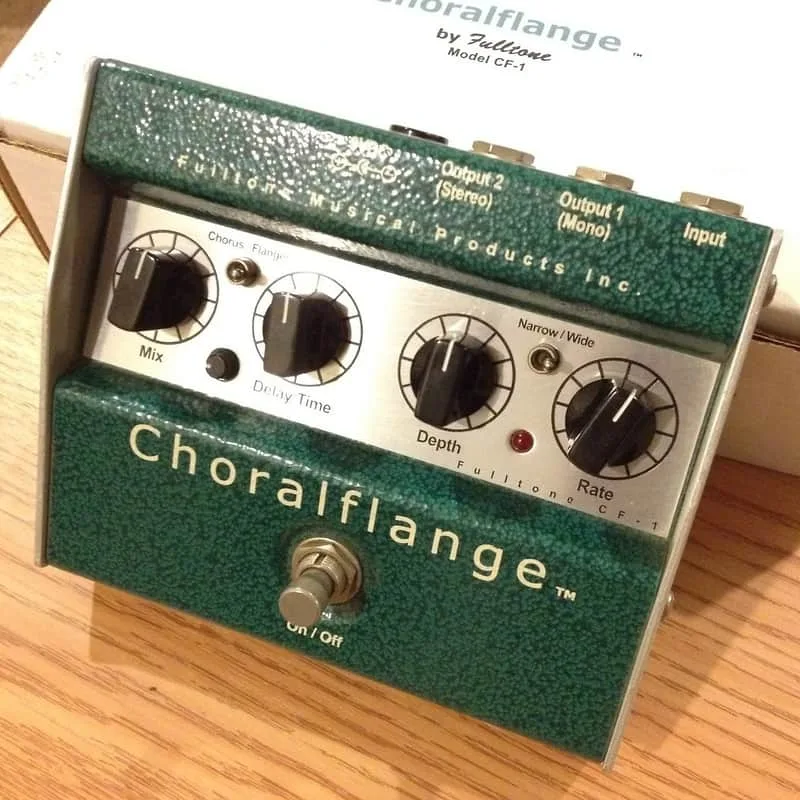


The Fulltone Choralflange, also reviewed as the CF-1 Choralflange, is an analog chorus and flanger pedal in one box, made by Fulltone (Fulltone Musical Products Inc of Los Angeles)1. A mode toggle switches the circuit between chorus and flanger, and the same knobs shape either effect, so one pedal covers two classic modulation sounds2.
The Choralflange has been discontinued by Fulltone. A July 2015 review reported the pedal was out of production as of that date, so it is now a secondhand-market item2.
An analog chorus and flanger in one pedal
Both reviewers described the Choralflange as an analog design, and both contrasted its character with digital modulation. Vintage Guitar's December 2001 review called it an analog chorus/flanger, and Pedal of the Day's Mike B described the sound in 201512:
"Nice and analog-y, warm and soothing, not all high-pitched like a lot of the digital stuff was/is, and extremely versatile, for a big batch of uses and textures in practically any pedalboard setup."
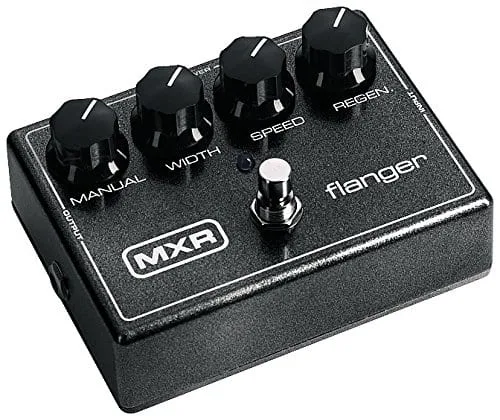
Vintage Guitar compared the Choralflange directly with two familiar stompboxes of the era and found it came out ahead: "Compared to faithful and familiar pedals like the Boss Chorus and MXR Flanger, the Choralflange is superior in sound and" variety of controls1. That is a reviewer's judgment rather than a measurement, but it points to what set the pedal apart: more control over the modulation than a standard single-effect chorus or flanger box offered.
The pedal works in mono or stereo. Plugging into the single input and either of the two output jacks runs it in mono; the second output jack opens up stereo operation12.
The controls
The Choralflange front panel mixes knobs and toggles. Two small toggle switches handle mode and range selection, and the knobs shape the modulation itself12.
| Control | What it does |
|---|---|
| Function toggle | Selects Chorus or Flanger mode2 |
| Range toggle | Narrow (one octave) or Wide (two octave) frequency bandwidth2 |
| Delay Time | Sets the frequency of the effect and the amount of vibrato present, up to 50 milliseconds; allows subtle or wildly detuned chorus and vibrato sounds2 |
| Rate | Sets the speed of modulation, indicated by a flashing LED1 |
| Depth | Sets effect intensity and thickness2 |
| Mix | Balances the effected signal against the straight guitar or bass signal2 |
| Volume | A small knob that sets the overall output volume2 |
| Gain trimmer | An external trimmer for gain2 |
The Delay Time control is the heart of the pedal's range. Because it reaches up to 50 milliseconds, it can go well past conventional chorus territory into heavily detuned vibrato sounds, while lower settings keep the effect subtle2. The Range toggle works alongside it: Narrow holds the sweep to one octave for a tighter effect, and Wide opens it to two octaves for a broader sweep2.
Vintage Guitar also noted a mini volume adjust knob that helps balance the signal's volume level when the effect is engaged, and that the instruction manual provides a selection of sample settings to give the user a good starting point1.
Bypass and setup
The bypass behavior is selectable rather than fixed. Dip switches inside the battery compartment let the owner set the pedal for either buffered or true bypass operation2. Vintage Guitar added a practical detail: true bypass applies to mono operation only, and the buffered setting is recommended for mono or stereo use with very long cables1. For a player running the Choralflange in stereo or at the end of a long cable run, the buffered setting is the one that preserves the signal.
What reviewers said
Both published reviews were positive. Vintage Guitar's 2001 review rated the CF-1 highly for features and tone, and found it superior in sound and control variety against the Boss Chorus and MXR Flanger1. Fourteen years later, Pedal of the Day's Mike B was still enthusiastic about both modes:
"You can use the first toggle switch to select between Chorus or Flanger mode, and let me tell you, both are just great."
He summed up the pedal as "an incredible analog chorus, as well as a kick-ass flanger," warm and versatile enough for a wide range of uses and textures on practically any pedalboard2.
Videos
Felice Malinconico
BallewsMusic
Pedal of the Day
Questions
Is the Fulltone Choralflange discontinued?
Yes. As of a July 2015 review on Pedal of the Day, the reviewer reported that Fulltone had discontinued the Choralflange. The pedal is no longer in production, so players looking for one are finding it on the secondhand market.
Can the Fulltone Choralflange run in stereo?
Yes. The pedal has a single input and two output jacks, and the second output jack lets you run it in stereo. Vintage Guitar noted it can be used in mono and stereo setups, though true bypass is available for mono operation only.
Is the Fulltone Choralflange true bypass?
It is selectable. Dip switches inside the battery compartment let you set the pedal for either true bypass or buffered operation. Vintage Guitar reported that true bypass works in mono only, and recommended the buffered setting for stereo or very long cable runs.
What is the maximum delay time on the Choralflange?
Up to 50 milliseconds. The Delay Time control sets the amount of vibrato present in the effect, and the knob allows everything from subtle chorus to wildly detuned chorus and vibrato sounds.
What does the Range toggle do on the Choralflange?
The Range toggle sets the frequency bandwidth of the effect: Narrow, a one octave sweep, or Wide, a two octave sweep. Narrow keeps the effect tighter and more subtle, while Wide opens it up for a broader, more dramatic sweep.
Sources (2)
- Fulltone CF-1 Choralflange, Vintage Guitar magazine, 2003-02-27
- Fulltone Choralflange Chorus Flanger, Pedal of the Day (www.pedal-of-the-day.com), 2015-07-27