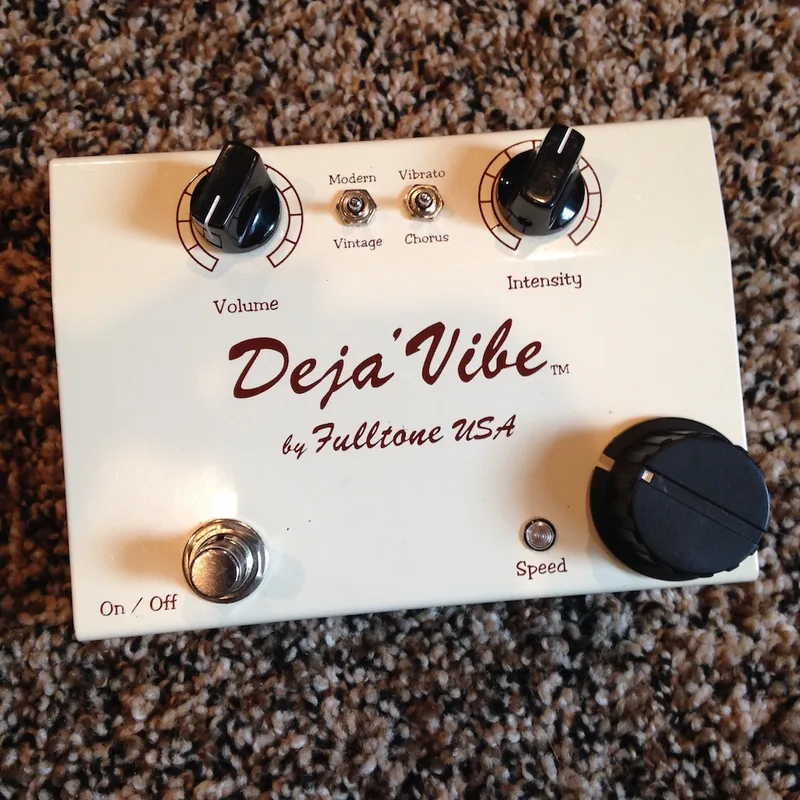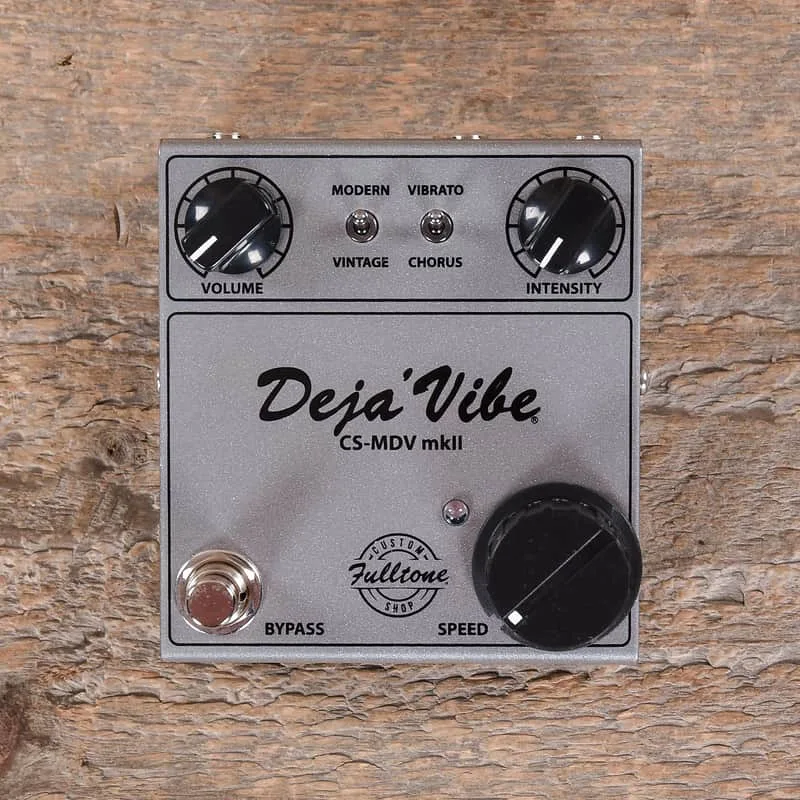


The Fulltone Deja Vibe CS-MDV mkII is an analog chorus and vibrato pedal built by Fulltone, and it is a deliberate recreation of the original 1960s Uni-Vibe circuit. Like the Uni-Vibe it is based on, it uses four photoresistors and an incandescent light bulb to produce thick, deep chorus and vibrato, the same light-and-photocell approach that gave the vintage unit its characteristic sweep1. Fulltone upgraded the pedal in 2018 from the earlier Deja Vibe/CS-MDV-1, alongside a refresh of the Full-Drive 2, two of the company's most successful and enduring pedals1.
For a player, the Deja Vibe covers the two halves of the Uni-Vibe sound: chorus mode, where the modulated signal is blended with the dry signal, and vibrato mode, where only the pitch-wobbled signal remains. Guitar World's reviewer Chris Gill found the effects to be a significant improvement over the original Uni-Vibe, with much greater warmth, fuller body and enhanced prominence that cuts right through a mix1.
A Uni-Vibe-style chorus and vibrato
The Uni-Vibe's sound comes from its opto-electronic design: a light bulb shining on photoresistors, whose changing resistance modulates the signal. The Deja Vibe CS-MDV mkII follows that topology directly, with four photoresistors and an incandescent bulb1. Fulltone's own description of the Mini Deja Vibe line calls it true to the original 1960s Univibe circuit, including what the company considers the most important parts, the photocells, which are 100% Fulltone-designed3.
The mkII's upgrade centers on those light-controlled parts. Mike Fuller replaced the original potentiometers with a pair of custom-made Fulltone opto-couplers possessing a range of 40 ohms to 5 mega ohms, which gives the pedal a wider speed range than the CS-MDV-11.
"the Fulltone unit's effects are a significant improvement with much greater warmth, fuller body and enhanced prominence that cuts right through a mix"
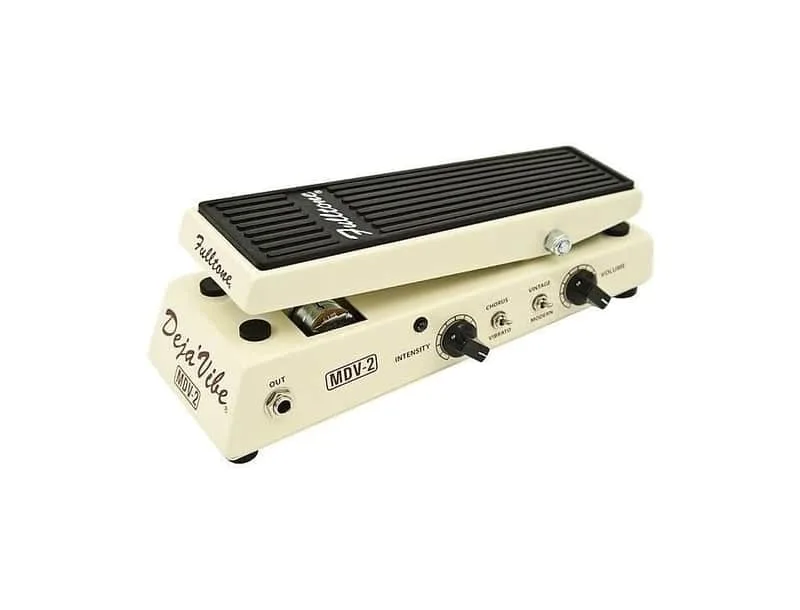
Players looking at other Uni-Vibe-style options can compare against the MXR Uni-Vibe Chorus/Vibrato, which Dunlop also builds as a chorus/vibrato pedal in the same tradition, or Fulltone's own earlier Mini DejaVibe and MDV2 Mini Deja Vibe 2.
The controls and expression input
The mkII carries the same set of controls as the CS-MDV-11:
| Control | What it does |
|---|---|
| Volume | Sets the output level |
| Intensity | Sets the depth of the chorus or vibrato effect |
| Speed (oversized knob) | Sets the modulation rate, with a wider range on the mkII |
| Modern/Vintage toggle | Mini two-way switch selecting between the two voicings |
| Vibrato/Chorus toggle | Mini two-way switch selecting the effect mode |
The modern/vintage and vibrato/chorus modes were part of the Mini Deja Vibe line before the mkII as well. That Pedal Show's 2017 Uni-Vibe comparison episode, which put Fulltone alongside Sweet Sound, Korg, MXR and Keeley vibe pedals, covers the vintage and modern modes of the Fulltone Deja Vibe4.
The expression input is where the mkII improves on its predecessor. The external pedal jack is now compatible with almost any type of expression pedal, including units with 10K, 50K or 100K potentiometers1. That matters because many pedals only accept one specific potentiometer value, which can force a player to buy a matching expression pedal. On That Pedal Show's demo of the Custom Shop Mini Deja Vibe mkII, Dan and Mick controlled the speed with an expression pedal while also working the intensity control, showing two ways a player can shape the effect in real time2.
The Custom Shop Mini Deja Vibe mkII takes 18 volts only, as noted on That Pedal Show, presumably for more headroom2. A standard 9V supply will not run it, so plan the pedalboard power accordingly. The earlier MDV2 Mini Deja Vibe 2, by contrast, ran on 9V DC, center negative3.
That Pedal Show's demo video shows the pedal in use, with speed controlled by expression pedal and intensity worked by hand2:
From the CS-MDV-1 to the mkII and beyond
The Deja Vibe line has moved through several versions. The MDV2 Mini Deja Vibe 2, reviewed by Pedal of the Day in 2014, was the second version of the Deja Vibe, in a Vintage Cream powder coated finish with oxblood lettering, sized no bigger than a standard wah-wah pedal5. Its dual speed pot gave access to all speeds from slowest to fastest with what the maker described as a perfect sweep and no abrupt speed changes, and a single switch changed the sound from a lush chorus to a gorgeous vibrato35. Pedal of the Day's Mike B. called it "an incredible work of sonic art from Fulltone"5.
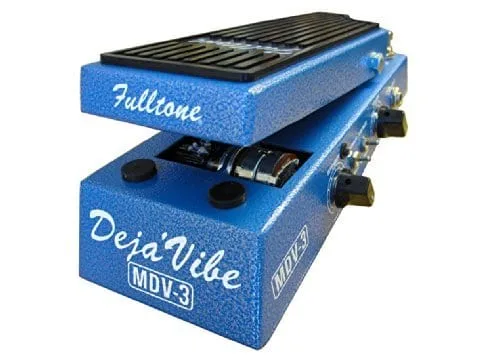
Fulltone later released the Deja Vibe 3, the successor to the Mini Deja Vibe 2, with a couple of new features and the same vibe sound5. In a 2026 Guitar World interview about his pedalboard, Joe Perry of Aerosmith described his Fulltone vibe pedal as "kind of like the original"6.
The 2018 upgrade that produced the CS-MDV mkII sits in the middle of that history: same controls and same circuit concept as the CS-MDV-1, but with the custom opto-couplers, the wider speed range and the more flexible expression jack that distinguish it1.
Videos
FulltoneMusicalProductsLLC
Guitar Bonedo
musictoyznetwork rasch
Questions
What is the difference between the Deja Vibe CS-MDV mkII and the original CS-MDV-1?
The mkII, released in 2018, keeps the same control set as the CS-MDV-1: volume, intensity, an oversized speed knob and mini toggles for modern/vintage and vibrato/chorus. The upgrade is inside. Mike Fuller replaced the original potentiometers with custom-made Fulltone opto-couplers with a range of 40 ohms to 5 mega ohms, giving a wider speed range, and the external pedal jack now works with almost any expression pedal, including 10K, 50K or 100K units.
Can I use an expression pedal with the Fulltone Deja Vibe mkII?
Yes. The external pedal jack is compatible with almost any type of expression pedal, including units with 10K, 50K or 100K potentiometers. On That Pedal Show, Dan and Mick demonstrated controlling the speed with an expression pedal while also working the intensity control by hand.
Is the Fulltone Deja Vibe based on the Uni-Vibe?
Yes. Like the original Uni-Vibe upon which it is based, the Deja Vibe CS-MDV mkII uses four photoresistors and an incandescent light bulb to produce its chorus and vibrato effects. Fulltone describes the Mini Deja Vibe line as true to the original 1960s Univibe circuit, including the photocells, which are 100% Fulltone-designed.
What does the modern/vintage switch do?
The mini two-way toggle selects between modern and vintage settings, alongside a second toggle for vibrato/chorus. That Pedal Show's Uni-Vibe comparison episode covers the vintage and modern modes of the Fulltone Deja Vibe, so players can hear both sides of the switch in a demo context.
Does the Mini Deja Vibe 2 come with a power supply?
The MDV2 Mini Deja Vibe 2 shipped with a power supply included, according to Pedal of the Day's 2014 review. It runs on 9V DC, center negative. Note that the later Custom Shop Mini Deja Vibe mkII takes 18 volts only, which rules out a standard 9V supply.
What is the Fulltone Deja Vibe 3?
The Deja Vibe 3 is the successor to the Mini Deja Vibe 2, with a couple of new features and the same vibe sound, as reviewed by Pedal of the Day. Joe Perry of Aerosmith described his Fulltone vibe pedal as kind of like the original in a 2026 Guitar World interview.
Sources (6)
- Review: Fulltone Deja Vibe CS-MDV MKII and Full-Drive 2 V2 Pedals, Guitar World, 2019-03-11
- JHS AT+, Tru-Fi Zosa, Fulltone Mini Deja Vibe MkII, ZVex Instant Lo-Fi Junky, That Pedal Show, 2018-11-27
- MDV-2 Mini Deja Vibe by Fulltone, RockBoard PedalPedia, 2026
- That Pedal Show, That Pedal Show, 2017-02-24
- Fulltone MDV2 Mini Deja Vibe 2, Pedal of the Day, 2014-04-03
- Joe Perry on the guitar pedals he can't live without, Guitar World, 2026-04-10