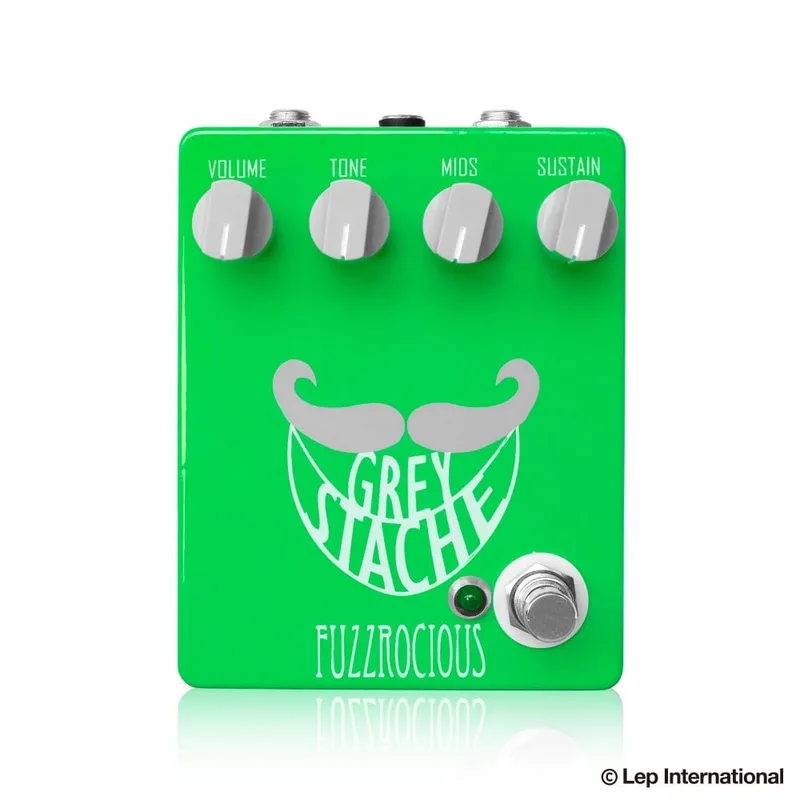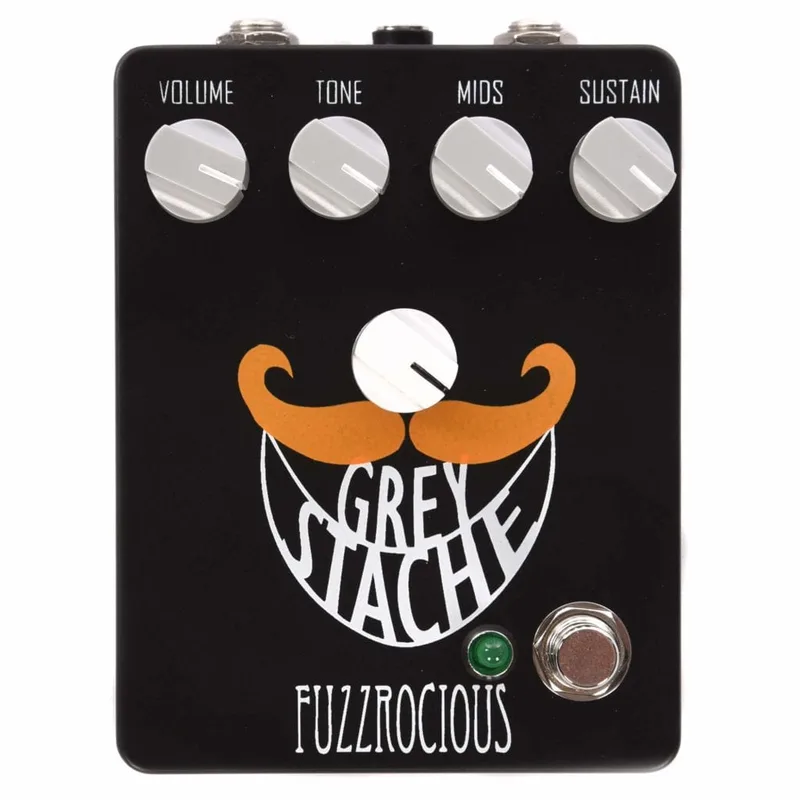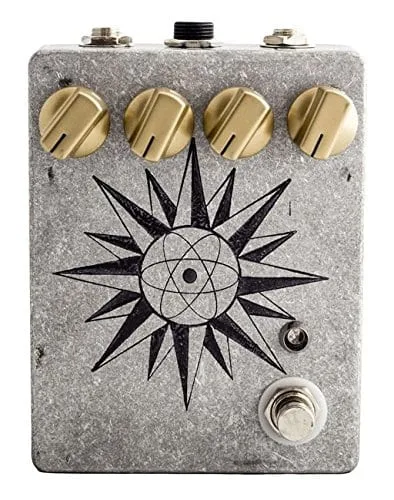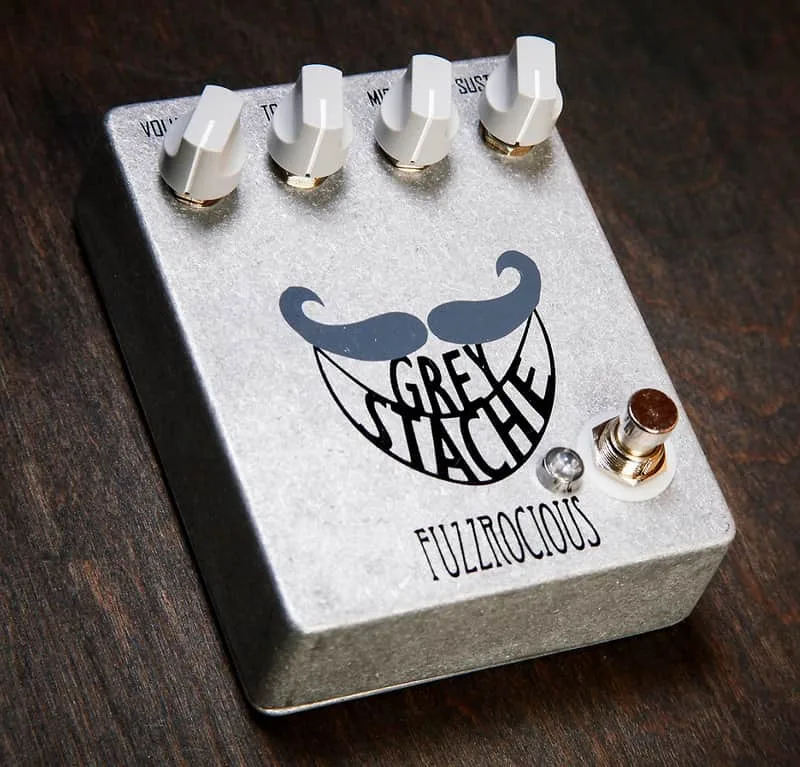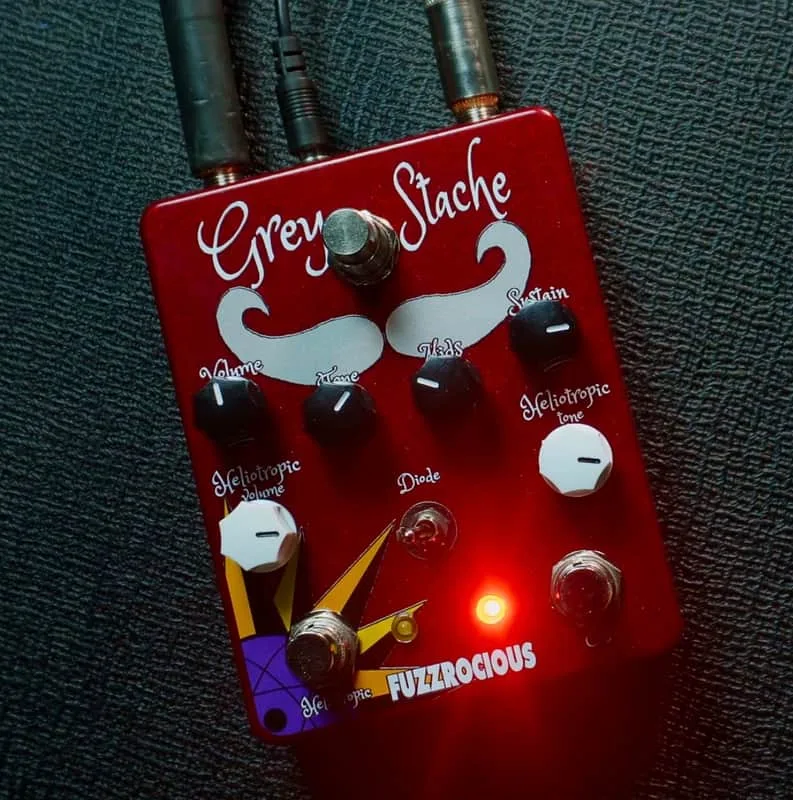



The Fuzzrocious Gray Stache/Heliotropic is a double fuzz pedal that puts two of the maker's fuzz designs in one enclosure, with top-mounted jacks for its inputs1. It belongs to a family of Gray Stache variants that includes the Gray Stache Civil War Era Muff, the Gray Stache with Clean Blend Mod and the Gray Stache with Octave Jawn Mod, alongside the standalone Heliotropic.
What it does to your sound
The two halves behave differently. Delicious Audio's Brent P. Gladless described the split this way: "The Grey Stache is your mids-forward bastard. It's built to cut through a band mix like a switchblade through bologna." The Gray Stache side goes from light crumbly breakup to heavy, aggressive fuzz1.
The Gray Stache circuit itself is based on the GGG-tuned and Civil War versions of a muff fuzz, and RockBoard's PedalPedia describes the result as "creating one versatile guitar AND bass-friendly monster!" The maker also notes that it is more than just a fuzz: dialing back the sustain achieves more of an overdrive sound2. MusicRadar's reviewer Alex Lynham likewise noted it has "been modelled on both the so-called Civil War-era Big Muff" and is intended for use on both bass and guitar3.
The pre-release batch of the double pedal used germanium clipping instead of the standard diode options. Gladless described it as "softer and smoother, but you gotta push the volume to get the feedback to wake up"1.
The controls: three footswitches and a diode toggle
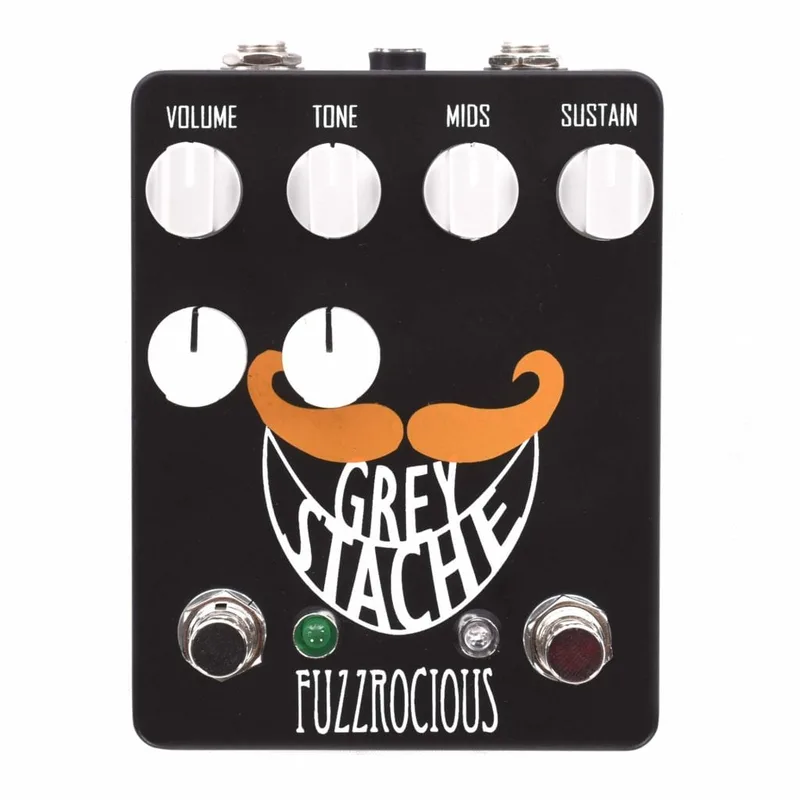
The double pedal's layout is built around three footswitches and a clipping toggle1:
- Right footswitch: turns the whole pedal on and off1
- Left footswitch: brings in the Helio circuit1
- Top footswitch: raised up above the pots so you can find it blind; momentary feedback and oscillation when stomped1
- Diode toggle: gives 1n914, none, or LED clipping1
For stacking the two circuits, Delicious Audio offered a usage tip: "Keep the Grey Stache volume at or above unity. Bump the Helio volume to taste."1
The standalone Gray Stache used a similar diode toggle. Pedal of the Day's Mike B, reviewing a 2014 demo version, described "a three-way toggle switch" giving "3 distinct clipping options to choose from: Silicon, No Diodes and LED," alongside four knobs up top, a mod side toggle, an on/off switch and an oscillation switch on that version43.
Power and connections
The Gray Stache/Heliotropic runs on 9 volts DC with a center negative plug, the common standard for pedalboard supplies1. The standalone Gray Stache's PedalPedia entry lists the same 9V DC center negative requirement2. The jacks are top-mounted, which keeps patch cables tidy on a crowded board1.
History and versions: the Heliotropic and the Gray Stache
Both circuits existed as standalone pedals before Fuzzrocious combined them. The Gray Stache is a fuzz based on the GGG-tuned and Civil War versions of a muff fuzz, which RockBoard's PedalPedia describes as "creating one versatile guitar AND bass-friendly monster!"2. The maker also notes it is more than a fuzz: dialing back the sustain gets you more of an overdrive sound2. The Heliotropic later joined the lineup as its own pedal, and the two now share a housing in the Gray Stache/Heliotropic1.
The Gray Stache/Heliotropic is a 2026 combination of two older Fuzzrocious circuits. The standalone Gray Stache and Heliotropic remain separate products, and the Gray Stache has appeared in several modded versions over the years.
What reviewers said
Reactions to the Gray Stache circuit have been strong on tone and mixed on price. Pedal of the Day's Mike B wrote: "This pedal is nothing shy of a Tyrannosaurus Rex trapped in an overdrive: beefy, chunky, fuzz, driving, meaty, rocking and rad." On the controls, he found "they are all useful, and the more knobs you have, the more detailed you can get with your tone," concluding that if you cannot find a sound you like, you are doing it wrong4.
MusicRadar's Alex Lynham had one reservation about the standalone Gray Stache: "Pricey."3
Videos
collector//emitter
TUNNEL OF REVERB
Patrick Hunter
Questions
What does the top footswitch do on the Grey Stache/Heliotropic?
The top footswitch is raised up above the pots so you can find it blind while playing. It is a momentary switch: hold it down and the pedal produces feedback and oscillation for as long as you stomp. The right footswitch turns the whole pedal on and off, and the left footswitch brings in the Helio side.
What diode options does the Grey Stache/Heliotropic offer?
A diode toggle gives three clipping choices: 1n914 silicon diodes, no diodes at all, or LED clipping. On the standalone Grey Stache, reviewers described the same three-way toggle as shifting the mid response of the pedal between Silicon, No Diodes and LED settings.
What power supply does the Grey Stache/Heliotropic need?
The pedal runs on 9 volts DC with a center negative plug, the standard boss-style supply used on most pedalboards. Use a supply that matches that voltage and polarity.
Can you use the Grey Stache and the Helio together?
Yes. The two circuits sit in one enclosure and can be stacked. Delicious Audio's suggested starting point is to keep the Grey Stache volume at or above unity and then bump the Helio volume to taste.
Where are the jacks on the Grey Stache/Heliotropic?
The jacks are top-mounted, so patch cables run straight down from the top edge of the enclosure. That layout suits tight pedalboards where side-mounted jacks would waste space.
How much did the Grey Stache/Heliotropic cost at launch?
The double pedal launched at $189. For comparison, the standalone Grey Stache was listed at $145, so the combined pedal cost more than the Grey Stache alone but less than the Heliotropic had on its own.
Sources (4)
- New Pedal: Fuzzrocious Grey Stache/Heliotropic Double Fuzz, Delicious Audio, 2026-02-19
- Grey Stache by Fuzzrocious, RockBoard PedalPedia, 2026
- Fuzzrocious Grey Stache w/Diode and Momentary Feedback Mods review, MusicRadar, 2018-10-22
- Fuzzrocious Pedals Grey Stache Fuzz, Pedal of the Day, 2014-10-02