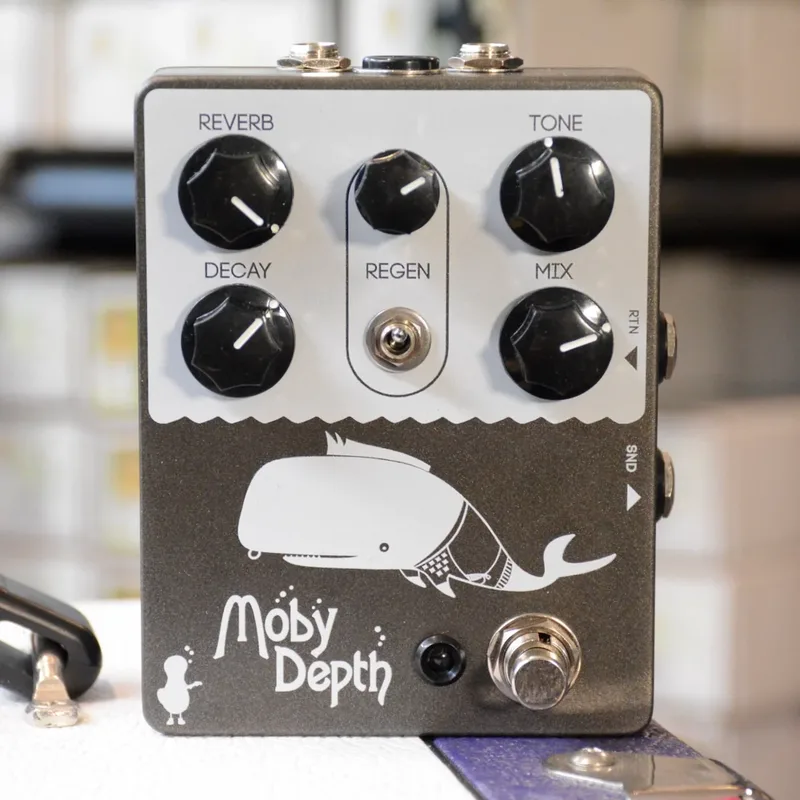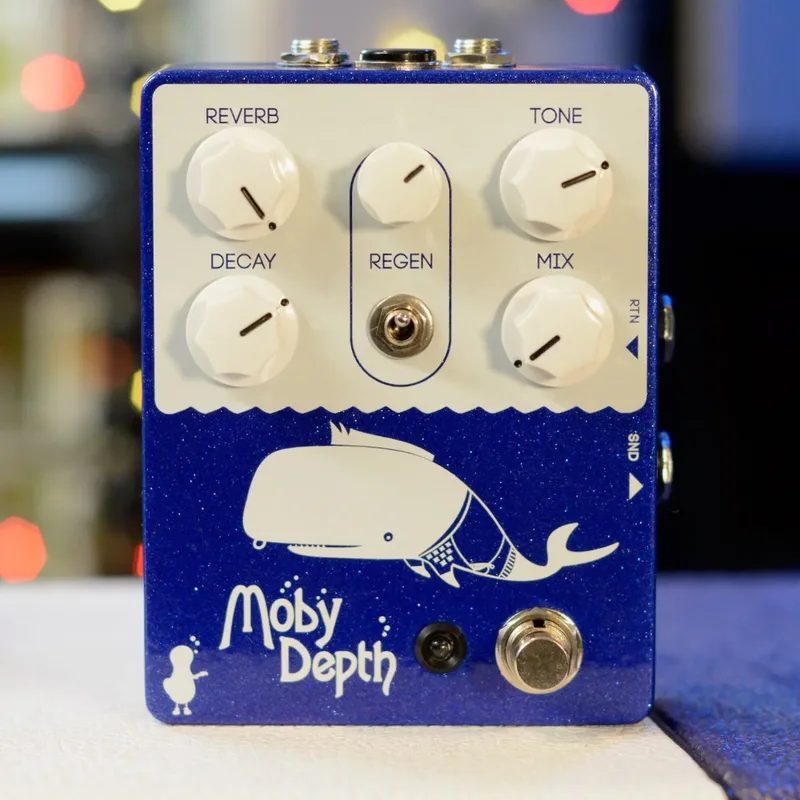
The GUP Tech Moby Depth is a reverb pedal that GUP Tech describes as "basically a spring reverb, but with many adjustments that make it unique among other reverb guitar pedals." It is not a mechanical spring tank: the circuit is built on Accutronics (Belton) digital reverb technology, and Premier Guitar, reviewing the earlier Jonny Rock Gear version of the pedal, called it a spring-reverb emulator driven by a Belton BTDR-3 chip12.
What sets the Moby Depth apart from a basic reverb box is its control set and its insert loop. Alongside the usual decay, tone and mix knobs it has a Regen control that feeds effected signal back into the reverb, and SND and RTN jacks that let you run another effect inside the reverb path. GUP Tech builds every pedal itself in Saguenay, Québec, Canada, and houses the Moby Depth in a powder coated die cast aluminum enclosure1.
How it works: spring sound, digital circuit
The Moby Depth gets its spring character from a Belton digital reverb block rather than a physical spring tank. GUP Tech's product page lists "Accutronics™ (Belton) digital reverb technology" as the basis of the circuit1. Pedal of the Day, reviewing the Jonny Rock Gear Moby Depth Reverb in August 2019, said it "utilizes Accutronics™ (Belton) digital reverb technology, resulting in a lush, exploratory reverb effect"3.
The Moby Depth gets its spring reverb sound from Accutronics (Belton) digital reverb technology1, the same approach used in many compact spring-reverb emulators. For a player, that means spring reverb behavior, including the boing and drip associated with tanks, without the size, weight and microphonics of a real spring assembly, all inside a powder coated die cast aluminum enclosure1.
The controls: Reverb, Decay, Tone, Mix and Regen
GUP Tech's product page gives a short description of each knob1:
| Control | What it does |
|---|---|
| REVERB | Overall volume of the reverb and insert |
| DECAY | Length of the reverb |
| TONE | Brightness control |
| REGEN | Amount of effected signal sent back into the reverb (feedback control) |
| SND | Goes through the input of any effect pedal |
| RTN | Receives output of any effect pedal |
Premier Guitar's review lists the same core set from the player's side: "Other controls: reverb level, decay, tone, and wet/dry mix knobs," alongside the regen feature2. Pedal of the Day described Mix as blending "the wet effected signal with your dry sound," and Tone as "a brightness control, enabling you to shape and sculpt the reverb tone to fit the rest of your rig"3.
The tone control drew specific praise from Premier Guitar, whose reviewer wrote:
"Gosselin's design also deserves kudos for a carefully tuned tone knob that yields warmth or splashiness, minus the treble overload of many spring emulators with wide-ranging, hard-to-dial-in tone controls."2
What Regen does
Regen is a feedback control: it sets how much of the effected signal is routed back into the reverb. Premier Guitar called it "the bonus regen feature (essentially like a delay's feedback function)," part of "a regeneration circuit governed by a toggle and a single knob"2. Pedal of the Day explained the same idea from the player's angle: "Regen to control the amount of effected signal sent back in the reverb," with the toggle switching "Regen on or off, depending on your sonic needs"3.
Pedal of the Day also noted that on the Jonny Rock Gear version, the Regen and Depth controls work together, "with more Depth producing a more powerful, deeper Regen effect"3.
The SND and RTN jacks
The SND and RTN jacks form an effects loop inside the reverb path. SND sends signal to the input of any effect pedal; RTN receives that pedal's output back1. A player can, for example, put an overdrive or modulation pedal in the loop so the reverb itself is shaped by that effect. Pedal of the Day's review of the Jonny Rock Gear version identified the send and return jacks as Neutrik NMJ4HCD2 parts3.
Power, build and where it is made
The Moby Depth runs on a standard 9V AC adapter with a DC output and negative center1, the same center-negative arrangement most pedalboard power supplies use. GUP Tech states that "all of our pedals are made by us in Saguenay, Québec, Canada"1. The enclosure is powder coated die cast aluminum1. As of 26 October 2026 the pedal is listed as re-stocking soon on GUP Tech's site, at a sale price of £123.00 GBP1.
Versions and related pedals
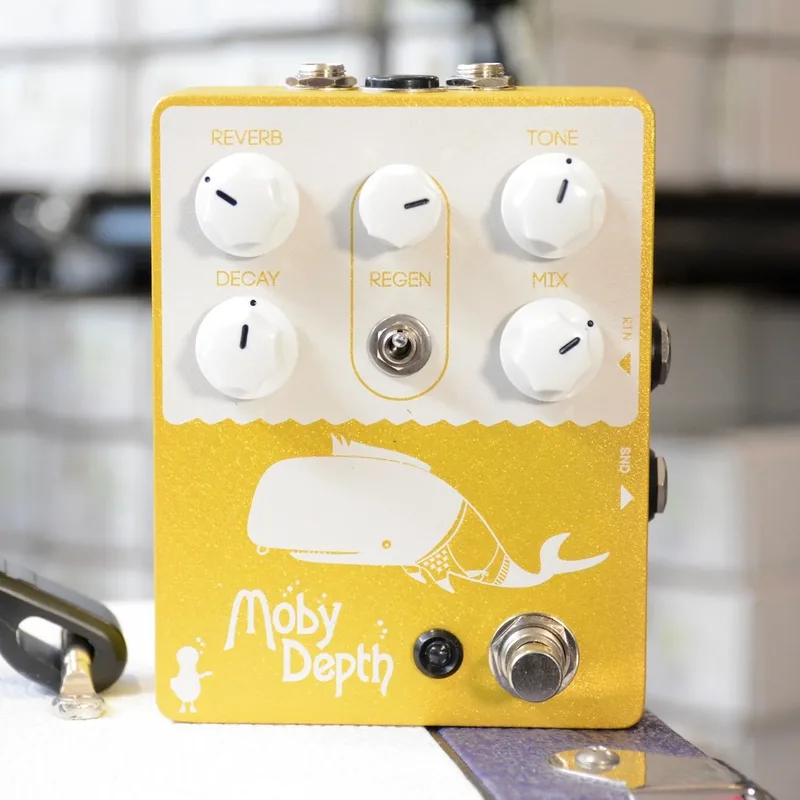
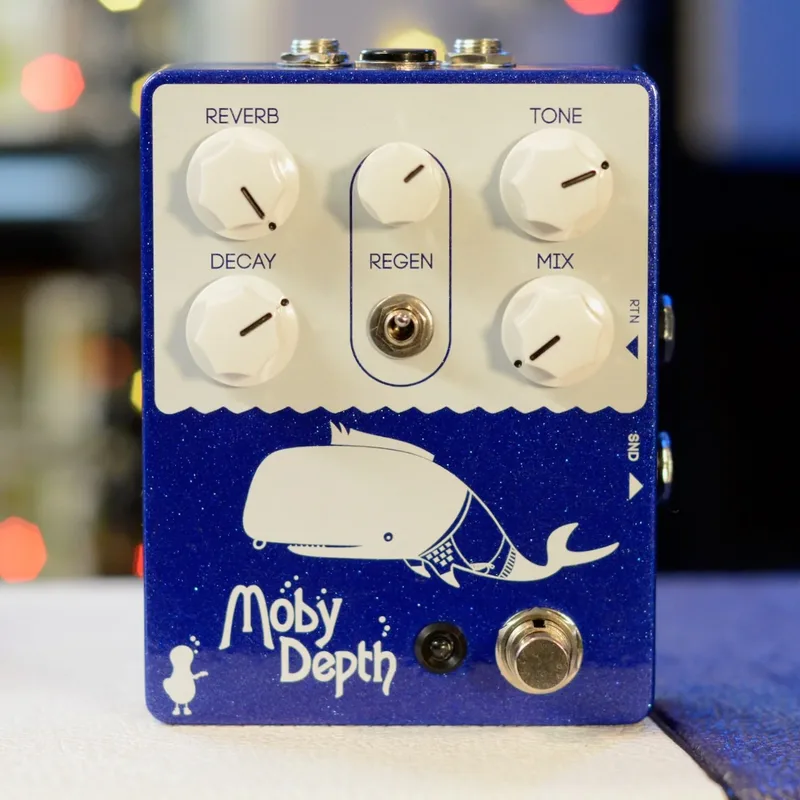
The Moby Depth has appeared in more than one form. The GUP Tech Moby Depth - Douche Edition carries the same control set and spring reverb circuit4, and the GUP Tech Moby Depth Spring Reverb Pedal Gold Rush Edition is "exactly the same circuit as the original, in a super limited Gold box," with pickup available at the GUP Tech shop, usually ready in 24 hours4. The pedal also has a history under the Jonny Rock Gear name, covered on the Jonny Rock Gear Moby Depth page. GUP Tech's reverb line includes the Berry-Verb V2 and the Berry-Verb Douche editions.
Questions
Where is the GUP Tech Moby Depth made?
GUP Tech builds all of its pedals itself in Saguenay, Québec, Canada. The Moby Depth comes in a powder coated die cast aluminum enclosure and is listed on the maker's site as re-stocking soon as of late October 2026.
What does the Regen knob do on the Moby Depth?
Regen controls the amount of effected signal sent back into the reverb, working like a delay's feedback control. Premier Guitar described it as a bonus regen feature, essentially like a delay's feedback function, and Pedal of the Day noted it can be switched on or off with a toggle depending on your sonic needs.
What does the SND jack do on the Moby Depth?
SND is a send output that goes to the input of any effect pedal, paired with an RTN jack that receives that pedal's output. This lets you insert another effect into the reverb path, so the reverb is processed by that pedal rather than the other way around.
What power supply does the Moby Depth use?
It uses a standard 9V AC adapter with a DC output and negative center, the common center-negative arrangement used by most pedalboard power supplies. GUP Tech lists no battery option or current draw figure for the pedal.
Is the Moby Depth a real spring reverb or a digital one?
It is not a mechanical spring tank. GUP Tech describes it as basically a spring reverb but builds it on Accutronics (Belton) digital reverb technology, and Premier Guitar called it a spring-reverb emulator driven by a Belton BTDR-3 chip.
Sources (4)
- Moby Depth Spring Reverb Pedal, GUP Tech (guptech.ca)
- Quick Hit: Jonny Rock Gear Moby Depth Review, Premier Guitar, 2017-04-16
- Jonny Rock Gear Moby Depth Reverb, Pedal of the Day, 2019-08-19
- Moby Depth Spring Reverb Pedal, guptech.ca