

The GUP Tech Tone Plier is a fuzz pedal from Canadian builder GUP Tech, based on the old Tonebender MK1.5 and MKII circuits1. It runs on a matched set of real germanium transistors, the same class of parts that defined the original Sola Sound fuzz boxes of the 1960s, and it offers two voices in one box: an MK1.5 mode and an MK2 mode1. GUP Tech describes it as one of their "pretty violent" fuzzes, with an easy two-knob setup1. The maker's listed price is £77.00 GBP, as stated on the product page1.
What the Tone Plier is and what it does
The Tone Plier is a two-knob germanium fuzz. Volume sets the output level and Attack sets the intensity of the fuzz, which GUP Tech calls an easy setup1. The pedal's two modes come from the two vintage circuits it draws on. In the maker's own words:
"the MK1.5 mode is quite cool, more control and precision than the fuzzy MK2"
So the MK1.5 side is the tighter, more controlled voice, while the MK2 side is the looser, fuzzier one1.
| Control | What it does |
|---|---|
| Volume | Sets the output level1 |
| Attack | Sets the intensity of the fuzz1 |
| Mode | Selects between the MK1.5 voice and the MK2 voice1 |
The two circuits it borrows from are among the most influential fuzz designs ever built. The Tone Bender MK1.5 was, in the words of the fuzz history site Fuzzboxes.org, "an influential two-transistor fuzz box"2, and MusicRadar's Jonathan Horsley describes it as "a fuzz '60s classic that typically deployed a pair of germanium transistors in its circuit"3. The MKII that followed used germanium transistors in a different circuit design, as tru-fi's history of the Tonebender notes4, and Coda Effects' technical analysis puts it plainly: "The MK2 version used two germanium transistors to get fuzzy tones"5. Premier Guitar's Tom Hughes adds that the earliest versions of the Tone Bender used three germanium transistors, like the later MKIV6. The Tone Plier sits right in the middle of that family tree, with the MK1.5's pair of transistors on one side and the MKII's approach on the other.
| Vintage circuit | Transistors | Character |
|---|---|---|
| Tone Bender MK1.5 | Two germanium transistors23 | The tighter, more precise voice GUP Tech puts in the MK1.5 mode1 |
| Tone Bender MKII | Germanium transistors45 | The fuzzier voice GUP Tech puts in the MK2 mode1 |
| Earliest Tone Benders | Three germanium transistors, like the later MKIV6 | The root of the family tree |
Germanium transistors and why they matter here
GUP Tech specifies a "Real Germanium matched transistors set" for the Tone Plier1. That matters for two reasons:
- Germanium parts are what the original Tone Benders used, and they clip and bias differently from the silicon transistors that replaced them in most later fuzzes6.
- Germanium transistors vary widely from unit to unit in gain and leakage, so matching them is how a builder gets consistent behavior out of a vintage-style circuit.
Other makers in the same territory make the same point: BLAMMO! Electronics, for instance, hand selects its NOS germanium transistors "for gain and leakage" for its own point-to-point Tone Bender MKII7.
Germanium fuzz circuits of this type are sensitive to what sits in front of them. GUP Tech says the Tone Plier "can be a bit capricious with buffer and other buffered pedals in front"1. If your board uses buffered bypass pedals, plan to put the Tone Plier first in the chain, or feed it straight from the guitar.
Power and setup
The Tone Plier runs on 9V DC, center negative only, and draws just 2mA1. That is a very light draw, so a single output on almost any pedalboard power supply will run it with room to spare. The center negative polarity is the standard for most modern pedals, but the maker's "only" is worth heeding: a center positive supply could damage it. No battery option is mentioned in the specifications.
- Voltage: 9V DC1
- Polarity: Center negative only1
- Current draw: 2mA1
- Battery: Not listed in the maker's specifications1
The Lab Series #30 Dual Tone Plier
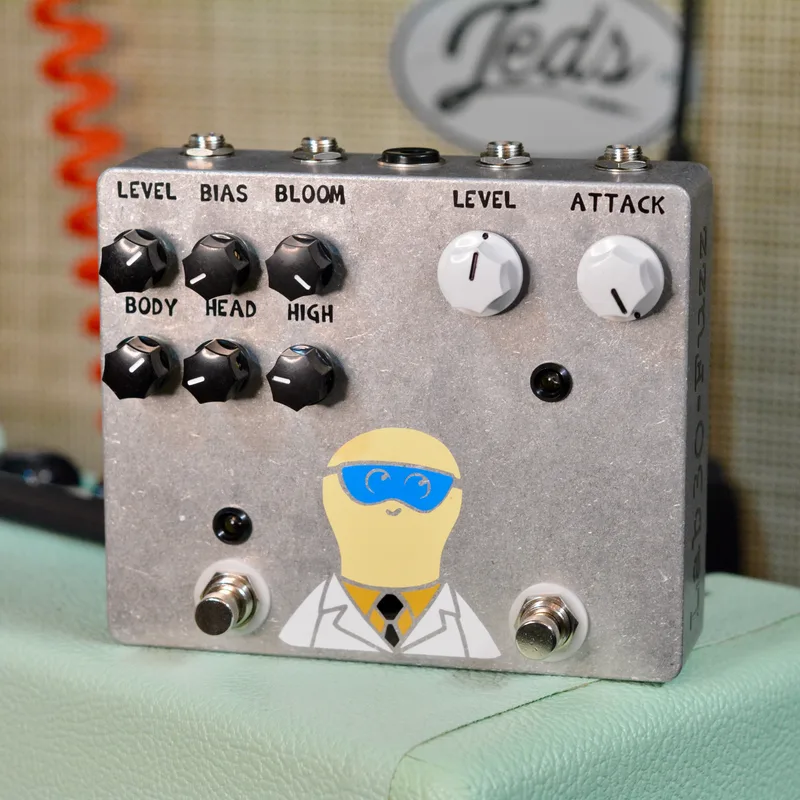
GUP Tech also built the Tone Plier into a larger dual pedal. The Lab Series #30 Dual Tone Plier combines two circuits in one enclosure: the Germanium Tone Plier, based on the Tone Bender MKII and first in the chain, alongside the B(ee) Fuzz8. A send-return jack at the center lets you connect the two circuits in any order, and it is internally jumped when nothing is connected8. As the maker puts it, "If you can't decide between our Germanium Tone Plier or the versatility of the B(ee) Fuzz, our Lab Series #30 includes both"8.
| Tone Plier | Lab Series #30 Dual Tone Plier | |
|---|---|---|
| Circuits | Tone Bender MK1.5 and MKII modes1 | Germanium Tone Plier (Tone Bender MKII) plus B(ee) Fuzz8 |
| Routing | Single fuzz8 | Send-return jack to link the two circuits in any order, internally jumped when unused8 |
How it compares to other Tone Bender takes
The Tone Plier is one of several modern pedals drawing on the MK1.5 and MKII circuits. The Brantone Electronics Tonemaster Mk1.5 Germanium Fuzz is a high end take on the same Tonebender type circuit, built tag-board style with Neutrik jacks and Alpha potentiometers9. In a video on the pedal, Just Nick named it his favorite version of the Tonebender fuzz for its expressiveness and versatility9. On the DIY side, General Guitar Gadgets offers its ToneBender Mark II Professional replica in PNP germanium, NPN germanium, NPN silicon, and PNP germanium with charge pump versions10, and GuitarPCB's Tonebender MKII board even suggests a hybrid build with a germanium Q1 and silicon Q2 and Q311. Within GUP Tech's own range, the Tone Plier's MKII side also appears in the Lab Series #30 alongside the GUP Tech Bee Fuzz8.
Videos
GUPtech
GUPtech
GUPtech
Questions
Does the Tone Plier use real germanium transistors?
Yes. GUP Tech specifies a real germanium matched transistor set for the Tone Plier, which is what gives it the character of the vintage Tone Bender circuits it is based on. Matched transistors matter in a fuzz like this because the gain and leakage of each germanium transistor shape how the circuit biases and clips.
Can the Tone Plier run on a battery?
The maker's specifications list only a 9V DC center negative power input and a 2mA current draw, with no mention of a battery option. At 2mA it is a very light pedal on a power supply, so a single isolated output can run it comfortably.
Does the Tone Plier work after a buffered pedal?
Not reliably. GUP Tech says the Tone Plier can be a bit capricious with buffers and other buffered pedals placed in front of it. This is common with vintage-style germanium fuzz circuits, which generally prefer to see the guitar directly or a true bypass pedal first in the chain.
What power supply does the Tone Plier need?
It needs a 9V DC supply with a center negative plug, and the maker states center negative only. Current draw is just 2mA, so it will run from almost any standard pedalboard power supply. The polarity requirement means a center positive supply should not be used.
Sources (11)
- Tone Plier (Tone Bender MKII Tribute), GUP Tech (guptech.ca)
- Sola Sound Tone Bender 'MK1.5' • Fuzzboxes, Fuzzboxes.org, 2021-05-18
- CopperSound goes super-compact with the revamped Gravity Bomb V2 Clean Boost and Renegade fuzz, MusicRadar, 2022-10-18
- The Sound of Rock, tru-fi.com
- Coda Effects, Coda Effects, 2016-10
- Stompbox Classics: Tone Bender, Part 2, Premier Guitar, 2009-10-21
- P2P Tone Bender MKii, BLAMMO! Electronics
- Lab Series #30, GUPtech (guptech.ca)
- Brantone Electronics Tonemaster Mk1.5 Germanium Fuzz, Delicious Audio, 2018-03-12
- Tone Bender™ MkII Clone: DIY Fuzz Kit, PCB & Schematic, General Guitar Gadgets, 2014-05-15
- PUTB_v2 (1), GuitarPCB.com, 2018-06