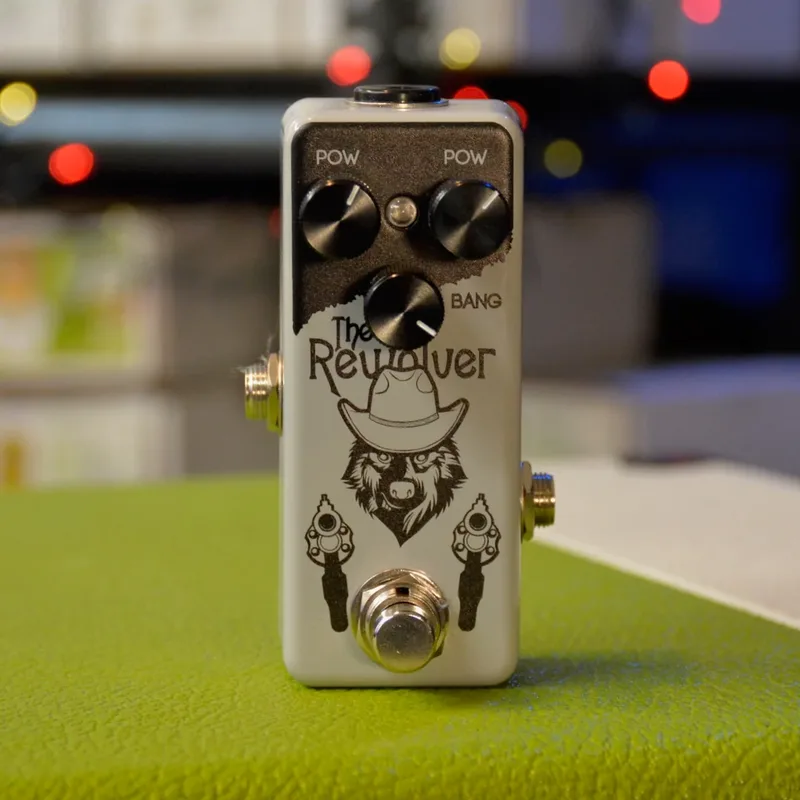
The GUPtech Rewolver is a "multi-fonction JFET Driver": a pedal built around two JFET boosters wired in cascade, with a Master Volume over the pair. GUPtech positions it as a boost or an overdrive, suggesting it "as a Boost or as an Overdrive in the beginning of your effect chain, or use it as a clean boost at the end"1. It sits among the builder's boost-oriented pedals alongside the GUPtech Peeps Clean Boost, the GUPtech Slime Mid-Boost and the GUPTech FrAG Boost.
How it works
The circuit is two boosters in a row, each feeding the next, with a single Master Volume controlling the output. GUPtech names the controls after the effect they have on the signal1:
| Control | What it does |
|---|---|
| POW | JFET Driver Boost/Volume1 |
| POW | JFET Driver Boost/Volume1 |
| BANG | Master Volume over both boosters1 |
Because the stages are JFET transistors rather than an IC, pushing them adds saturation from the transistors themselves. GUPtech describes the result this way1:
"Turning up the Boosters give you a sweet saturation from the transistors, and the Master Volume makes the amp break up."
That amp break up is what blurs the line between boost and overdrive: with the Master Volume high, the pedal drives the front of the amp, and with it low it acts as a clean boost. For more on the difference between the two roles, see Boost Pedals and Overdrive Pedals.
Using it
GUPtech suggests three placements: as a boost, as an overdrive at the start of the chain, or as a clean boost at the end1. A player quoted on the product page, Jordan Alegant, describes a fourth use:
"I've been using it as a light overdrive / distortion after a clean boost and it's divine."
Power and hardware
The Rewolver runs on 9V power with DC negative center polarity, and GUPtech lists compatibility with a standard 9V adaptor; the same page also describes it as 9V AC adaptor compatible1. Power consumption is listed at 2mA1, low enough that it should not strain a shared power supply output. The pedal is housed in a powder coated die cast aluminum enclosure1.
The maker's page gives the price in British pounds, £82.00 GBP, even though GUPtech is a Canadian builder1.
Questions
Is the Rewolver a boost or an overdrive?
GUPtech describes it as both: a multi-function JFET Driver that can be used as a boost or as an overdrive at the beginning of an effect chain, or as a clean boost at the end. Turning up the two boosters produces saturation from the JFET transistors, and the Master Volume can push the amp into break up, so where you place it and how far you turn it up decides which role it plays.
What polarity does the Rewolver's power supply use?
The Rewolver runs on DC negative center power and is compatible with a standard 9V adaptor, according to GUPtech's product page. GUPtech also lists it as 9V AC adaptor compatible, so the page gives both AC and DC adaptor compatibility.
How much current does the Rewolver draw?
GUPtech lists power consumption at 2mA, which is very low by pedal standards and means almost any standard pedalboard power supply output can run it.
What is the Rewolver's enclosure made of?
The pedal is housed in a powder coated die cast aluminum enclosure, the standard rugged pedal format.
Does the Master Volume make the amp break up?
Yes, according to GUPtech. The maker says that turning up the boosters gives a sweet saturation from the transistors, and that the Master Volume makes the amp break up.
Sources (1)
- The Rewolver, GUPtech (guptech.ca)