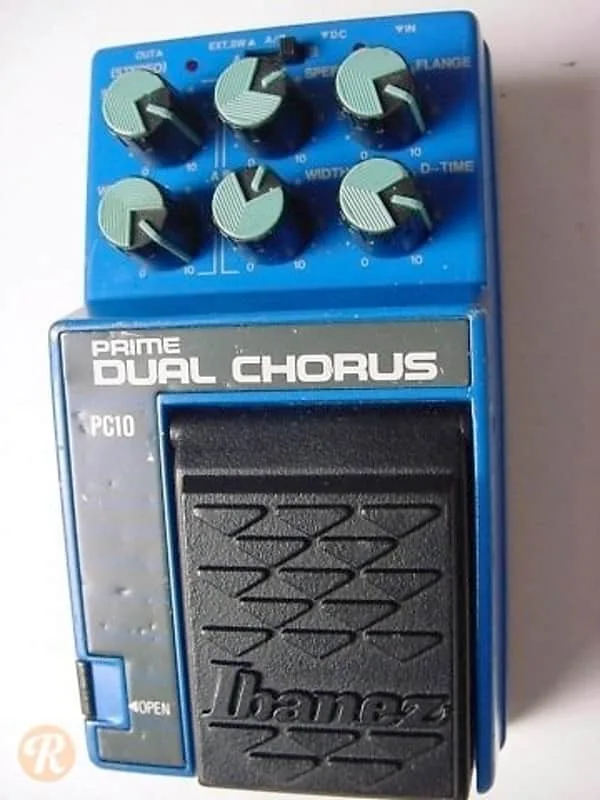


The Ibanez PC10 Prime Dual Chorus is an analog chorus and flanger pedal from Ibanez's Power Series, produced from 1986 to 19931. What sets it apart from a standard chorus is that it carries two completely separate modulation sections in one housing, so a player can set up two different modulation sounds and move between them from the top of the pedal21. Ibanez pitched it as a way to get both chorus and flanger in a single purchase: "For just about the price of either you can have both in the new Ibanez PC10"2.
Like the Ibanez TC10 Twin Cam Chorus, the PC10 is a chorus with two modulators, or LFOs1. One of the modulators can also create flanging effects by decreasing delay time and increasing intensity, which is how the pedal covers both effect types1.
Two modulation sections and the A, B and A/B modes
The core idea of the PC10 is that its two modulation sections are completely independent, each with its own settings, and you choose how to use them21. A top mounted A/B switch selects between the two sections, and an optional external footswitch can be plugged into a dedicated jack to do the same thing from a distance21.
How the pedal's own footswitch behaves depends on which mode you are in1:
| Mode | Footswitch action |
|---|---|
| A | Toggles between effect A and dry signal |
| B | Toggles between effect B and dry signal |
| A/B | Alternates between effect A and effect B |
That A/B mode is the interesting one for a live player: instead of switching an effect on and off, the pedal jumps between two fully different modulation sounds, which is closer to how a channel-switching amp works than a conventional chorus pedal1.
Stereo output
The PC10 is true stereo. It has a stereo output jack that, when accessed with a 1/4 inch stereo plug, gives both the normal and the inverted effect output, enabling you to play in true stereo21. Run into two amps, the normal and inverted outputs spread the modulated signal across the stereo field, which is where a dual-modulator design like this has the most room to show what it can do.
How it compares with the TC10 Twin Cam Chorus
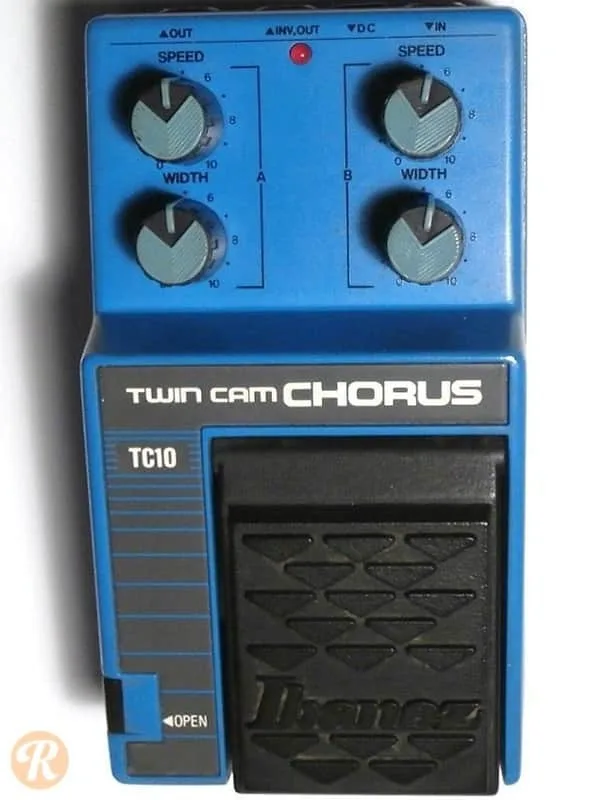
The PC10's closest relative in the Power Series is the TC10 Twin Cam Chorus, which shares the same dual modulator chorus design1. The TC10's approach to its two modulators is described in terms of roles: use modulator A for true vibrato and high speed pitch bends, and modulator B for normal chorusing effects, either separately or mixed together for unique sweeps and complex patterns3.
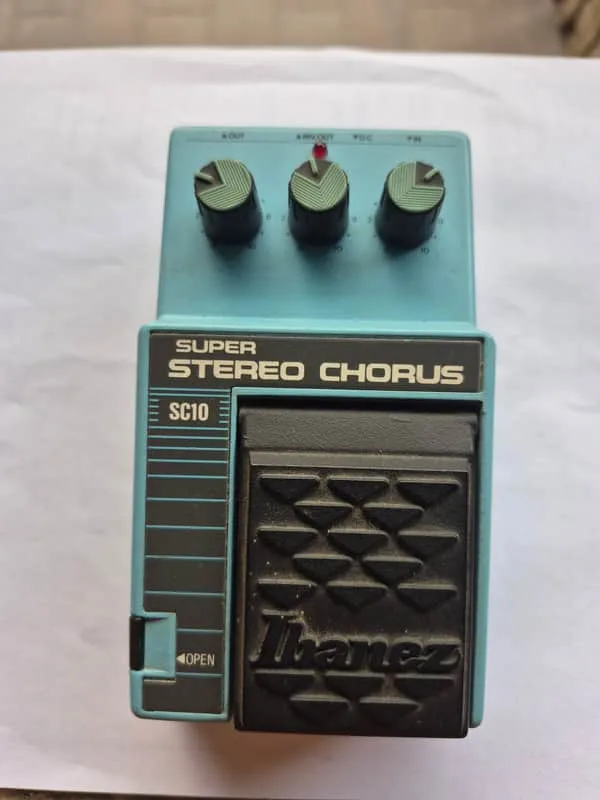
ToneHome describes the TC10's dual-modulator sound as an improvement over the single-modulator Ibanez SC10 Super Stereo Chorus3:
"the TC10 allows deeper and more realistic chorusing than the SC10 without as much chance of offensive side effects such as phase shifts (causing amplitude drops at regular intervals), out of tune notes or chords and periodic sweeps unrelated to the tempo of the music."3
ToneHOME3
The same logic applies to the PC10's sound. ToneHome describes the PC10's dual chorusing with variations, including flanging from modulator B, as "some of the most lush sounds available through processing"1.
Where it came from and where to find one
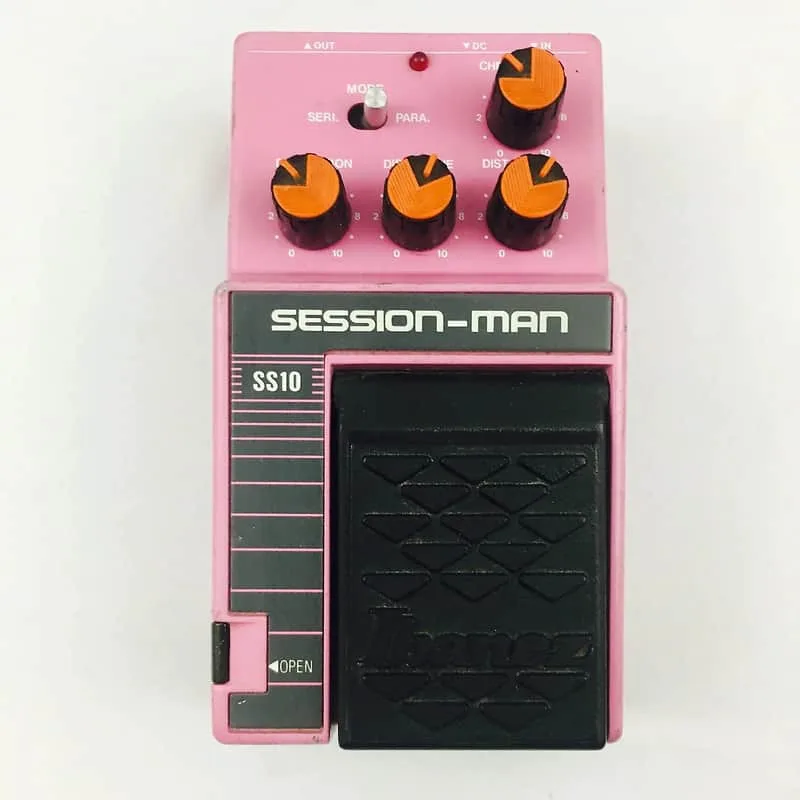
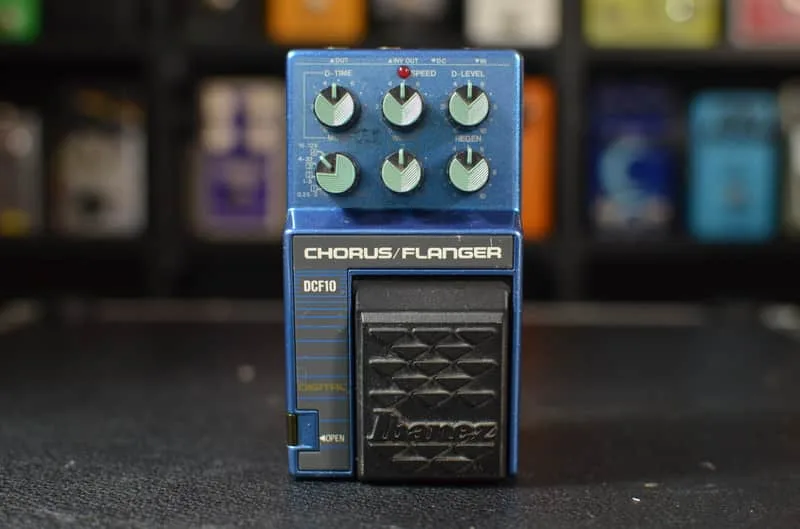
The PC10 belongs to Ibanez's Power Series, the 1980s range that also included the Ibanez SS10 Session-Man and the Ibanez DCF10 Digital Chorus/Flanger. A Power Series pocket manual dated September 1987 lists the PC10 Prime Dual Chorus in the range, and the unit was built in Japan1.
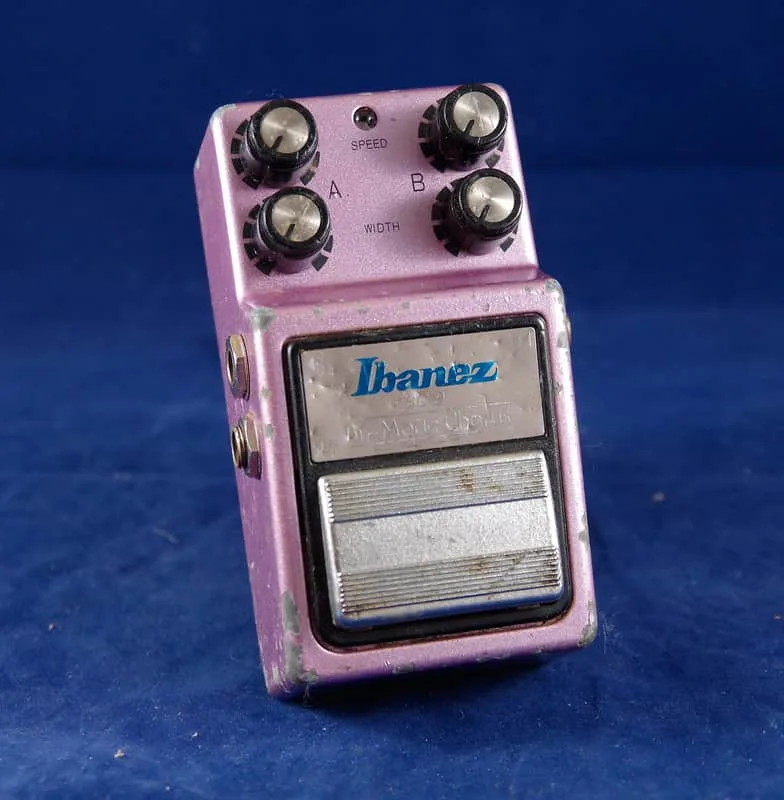
Production ran from 1986 to 1993, and the pedal has never been reissued1. ToneHome lists its availability as rare and its collectibility as average1, so a player who wants one is shopping the vintage market, where Power Series chorus pedals from this era, like the Ibanez BC9 Bi-Mode Chorus and the Ibanez CS9 Stereo Chorus, also circulate. Players wanting a new Ibanez chorus today are served instead by compact options such as the Ibanez CSMINI.
Videos
LongFallBoots
Six string to rock
Manuel Bastian
Questions
What is the difference between A, B and A/B modes on the Ibanez PC10?
The PC10 has two separate modulation sections, A and B. In A mode the footswitch toggles between effect A and dry signal; in B mode it toggles between effect B and dry. In A/B mode the footswitch alternates between effect A and effect B, so you can jump between two different modulation settings without touching the knobs.
Is the Ibanez PC10 true stereo?
Yes. The PC10 has a stereo output jack that, when accessed with a 1/4 inch stereo plug, gives both the normal and the inverted effect output, enabling true stereo operation. With a standard mono plug you get the normal single output.
Was the Ibanez PC10 Prime Dual Chorus ever reissued?
No. The PC10 was produced from 1986 to 1993 and has not been reissued. ToneHome lists its availability as rare and its collectibility as average, so finding one means searching the vintage used market rather than buying a new unit.
Where was the Ibanez PC10 made?
The PC10 was made in Japan. It belongs to the Ibanez Power Series of the late 1980s, and a 1987 Power Series pocket manual lists the PC10 Prime Dual Chorus among the range's Japanese-built effects.
Can the PC10 be switched with an external footswitch?
Yes. The two modulation sections can be accessed either by the top mounted A/B switch or by plugging an optional footswitch into the unit's footswitch jack, which lets you change sections mid-performance without reaching down to the pedal.
Sources (3)
- TONEHOME, TONEHOME - the World of Vintage Guitar Effects Pedals, 1987
- PC-10 Prime Dual Chorus by Ibanez, RockBoard PedalPedia, 2026
- TONEHOME, TONEHOME