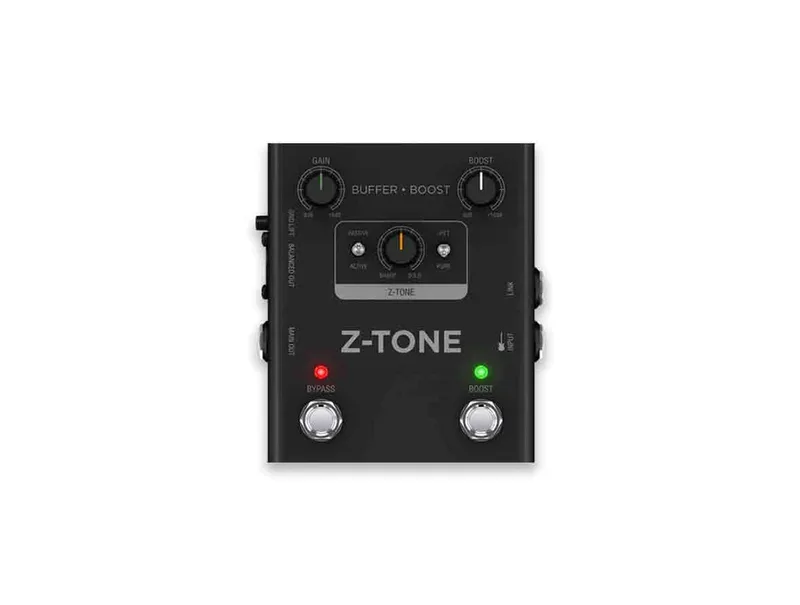


The IK Multimedia Z-Tone Buffer Boost is an analog pedal that combines a preamp, buffer, clean boost and active DI box in one compact metal enclosure1. IK Multimedia describes it as combining "professional tone shaping, buffering, DI and clean boost in one compact pedal for guitar"1. Its distinguishing feature is the Z-TONE impedance circuit, a variable input impedance that changes how your pickups respond, alongside a choice of PURE and JFET input stages for transparency or added harmonics1.
For a player with a long pedalboard or cable runs, the buffer keeps the signal strong to the amp, and the balanced XLR output lets the same pedal feed a mixing desk or recording interface as a DI12. The pedal was launched at NAMM 2020 alongside the Z-TONE DI3.
IK Multimedia's site lists the Z-TONE Buffer Boost as sold out4. At launch it was offered for $169.992; Guitar World's review and Premier Guitar both list it at $14935.
A buffer, clean boost and DI in one pedal
The Z-Tone Buffer Boost is built around what IK Multimedia calls an ultra low noise, high bandwidth and ultra low distortion preamp, buffer and direct box, with a boost control and variable gain and input impedance1. Two footswitches control it: one bypasses the pedal entirely, the other engages the boost function6.
The boost side works through the Gain knob and the second footswitch, which can bring in up to 10dB of clean boost3. The Gain control itself ranges from -8dB to +8dB, and the boost range runs from 0dB to +10dB1.
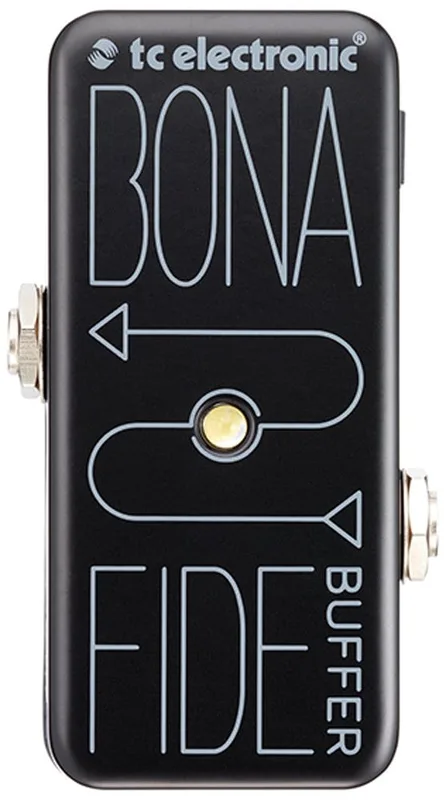
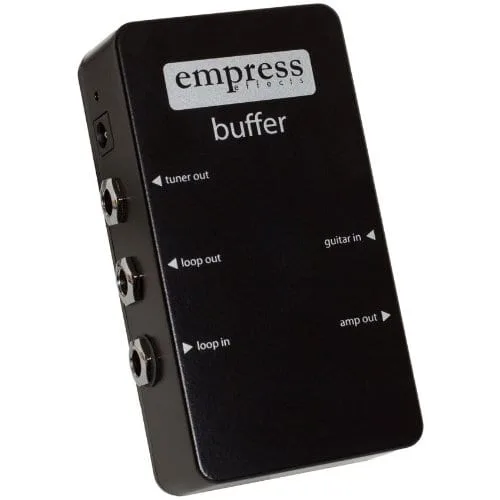
As a buffer, it provides a buffered signal for longer pedalboards and cable runs, which is the same job done by dedicated units like the TC Electronic Bonafide Buffer or the Empress Effects Buffer. What sets it apart from most of those is the DI output and the impedance control, which come from its heritage in IK Multimedia's audio interfaces3.
Guitar World's reviewer Trevor Curwen concluded that "the Z-Tone Buffer Boost packs a massive amount of utility in one pedal. It's an asset for your pedalboard with practical" recording capabilities3.
Controls
| Control | What it does |
|---|---|
| Gain knob | Sets the gain, from -8dB to +8dB, and the boost level up to +10dB13 |
| Z-TONE knob | Varies the input impedance, from 1MΩ down to 2.2kΩ in passive mode17 |
| PURE/JFET toggle | Selects the input stage: PURE for transparency, Class-A JFET for added harmonics17 |
| Active/passive toggle | Adapts the pedal to active or passive instruments75 |
| Footswitch 1 | Bypasses the pedal entirely6 |
| Footswitch 2 | Engages the boost function6 |
PURE and JFET input stages
The two input stages are the tonal heart of the pedal. IK Multimedia describes them as offering "a choice between transparency and added harmonics"1. PURE is the clean path: IK Multimedia measures total harmonic distortion at the balanced output (1kHz, +4dBm input) at 0.0033% in PURE mode. The JFET stage, a Class-A input buffer activated by its own toggle1, measures 0.2% THD under the same conditions, which is the added harmonic content players would choose it for1.
Power and connections
The pedal can be powered three ways: a 9V battery, an external 9VDC supply with positive outside polarity (not included), or +48V phantom power on the balanced XLR output from a desk or interface1. Running on phantom power also raises the headroom: maximum input level before clipping is +13dBm when powered by 48V phantom, and +9dBm when powered by a 9V battery1.
Connections are a standard guitar input, a standard main output, a standard Link output and a balanced XLR output3. The unbalanced output impedance is 56Ω and the balanced output is 600Ω1.
The external DC power requirement is 9VDC with positive outside polarity, the opposite of the center-negative standard used by most pedal power supplies, and the supply is not included. A 9V battery or phantom power avoids that mismatch1.
Specifications
| Specification | Value |
|---|---|
| Frequency response | 5Hz to 30kHz, -1dB1 |
| Dynamic range | Better than 114dB(A) for both outputs, input gain at 0dB1 |
| Phase deviation | 0° +/-10° from 20Hz to 20kHz1 |
| Input impedance (passive mode) | Variable from 1MΩ down to 2.2kΩ1 |
| Input impedance (active mode) | Approx. 20kΩ1 |
| I/O gain | Unitary from input to both outputs with Gain at 0dB and Z-TONE at the SHARP position1 |
| Size | 10.8cm/4.25" x 12cm/4.72" x 5.8cm/2.28"1 |
| Weight | 600g/21.2oz1 |
| Made in | Italy3 |
From the AXE I/O interface
The Z-Tone Buffer Boost did not start from scratch. Guitar World's review explains that IK Multimedia's AXE I/O audio interface "has now spawned two smaller utility units, the Z-Tone Buffer Boost and Z-Tone DI," carrying over the interface's enhanced gain-staging and tonal adjustment without the USB audio capability3. The Z-TONE impedance technology itself was the feature IK Multimedia built the pedal around at its NAMM 2020 launch1.
What reviewers said
Guitar World's Trevor Curwen found the pedal "packs a massive amount of utility in one pedal" and called it "an asset for your pedalboard" with practical recording capabilities3. Premier Guitar's review noted the switches for accommodating active or passive pickups and listed the street price at $1495.
Videos
ikmultimedia
ikmultimedia
ikmultimedia
News
Questions
Is the IK Multimedia Z-Tone Buffer Boost true bypass?
Yes. IK Multimedia lists the pedal as true bypass, so with the pedal disengaged the signal passes through without buffering. One footswitch bypasses the pedal entirely, while the second engages the boost function.
What does the Z-Tone knob do?
The Z-Tone knob adjusts the input impedance of the pedal's variable impedance circuit. In passive mode it varies from 1MΩ down to 2.2kΩ, which changes how your pickups respond and how the top end feels. IK Multimedia describes it as a way to change how your pickups respond.
Can I use the Z-Tone Buffer Boost as a DI box for recording?
Yes. It is an active DI as well as a buffer and boost, with a transformer-based galvanically isolated balanced XLR output that accepts +48V phantom power from a mixing desk or audio interface. Guitar World's reviewer called it an asset for your pedalboard with practical recording capabilities.
What is the difference between the PURE and JFET modes?
PURE and JFET are the two input stages. PURE aims for total transparency, with measured total harmonic distortion of 0.0033% at the balanced output, while the Class-A JFET stage adds harmonics, measuring 0.2% THD under the same conditions. A toggle switch selects between them.
Does the Z-Tone Buffer Boost work with active pickups?
Yes. A toggle switch adapts the pedal to active or passive instruments. With the Z-TONE circuit set to active mode the input impedance is approximately 20kΩ; in passive mode it is variable from 1MΩ down to 2.2kΩ.
Sources (7)
- Z-TONE Buffer Boost, IK Multimedia
- IK Multimedia seeks to optimize the feel and tone of your guitar with the Z-Tone Buffer Boost pedal, Guitar World, 2020-06-25
- IK Multimedia Z-Tone Buffer Boost & Z-Tone DI review, Guitar World, 2020-10-01
- TONEX Capture, IK Multimedia
- IK Multimedia Z-Tone Buffer Boost Review, Premier Guitar, 2020-11-30
- IK Multimedia announce the Z-Tone Buffer Boost DI Pedal, Guitar.com, 2020-06-25
- NAMM 2020: IK Multimedia Z-TONE buffer boost and Z-TONE DI, gearnews.com, 2020-01-17