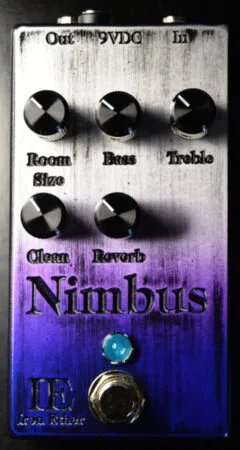


The Iron Ether Nimbus is a reverb pedal designed specifically for bass and baritone instruments. Iron Ether describes it as a high quality reverb that allows for "deep and powerful reverbs to be created, with a built-in highpass filter on the reverb signal to keep the" instrument's low end intact without muddiness, plus a lowpass filter for darker timbres1. The clean signal stays analog throughout the signal path, so your dry tone is never converted, and the maker says the simple interface lets you sculpt complex reverb sounds intuitively rather than being locked to presets or pre-defined tonalities1.
The pedal lists at $295.002. Each unit is individually machine-engraved and hand-finished, so no two look exactly alike, though they are painted in the same style and color scheme as pictured2. A Special Edition, the Nimbus SE, adds expression controls and a different look at $325.003.
What the Nimbus does for your sound
Because it was built with bass and baritone in mind, the Nimbus handles low frequencies differently from a typical guitar reverb. The reverb signal passes through a built-in highpass filter, which removes the lowest frequencies from the wet signal so long decays do not turn muddy or blur the notes you are playing. A lowpass filter on the other end lets you darken the reverb's timbre when you want a more distant, washy character1. Your clean signal has its own volume control and remains analog the whole way through the pedal1.
The range runs from small practice rooms to massive concert halls with long ambient decay, and with the filter defeated, approximately infinite decay time is possible1. At the far end of that range sits Infinite mode, covered below.
The controls
The Nimbus keeps its control set small, with each knob doing real work across the whole reverb sound1.
| Control | What it does |
|---|---|
| Clean | Controls the volume of the clean signal, which remains analog throughout the signal path1 |
| Room Size | Controls the size of the reverberating space, continuously variable from small practice rooms to massive concert halls with long ambient decay; with the filter defeated, approximately infinite decay time is possible1 |
| Bass | Controls the level of low frequencies within the reverb's feedback path; turns off at minimum to allow full-range reverb1 |
The Bass knob is worth a closer look for bass players. Because it shapes the low end inside the reverb's feedback path rather than on your dry signal, turning it down thins the reverb itself while your fundamental stays untouched. At its minimum position the control switches off completely, giving you full-range reverb when you want the whole spectrum in the wash1.
Infinite mode
Turning Room Size, Bass, and Treble all the way clockwise sets the Nimbus into Infinite mode1. In this mode the decay extends to approximately infinite, so a note you play sustains and rings out indefinitely. This is the pedal's route to ambient pads and drones: hold a chord or a low note, engage Infinite mode, and the reverb keeps it alive while you play over the top. The maker notes that with the filter defeated, approximately infinite decay time is possible through the Room Size control as well1.
Power, size and placement
The Nimbus runs on an industry-standard 9 volt DC center negative power supply and draws 85mA1. That is a modest draw for a reverb pedal, well within what a typical isolated pedalboard power supply provides, though it is more than a simple analog overdrive, so plan accordingly if you daisy-chain. The pedal measures 4.7″ x 2.5″ (12cm x 6.3cm), a compact footprint that leaves room on small boards1.
The Nimbus SE
The Nimbus Special Edition takes the liquid and deep reverb of the Nimbus and adds expression features4. Its most notable control assignment is called "Size": when the expression input is assigned to Size, it controls the Room Size, Bass, and Treble simultaneously, taking the pedal from a small, subtle room sound up to infinite-hold pads4. With this assignment you can set up a second reverb sound using the Exp knob and toggle between the two, and at maximum the pedal goes to infinite reverb times to hold a note infinitely4. Activating the Exp switch sets Room Size, Bass, and Treble all to maximum, creating a nearly infinite, cavernous sound4.
The SE also differs in hardware and appearance:
- Black face-plate with gold-plated copper lettering5
- Color-changing back-lit LED showing bypass and expression pedal/switch status5
- Expression pedal/switch input, with status shown by the LED5
- All jacks located at the top of the pedal to save pedalboard space4
- Same 9V DC center negative power and 85mA draw as the standard Nimbus4
- Same 4.7″ x 2.5″ (12cm x 6.3cm) dimensions4
The SE lists at $325.003. Its bypass arrangement is also more flexible than a simple true bypass: the standard bypass stomp switch gives true bypass, and the Exp stomp switch can be used as a silent "trails" bypass when assigned to "In Lvl" at other than infinite reverb times, so the last notes played before bypassing ring out rather than cutting off4.
A related pedal from another maker
Maneco Labs builds a pedal called the Small Nimbus, which the maker lists with an Oliverb mode6. It is a separate product from a different company, not a version of the Iron Ether pedal, but the shared name comes up in searches and is worth distinguishing.
Videos
Prymaxe
Justin Goodman
SzymanskiBass
Questions
What does Infinite mode do on the Iron Ether Nimbus?
Turning the Room Size, Bass, and Treble knobs all the way clockwise puts the Nimbus into Infinite mode. In this mode the reverb decay extends to approximately infinite, so notes you play ring out and sustain indefinitely, which is useful for ambient pads and drones. On the standard Nimbus this is reached with the knobs themselves; the SE can also reach it through its expression controls.
What does the Bass knob do on the Nimbus?
The Bass knob controls the level of low frequencies within the reverb's feedback path. Turning it down thins out the low end of the reverb itself, while your dry signal is unaffected. At its minimum position the control turns off entirely, allowing full-range reverb.
How much current does the Iron Ether Nimbus draw?
The Nimbus draws 85mA. It runs on an industry-standard 9 volt DC center negative power supply, the same type used by most modern pedals, so it works with common pedalboard power supplies. The Nimbus SE draws the same 85mA.
What is the Iron Ether Nimbus SE?
The Nimbus Special Edition is a variant of the Nimbus with the same liquid, deep reverb plus expression features. Its Exp controls can be assigned to a Size setting that moves Room Size, Bass, and Treble together, letting you toggle between two reverb sounds or hold a note infinitely. It has a black face-plate with gold-plated copper lettering and a color-changing back-lit LED, and lists at $325.00.
How big is the Iron Ether Nimbus?
The Nimbus measures 4.7 inches by 2.5 inches, or 12cm by 6.3cm, about the size of a compact mini-style pedal. The Nimbus SE is the same size. All of the SE's jacks are located at the top of the pedal to save pedalboard space.
Is the Iron Ether Nimbus SE true bypass?
Yes. The Nimbus SE uses true bypass through its standard bypass stomp switch. It also offers a silent trails bypass: when the Exp stomp switch is assigned to In Lvl at settings other than infinite reverb times, it acts as a trails bypass, so the last notes played before bypassing ring out rather than cutting off abruptly.
Sources (6)
- Nimbus - Iron Ether, Iron Ether
- Nimbus - Iron Ether, Iron Ether
- Arcing Prisms, Iron Ether
- Nimbus SE, Iron Ether
- Nimbus SE, Iron Ether
- Pedal: Small Nimbus, Maneco Labs