

The Jackson Audio Golden Boy is a transparent overdrive pedal designed in collaboration with Joey Landreth of The Bros. Landreth. Jackson Audio describes it as the company's most versatile and transparent overdrive, built on the Bluesbreaker/King of Tone circuit for an open, uncompressed sound1. Alongside the drive circuit it carries a separate MOSFET boost, the same type of boost as the AMP mode in Jackson Audio's PRISM Preamp, and a studio-grade three-band EQ based on the Baxandall circuit1.
The pedal launched at $2992 and MusicRadar has called it Jackson Audio's best-selling pedal so far3. It is made in the USA4 and sold new in a gold finish, with the maker's page listing a shipping lead time of 3 to 4 weeks5.
What it does to your sound
The drive side is based on the Bluesbreaker/King of Tone circuit, which Jackson Audio says produces a tone that is "very open, uncompressed and transparent sounding", pointing players toward John Mayer overdriven tones as a reference1. Four clipping diode presets change the character of that drive, and level-matching circuitry keeps the output volume constant when you switch between them1.
The EQ is a three-band active Baxandall design. Each band is flat at 12:00 with ±12dB of boost or cut on either side of center, center detents on the pots, and a mid frequency centered around 660Hz15.
The controls and footswitches
The Golden Boy has independent footswitches for drive and boost4. The knobs cover gain, the three EQ bands, and a BOOST knob that sets the amount of boost when the boost footswitch is engaged1.
The footswitches do more than turn circuits on and off:
- DRIVE footswitch: a quick tap cycles clipping presets; press and hold for more than 1 second to enter clipping program mode1.
- BOOST footswitch: a quick tap cycles boost presets; press and hold for more than 1 second to enter boost program mode1.
- Both footswitches together: each simultaneous press advances the GAIN CYCLE by 25% of the gain knob's value, up to 100%, with the LED getting brighter at each step (50%, 75%, 100%)1.
An internal jumper on the boost circuit selects between STND BOOST, which has no noise but about 5% less gain at the highest setting, and ALT BOOST, which gives 100% gain at the cost of some knob crackle1.
Four clipping presets
The four clipping presets each use a different diode arrangement, and Jackson Audio says they drastically alter the tone and feel of the pedal1.
| Preset | LED | Clipping | Character |
|---|---|---|---|
| GREEN, Classic Screamer | Green | Two symmetrical silicon diodes | Classic drive and compression like the Tube Screamer1 |
| MAGENTA, Asymmetric | Magenta | Three asymmetric silicon diodes | Clips top and bottom of the waveform differently for a more complex tone1 |
| BLUE, Symmetrical | Blue | Four symmetrical silicon diodes | More focused and direct tone, as in the Timmy and King of Tone1 |
| AMBER, Vintage Marshall | Amber | Two red LEDs, symmetrical | Much higher headroom, like a vintage Marshall1 |
The maker's product page summarizes the four voices as GREEN "tight and mid-forward", MAGENTA "responsive and harmonically rich", BLUE "focused with more headroom", and AMBER "open and amp-like"5.
Four boost presets
The boost is a MOSFET circuit in its own true bypass loop, so it can be used independently of the drive circuit1. What sets it apart, according to Jackson Audio, is that it has four presets, each EQ'd slightly differently1.
| Preset | LED | EQ character |
|---|---|---|
| Bright Boost | Yellow | Thinner sound, useful for boosting a thick overdrive1 |
| Mid Boost | Green | Not as thin as yellow, allows more lows, Tube Screamer-like mid character16 |
| Tailored Boost | Aqua | Complements most any overdrive setting1 |
| Full Range | Blue | No tonal coloring, full frequency with no attenuation of highs or lows16 |
In Sweetwater's demo video, Brad Jackson explained the reasoning behind the aqua mode: it cuts a little low end because "when you put a boost in front of an overdrive if you put t[oo much low end]... it can make it flub out and lose definition"6. He also favors the MOSFET boost over op-amp or JFET designs for its amp-like characteristic when pushing an amplifier6.
"It is in my opinion the simplest to use of these 4, sounds terrific - but can't quite compete with the overall range of tones generated by the other 3."
MIDI control
Since the Broken Arrow came out in 2019, all of Jackson Audio's overdrive pedals have featured MIDI control over clipping options, gain cycle options, boost EQ options and the on/off state of both circuits1. The Golden Boy's MIDI implementation maps to these control change messages:
| CC | Function | Values |
|---|---|---|
| CC #1 | Drive on/off | 127 = on, 0 = off1 |
| CC #2 | Boost on/off | 127 = on, 0 = off1 |
| CC #3 | Clipping diodes | 1 = 2x symmetrical, 2 = 3x asymmetrical, 3 = 4x symmetrical, 4 = 2x symmetrical red LEDs1 |
| CC #4 | Gain cycle | 1 = 25%, 2 = 50%, 3 = 75%, 4 = 100%1 |
| CC #5 | Boost EQ | 1 = Bright, 2 = Mid, 3 = Tailored, 4 = Full1 |
MIDI arrives over a TRS jack rather than a DIN-5 socket. Disaster Area Designs lists the Golden Boy as requiring a 5P-TRS PRO cable or a MultiJack with TRS89.
Power is 9V DC maximum, center negative, with a minimum current requirement of 150mA1. That draw rules out a battery and means the pedal needs a supply that can deliver adequate current on an isolated output.
History: Joey Landreth, the Broken Arrow and the Golden Boy Mini
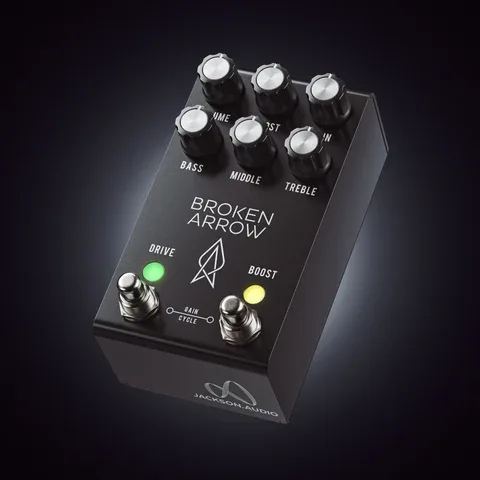
Guitar Pedal X's Stefan Karlsson describes the Golden Boy as "really an alternative version of the Broken Arrow pedal", which had a Tube Screamer style core voicing where the Golden Boy goes transparent7. The Broken Arrow shares the same architecture: four clipping diode presets, a MOSFET boost with four EQ'd presets, and a 3-band Baxandall-style EQ610.
Landreth had toured with the Broken Arrow on his board for a few months before the Golden Boy collaboration10, and in a Guitar.com interview he was blunt about the signature pedal:
"even if I wasn't associated with this pedal I'd be using it, it just has 'that' sound."
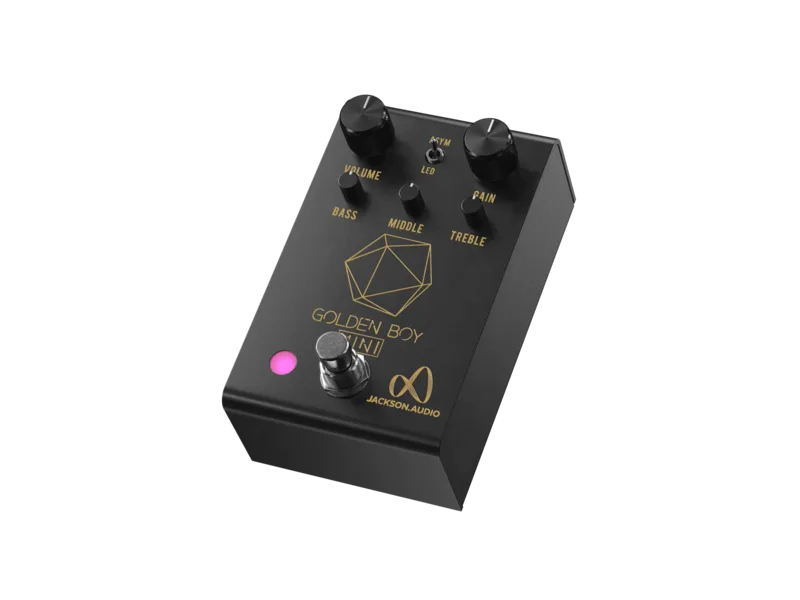
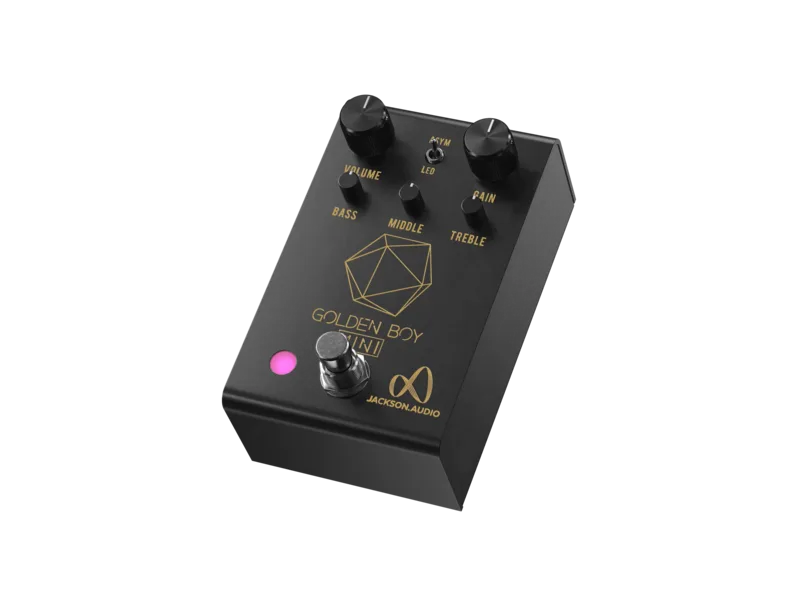
In July 2023 Jackson Audio and Landreth launched the Golden Boy Mini, a streamlined version that is not physically smaller than the original but trims the feature set: two clipping responses (asymmetrical and LED) instead of four presets, a three-band Baxandall-style EQ, top-mounted jacks and a 35mA draw, at $179 against the original's $299211. It shipped in three anodized colourways: standard gold, black limited to 1000 units, and rose gold limited to 500 units2.
What reviewers said
Guitar.com's review, which drew on Joey Landreth's own perspective, highlighted the blue drive mode for "creating natural, uncompressed break-up with blooming sustain"4. In Delicious Audio's reader poll of the best guitar pedals of 2020, the Golden Boy finished in 11th place with 2 points124.
Sweetwater's demo video walks through the boost EQ modes, including the aqua mode, and the blue mode, which is a full frequency boost with no attenuation of highs or lows6:
Videos
Jackson Audio
Ryan Kiesshauer
News
Questions
Is the Jackson Audio Golden Boy true bypass?
The boost circuit is in its own true bypass loop, which is what lets it run independently of the drive circuit. Jackson Audio's manual describes the boost this way; it does not characterize the drive side's bypass in the same terms.
What is the difference between the Golden Boy and the Golden Boy Mini?
The Mini is a streamlined version with two clipping responses (asymmetrical and LED) instead of the full pedal's four presets, a three-band Baxandall-style EQ, top-mounted jacks and a 35mA draw. It launched in July 2023 at $179 against the original's $299.
Is the Golden Boy based on the King of Tone?
Yes, in circuit terms. Jackson Audio's manual states the Golden Boy is based on the Bluesbreaker/King of Tone circuit, which gives it an open, uncompressed and transparent character rather than a mid-humped Tube Screamer voicing.
Can the Golden Boy boost be used without the overdrive?
Yes. The boost circuit sits in its own true bypass loop, so it can be engaged on its own with the drive off. It is a MOSFET boost with four EQ presets, and an internal jumper selects between a quieter standard version and a full-gain alternative.
What cable do I need for MIDI on the Golden Boy?
The Golden Boy receives MIDI over a TRS jack rather than a DIN-5 socket. Disaster Area Designs lists it as requiring a 5P-TRS PRO cable or a MultiJack with TRS, so a standard MIDI DIN-5 to TRS conversion cable is what you need.
Does the Golden Boy take a battery?
The Golden Boy is powered by a 9V DC center-negative supply and needs at least 150mA of current, which puts it beyond what a battery or a small daisy chain is practical for. Plan on an isolated or high-current power supply.
Sources (12)
- Golden Boy User Manual, Jackson Audio
- Jackson Audio and Joey Landreth launch Golden Boy Mini overdrive, Guitar.com, 2023-07-07
- Joey Landreth and Jackson Audio collaborate on Mini version of their Golden Boy overdrive pedal, MusicRadar, 2023-07-06
- Review: Jackson Audio Golden Boy, Guitar.com, 2020-07-22
- Golden Boy Transparent Overdrive, Jackson Audio
- Jackson Audio Golden Boy Transparent Overdrive Pedal Demo, Sweetwater, 2020-11-11
- Guitar Pedal X, Guitar Pedal X, 2020-08-04
- Supported Devices, Disaster Area Designs, 2021-10-11
- BROKEN ARROW v2, Jackson Audio
- "I’ve never been a huge Tube Screamer guy": Joey Landreth on the Bluesbreaker-inspired Golden Boy, Guitar.com, 2020-07-22
- Golden Boy Mini Overdrive, Jackson Audio
- The Best Guitar Pedals Of 2020 according To The Internet Experts, Delicious Audio, 2021-01-21
 Joey Landreth