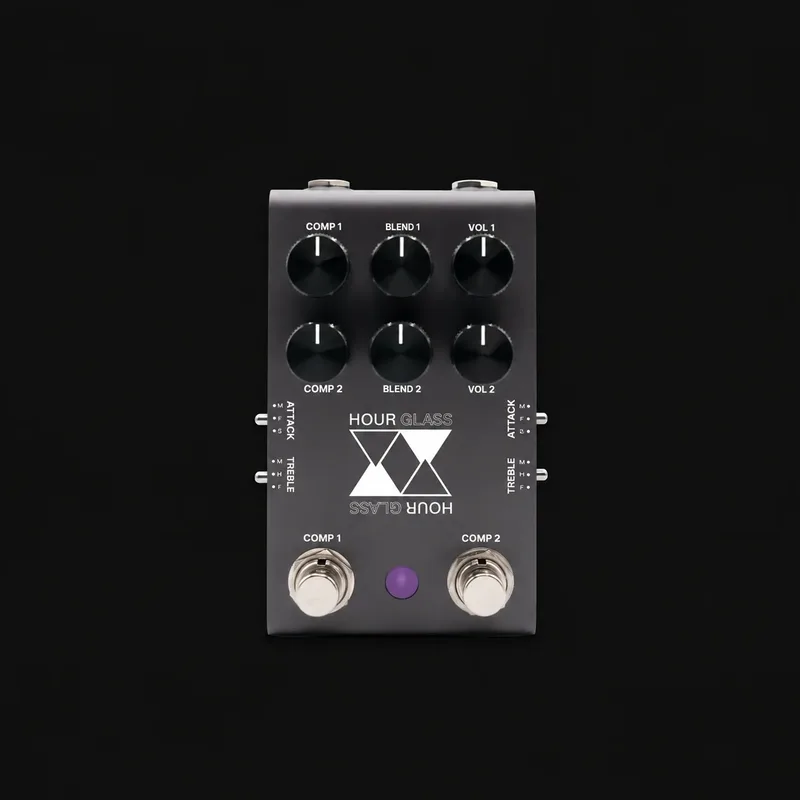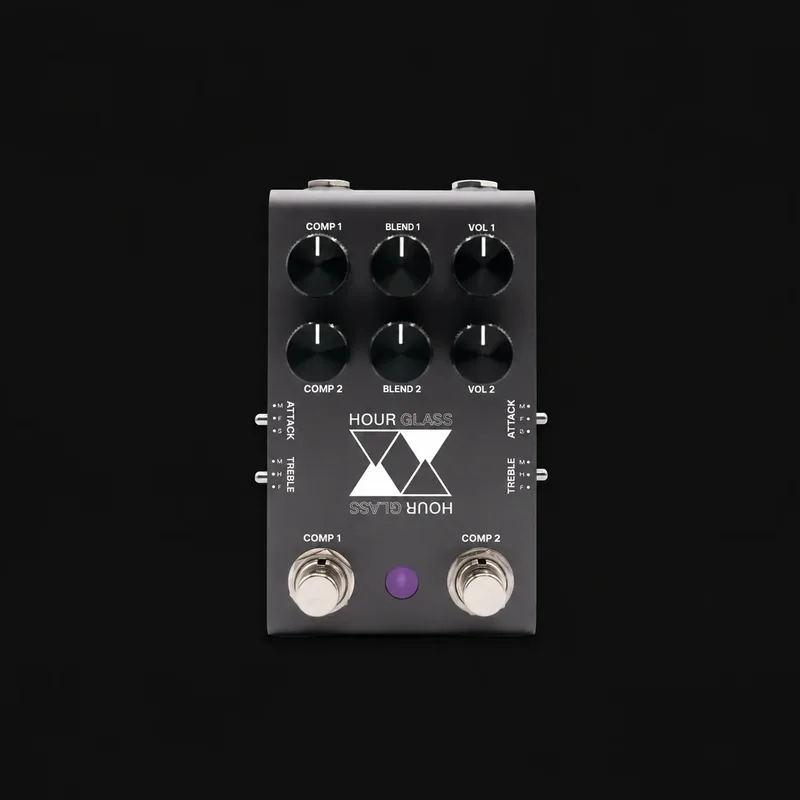
The Jackson Audio Hour Glass Dual Compressor is an analog dual compressor pedal: two identical OTA (operational transconductance amplifier) compression circuits in one housing, each with its own controls and its own footswitch12. You can set the two sides differently and switch between them, or engage both at once and stack them for what Jackson Audio calls "long, smooth sustain while maintaining clarity"1.
The design follows a familiar studio idea, parallel compression, in pedal form. Each circuit has a Blend control that mixes your clean signal back in with the compressed signal, so heavy compression does not have to mean a squashed, lifeless tone1. MusicRadar's Jonathan Horsley described it at launch as "a tricked-out compressor pedal that was inspired by classic OTA analogue units from Ross"2.
Two analog compressors in one pedal
The core of the Hour Glass is that both circuits are complete compressors, not a main compressor plus a simplified second voice. Each channel has Compression, Blend and Volume controls, its own three-way attack switch and its own footswitch, so either side can serve as your only compressor or as one half of a two-sound setup2.
Jackson Audio suggests a few ways players use the two sides:
- Set Compressor A for subtle control, a particular guitar, or an always-on foundational sound1
- Set Compressor B for stronger compression, another guitar, or a dedicated lead and sustain sound1
- Match both sides and stack them for extended sustain1
Because the jacks sit on the top of the pedal rather than the sides, it saves horizontal space on a pedalboard2.
Controls
Each compressor channel carries the same control set, with a shared Treble toggle for the top end23.
| Control | What it does |
|---|---|
| Sustain | Controls the amount and length of compression1 |
| Blend | Mixes the clean signal with the compressed signal1 |
| Level | Sets the output volume of the selected compressor1 |
| Attack switch | Three-way: Fast, Medium or Slow attack time3 |
| Treble toggle | Flat, Medium or High boost options to shape high-frequency tones3 |
The Blend control is what makes the parallel compression approach work: dial in strong compression on the Sustain control, then blend in as much or as little of your untouched clean signal as you want2.
Attack settings
Each compression circuit has its own three-way attack switch, with times MusicRadar lists as fast (100ms), medium (400ms) and slow (1600ms)2. The attack time determines how much of the initial hit of a note gets through before the compressor clamps down.
- Fast: responds quickly to peaks for tighter, more controlled dynamics1
- Medium: balances pick definition with smooth, even compression1
- Slow: allows more of the initial note through before compression begins1
A fast setting suits tight, controlled playing where you want peaks tamed immediately; slow lets the pick attack through untouched, which keeps articulation front and center before compression sets in.
Power
RockBoard's PedalPedia listing gives 9V DC, center negative, with a 60mA current draw3, while MusicRadar's launch report says the Hour Glass takes 9 to 18V DC from a pedalboard power supply2. Either way it runs from a pedalboard supply, not a battery.
If your power supply tops out at 9V, the 9 to 18V DC figure from MusicRadar suggests the Hour Glass can also run at higher voltages, which some players use for additional headroom. Check your supply's voltage options against both figures before wiring it in.
Where it came from
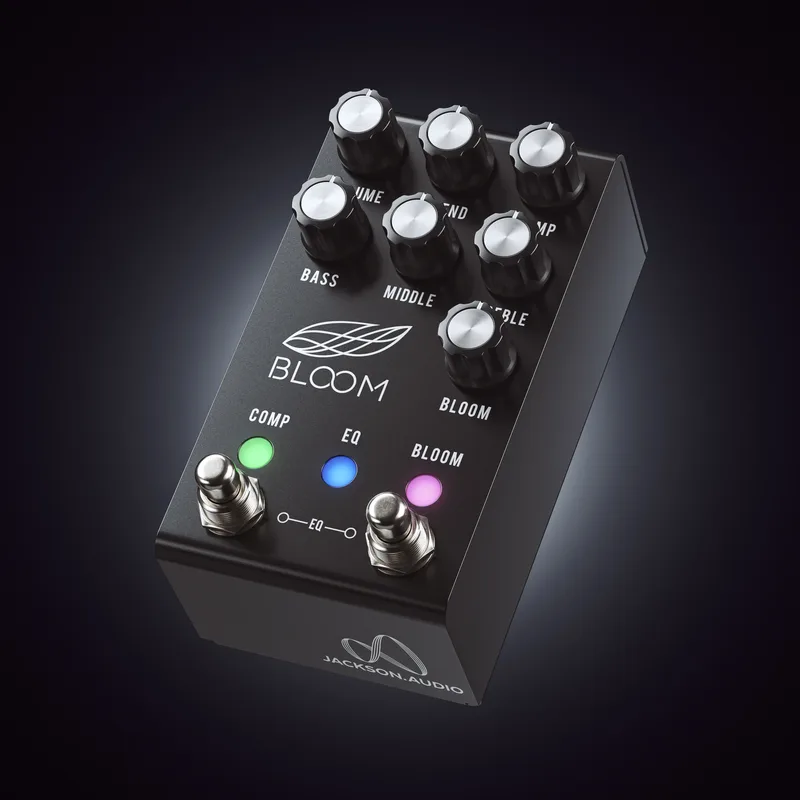
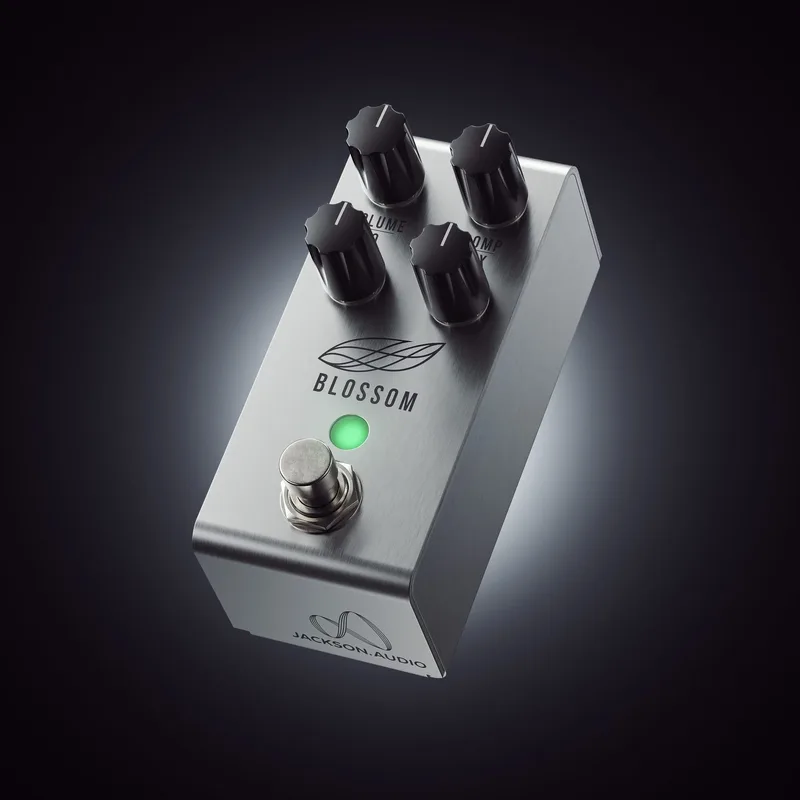
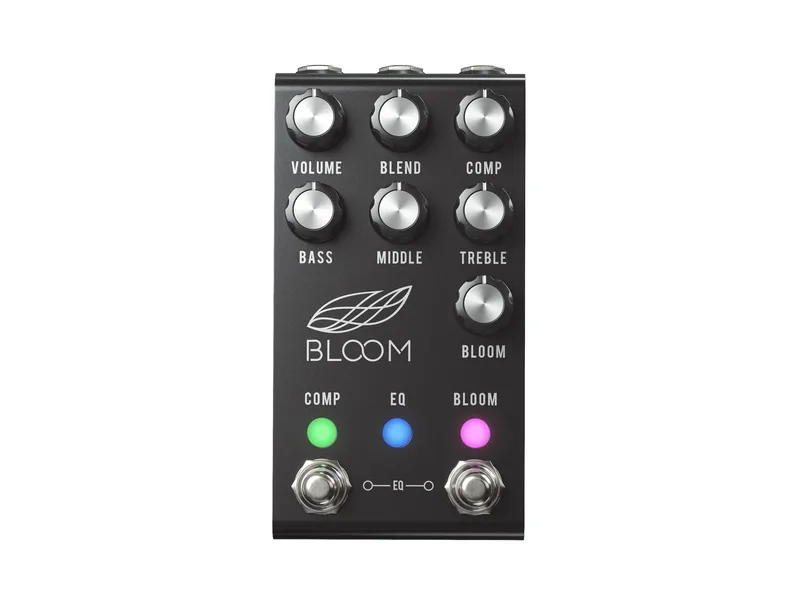
Jackson Audio also makes other compressors in the same family, including the Bloom, the BLOOM v2 MIDI and the Blossom, which take different approaches to the same job.
Questions
Can you run both compressors at once on the Jackson Audio Hour Glass?
Yes. The two compressor circuits can be switched between, matched, or stacked with both engaged at the same time. Jackson Audio says stacking them gives long, smooth sustain while maintaining clarity, and MusicRadar confirmed both circuits can be used simultaneously.
Is the Jackson Audio Hour Glass analog or digital?
It is analog. Jackson Audio describes it as a dual compressor built around dual OTA analog circuits, a topology inspired by classic OTA analog compressor units from Ross.
What power does the Hour Glass Dual Compressor use?
RockBoard's PedalPedia listing gives 9V DC, center negative, with a 60mA current draw, while MusicRadar's launch report says the pedal takes 9 to 18V DC from a pedalboard power supply. It is powered from a supply rather than a battery.
What do the attack settings on the Hour Glass do?
Each compression circuit has a three-way attack switch with fast, medium and slow settings. MusicRadar lists the times as 100ms, 400ms and 1600ms. Fast responds quickly to peaks for tighter dynamics, medium balances pick definition with smooth compression, and slow lets more of the initial note through before compression begins.
What does the Treble switch do on the Hour Glass?
The Treble toggle switch selects Flat, Medium, or High boost options to shape the high-frequency response. Flat leaves the top end alone, while the Medium and High positions add progressively more treble boost.
Sources (3)
- Hour Glass Dual Compressor, Jackson Audio
- “Unlock timeless sustain and endless creativity with dual, independent circuits inspired by the legendary Ross compressor”: Jackson Audio unveils the Hour Glass Dual Studio Compressor, MusicRadar, 2023-10-06
- Hour Glass Dual Compressor by Jackson Audio, RockBoard (PedalPedia), 2026