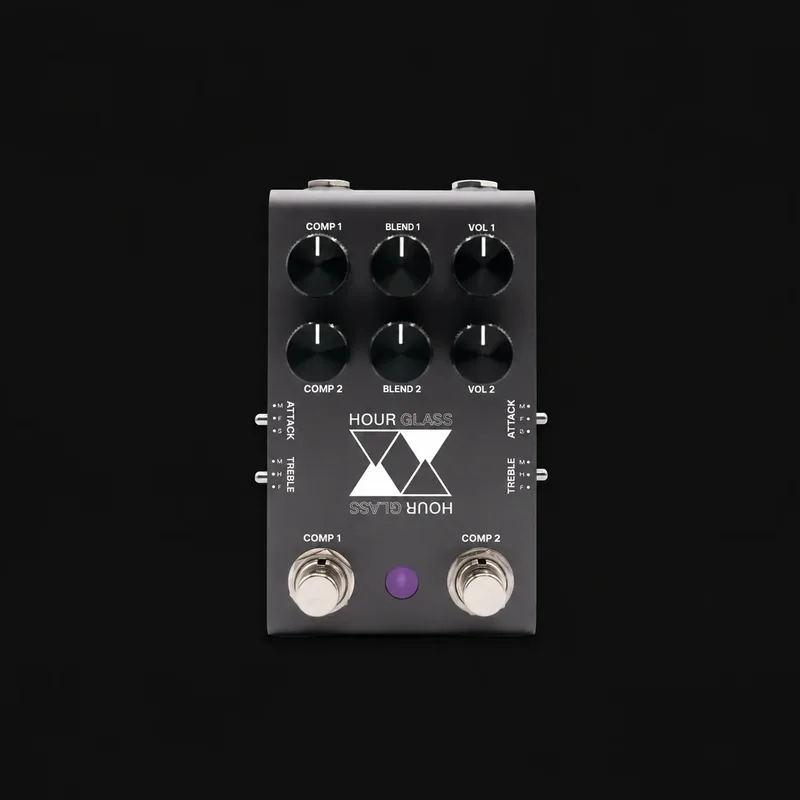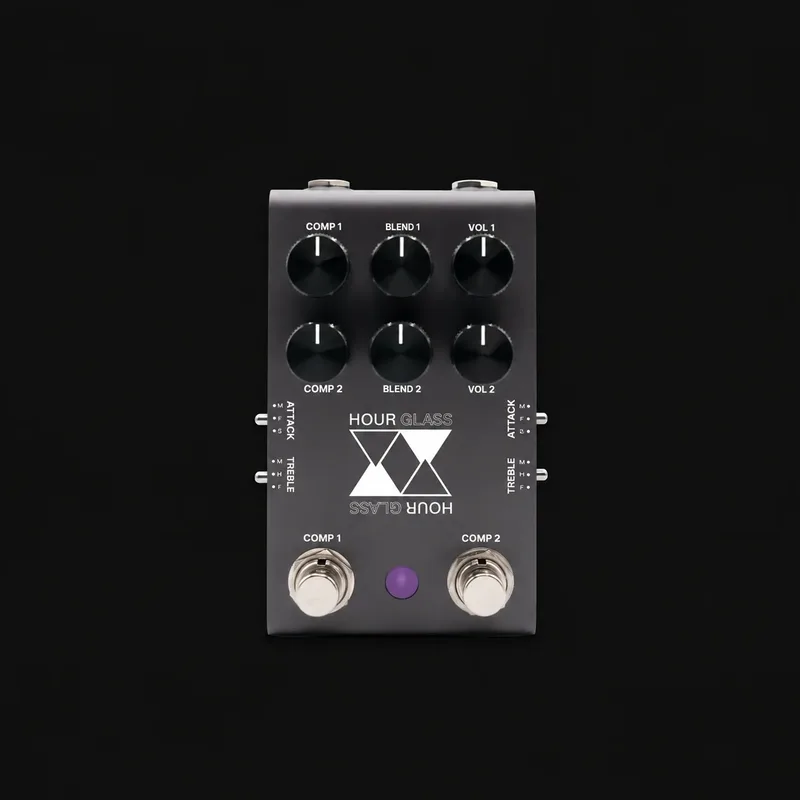
The Jackson Audio Hour Glass Dual Studio Compressor is an analog dual compressor pedal that puts two identical compression circuits in one enclosure, each with its own set of controls and footswitches1. Each circuit offers parallel compression with a Blend control, so part of your clean signal stays untouched alongside the compressed signal1. Jackson Audio announced it on 6 October 2023, and it was out at launch, priced at $299 in the US and £325 in the UK1.
The design is inspired by classic OTA analog compressor units from Ross, the circuit family behind many vintage-style compressors1. MusicRadar describes the result as transparent compression, reported as "warm" and "natural", capable of boosting sustain for long lead notes1.
Two compressors in one pedal
The core idea of the Hour Glass is that you get two complete compressors rather than one with extra features. MusicRadar's Jonathan Horsley explains the layout plainly1:
"there are two of 'em here, both identical, each offering parallel compression, complete with a Blend control"
Because each circuit has its own footswitch, you can leave one side always on and bring the other in when you need it. Jackson Audio suggests a few ways to split the duties2:
- Compressor A: set it for subtle control, a particular guitar, or an always-on foundational sound.
- Compressor B: set it for stronger compression, another guitar, or a dedicated lead and sustain sound.
- Both together: stacking the two compressors gives long, smooth sustain while maintaining clarity.
That last point answers the question most players ask first about a dual compressor: yes, both circuits can run at the same time. MusicRadar confirms it directly: "You can, of course, use both compressor circuits simultaneously"1. For a player who wants one gentle always-on setting and a second, heavier setting for solos, this saves either swapping settings mid-song or carrying two separate pedals.
Controls and switching
Each channel carries the same control set, which Jackson Audio labels Level, Sustain, and Blend2. MusicRadar describes the same three as Compression, Blend and Volume for each channel1, so the naming differs slightly between the maker's page and the press coverage, but the functions line up.
| Control | What it does |
|---|---|
| Level | Sets the output volume of the selected compressor2 |
| Sustain | Controls the amount and length of compression2 |
| Blend | Mixes the clean signal with the compressed signal2 |
The Blend control is what makes each circuit a parallel compressor: you dial in how much of your dry signal sits alongside the compressed one, which keeps pick attack and dynamics from being flattened entirely1.
Beyond the knobs, each circuit has two toggle switches3:
- Attack switch: a three-way selector for Fast, Medium, or Slow attack times.
- Treble switch: a three-way selector for Flat, Medium, or High boost, to shape high-frequency response.
Attack times
Each compression circuit has its own three-way attack settings. MusicRadar gives the actual times1:
| Setting | Attack time | Character, per Jackson Audio2 |
|---|---|---|
| Fast | 100ms | Responds quickly to peaks for tighter, more controlled dynamics |
| Medium | 400ms | Balances pick definition with smooth, even compression |
| Slow | 1600ms | Allows more of the initial note through before compression begins |
Having the attack switch per circuit means the two sides can behave differently: a fast attack on an always-on side for evenness, and a slow attack on the lead side so the front of each note stays articulate before compression sets in132.
Power and hardware
The Hour Glass runs on 9V DC with a center negative plug3. Jackson Audio's specifications do not list a battery option, so it needs a power supply output. The maker describes the enclosure as reassuringly compact, making the most of its pedalboard footprint1.
The enclosure is compact for a dual-effect pedal. MusicRadar found it "reassuringly compact, making the most of its pedalboard footprint", with the jacks mounted on the top of the pedal rather than the sides, which helps when pedals sit close together on a board1.
The maker's page and the press coverage disagree on price. At launch in October 2023 the Hour Glass was $299 in the US and £325 in the UK1; Jackson Audio's product page lists £227 as of October 20262. The two figures come from different dates, so treat the launch price as historical and the maker's current listing as the newer number.
Where it came from
The Hour Glass is out now1. Its circuit is a deliberate nod to the past: Jackson Audio says it is inspired by classic OTA analog units from Ross1, the same design lineage as many vintage-style compressor pedals. Rather than adding EQ, presets, or MIDI, the Hour Glass puts two of these circuits in one pedal, which is what sets it apart from the company's other compressor offerings.
Questions
Can both compressors on the Hour Glass run at the same time?
Yes. The two compressor circuits can be used simultaneously, and each has its own footswitch and controls. Jackson Audio says stacking both compressors gives long, smooth sustain while maintaining clarity, so you can set one side for an always-on sound and the other for stronger compression or leads.
What are the attack times on the Hour Glass?
Each compression circuit has a three-way attack switch with fast, medium, and slow settings. MusicRadar lists the times as fast at 100ms, medium at 400ms, and slow at 1600ms. Fast responds quickly to peaks, slow lets more of the initial note through, and medium balances pick definition with even compression.
How much current does the Hour Glass draw?
The Hour Glass draws about 60mA. That is modest by pedalboard standards, but it is more than a typical analog drive pedal, so plan a power supply output that can cover it.
Does the Hour Glass take a battery?
No battery option appears in the maker's specifications. The Hour Glass runs from a 9V DC center negative power supply, and MusicRadar notes it accepts 9 to 18V DC from a pedalboard power supply.
Is the Jackson Audio Hour Glass analog?
Yes. Jackson Audio lists the Hour Glass as an analog dual compressor, and its circuit is inspired by classic OTA analog compressor units from Ross, the same family of circuits behind many vintage-style compressor pedals.
How much does the Hour Glass cost in the US?
At launch in October 2023 the Hour Glass Dual Studio Compressor was priced at $299 in the US and £325 in the UK. Jackson Audio's own product page lists it at £227 as of October 2026, so current US pricing may differ from the launch figure.
Sources (3)
- “Unlock timeless sustain and endless creativity with dual, independent circuits inspired by the legendary Ross compressor”: Jackson Audio unveils the Hour Glass Dual Studio Compressor, MusicRadar, 2023-10-06
- Hour Glass Dual Compressor, Jackson Audio
- Hour Glass Dual Compressor by Jackson Audio, RockBoard (PedalPedia), 2026