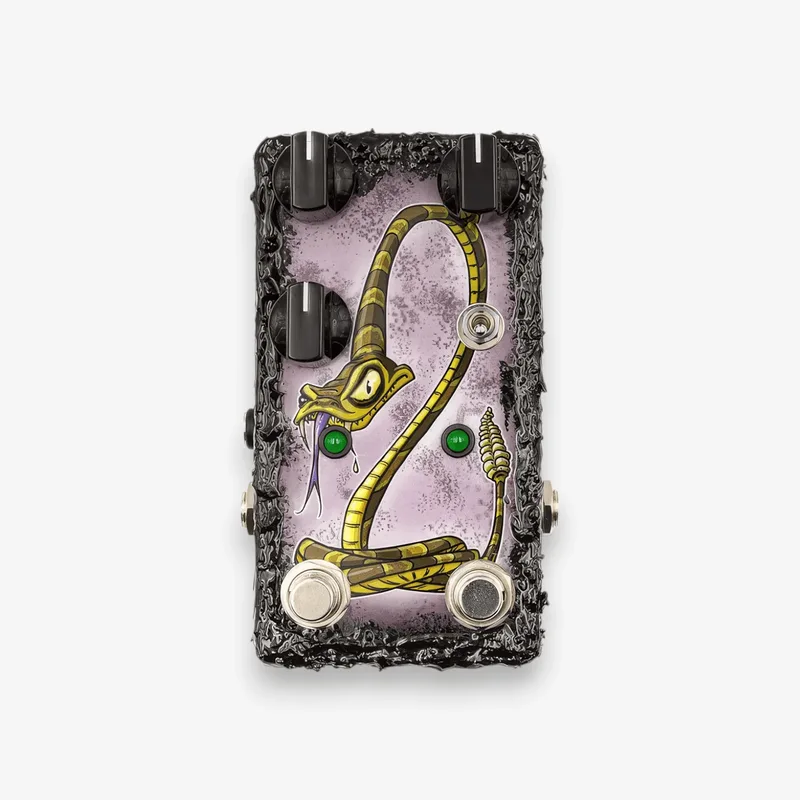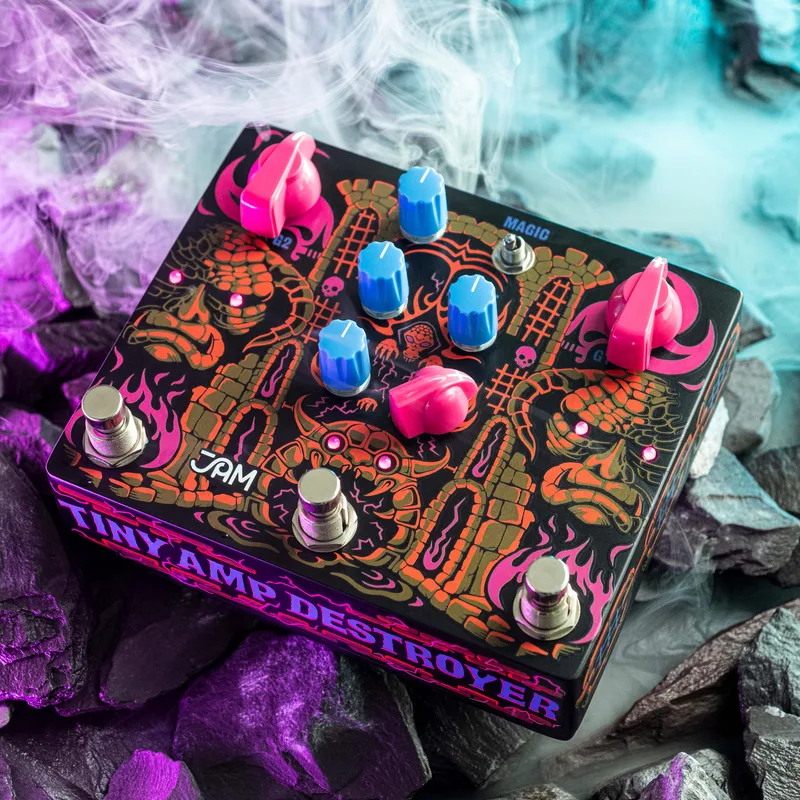



The pedal is not a clone of anything. According to JAM, it began with Mackenzie pushing two of the company's Boomster pedals into his favorite pawn-shop amp until it stopped behaving as intended; JAM then captured that unstable breakup and unruly response and used it as the foundation for a completely fresh circuit1.
The controls
Both drive stages share an overall Level control and active Bass and Treble controls with boost and cut2. The Bass, Treble, MAGIC and Notch controls affect the G1 and G2 stages only, so the treble booster keeps its own character regardless of how the EQ is set1.
| Control | What it does |
|---|---|
| Level | Overall output level, shared by both drive stages2 |
| Bass | Active bass EQ with boost and cut, affects G1 and G2 only1 |
| Treble | Active treble EQ with boost and cut, affects G1 and G2 only1 |
| MAGIC | Shifts the response toward a compressed, boxy, unstable small-amp character2 |
| G1 footswitch | Engages the hotter drive stage1 |
| G2 footswitch | Engages the more restrained drive stage1 |
| Third footswitch | Engages the independent treble booster2 |
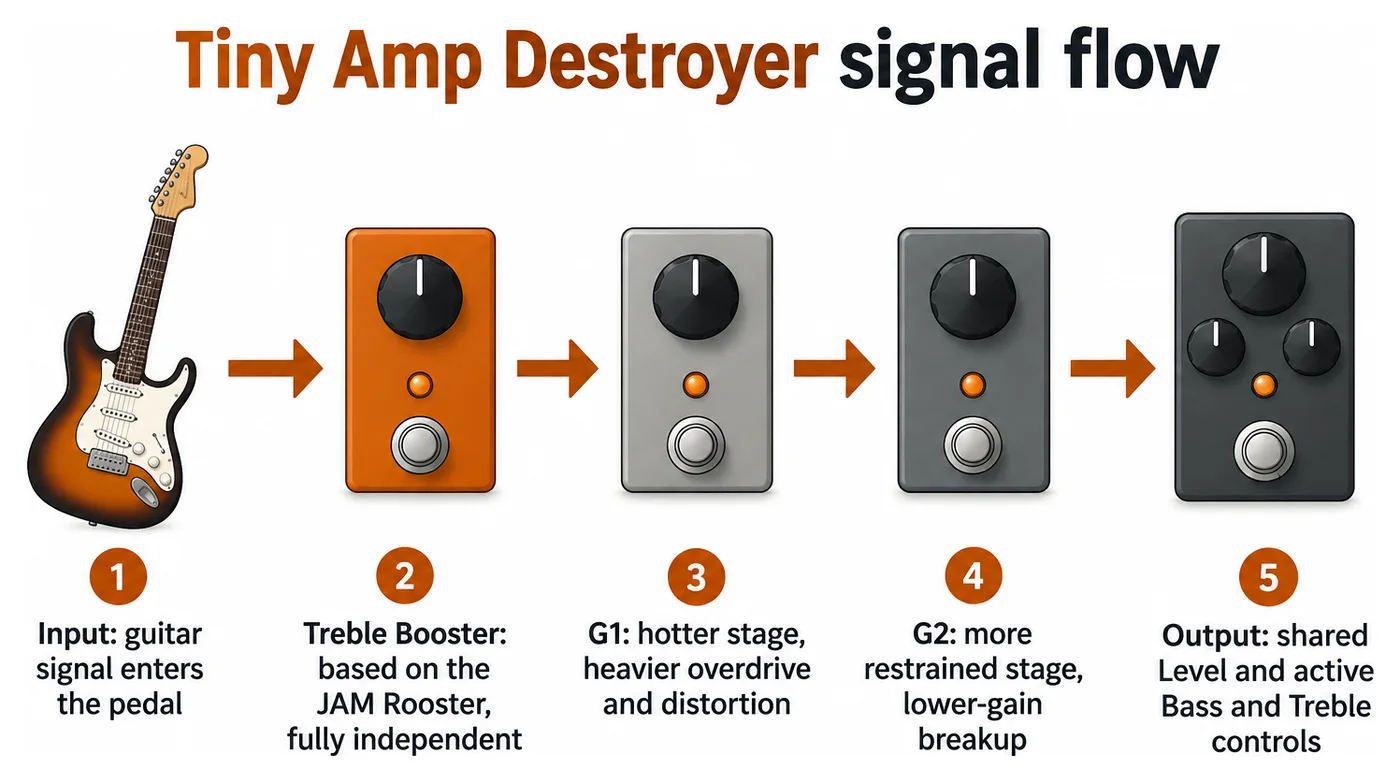
The two gain stages cover different ground. G2 is the more restrained stage, handling lower-gain breakup and driven tones, while G1 runs hotter, moving into heavier overdrive and distortion. Each can be used on its own or stacked with the other1.
The third footswitch activates an independent treble booster based on the JAM Pedals Rooster. It sits before G1 and G2 in the signal path, and JAM says it tightens the low end, sharpens the attack and changes how both drive stages respond1. The full signal flow is:
Modes and the internal DIP switch
An internal DIP switch selects between two treble-booster responses1:
- Full: a broader response with greater low-frequency content. The pedal ships in this mode2.
- Standard: a more focused, traditional treble-booster response2.
The pedal also has two operating modes, selected by holding the G1 footswitch while connecting power2:
- Two LED blinks: normal operation, with each footswitch controlling its own circuit2.
- Three LED blinks: G1 Global Bypass, where the G1 footswitch controls the entire pedal. JAM suggests leaving G2 and the treble booster engaged, then bringing the complete sound in with one press1.
Origins and artwork
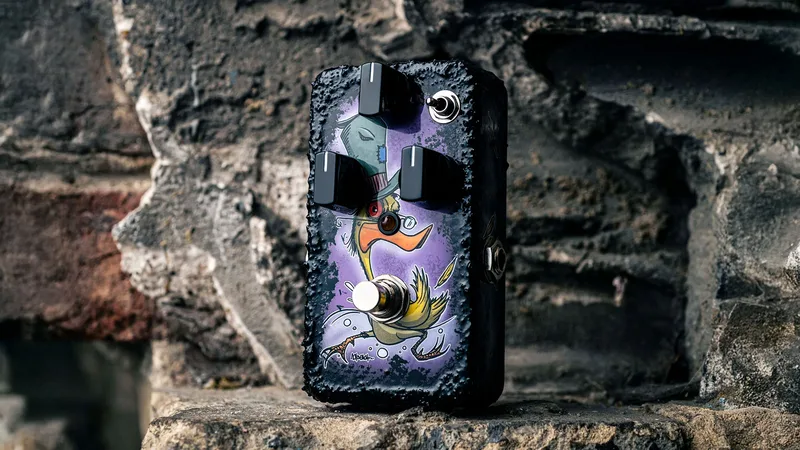
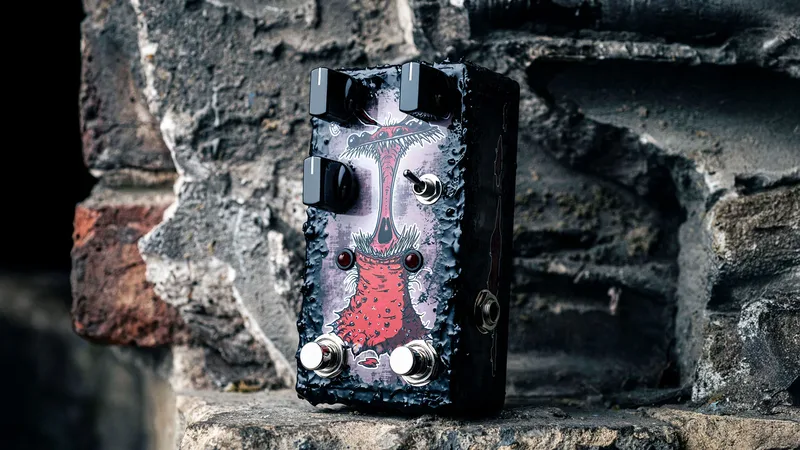
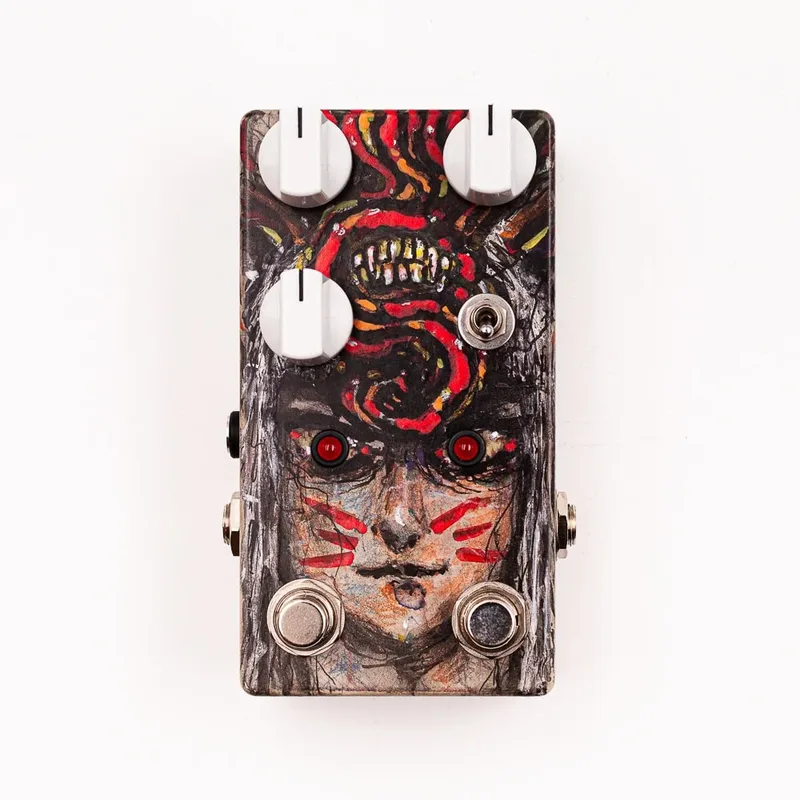
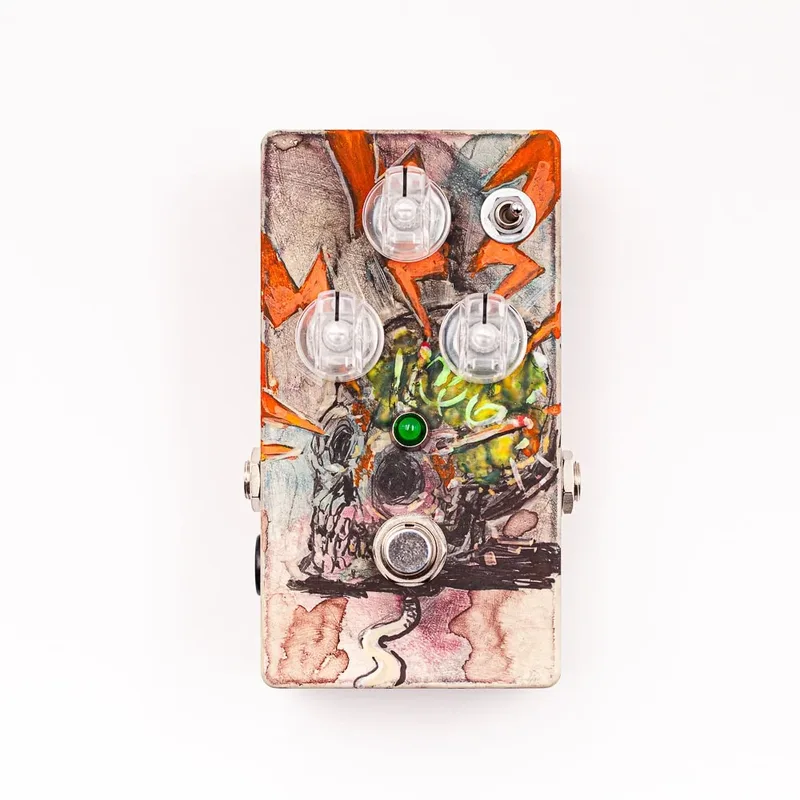
The original artwork was created by Jason Galea, King Gizzard's longtime visual collaborator and the artist behind much of the band's album artwork, posters, stage imagery and visual universe2. Limited artwork versions are one-of-a-kind hand-painted pieces that differ in detail from the photos shown on the product page1.
JAM also sells B-stock units: pedals that failed the cosmetic quality check but are otherwise described as brand new, in 100% working order, with original packaging and a lifetime warranty1.
The Tiny Amp Destroyer runs on 9 V DC, center-negative, drawing up to 90 mA with all circuits engaged1. That draw rules out a battery, and it is worth keeping in mind on a shared or daisy-chain supply.
What reviewers said
"it's completely unique, but what a great concept."
Videos
JAM pedals
JAM pedals
JAM pedals
News
Questions
Is the Tiny Amp Destroyer true bypass?
Yes. JAM Pedals lists the Tiny Amp Destroyer as true bypass. It runs on 9 V DC with a centre-negative plug and draws a maximum of 90 mA with all of its circuits engaged, so it needs a proper power supply rather than a battery.
What does the MAGIC switch do on the Tiny Amp Destroyer?
Engaging MAGIC shifts the pedal's response toward the compressed, boxy and unstable character of a tiny amplifier being pushed beyond its limits. According to JAM Pedals, MAGIC, along with the Bass, Treble and Notch controls, affects the G1 and G2 drive stages only.
What is the Tiny Amp Destroyer treble booster based on?
The third footswitch activates an independent treble booster based on the JAM Pedals Rooster. It sits before the two drive stages in the signal path, and JAM says it tightens the low end, sharpens the attack and changes how both drive stages respond.
Who did the artwork on the Tiny Amp Destroyer?
The original artwork was created by Jason Galea, King Gizzard & the Lizard Wizard's longtime visual collaborator, the artist behind much of the band's album artwork, posters and stage imagery. Limited artwork versions are one-of-a-kind hand-painted pieces that differ in detail from the product photos.
Sources (3)
- Tiny Amp Destroyer B-Stock, JAM Pedals (www.jampedals.com)
- Tiny Amp Destroyer, JAM Pedals (www.jampedals.com)
- Jam Tiny Amp Destroyer, Keeley Tube Drive, Death By Audio Amp Crash, Summer School Spring Break, That Pedal Show (YouTube), 2026-09-25