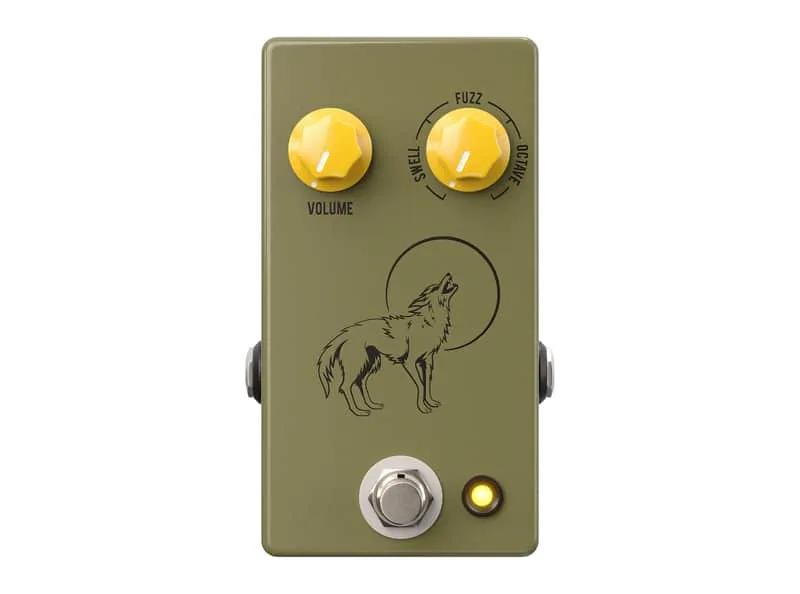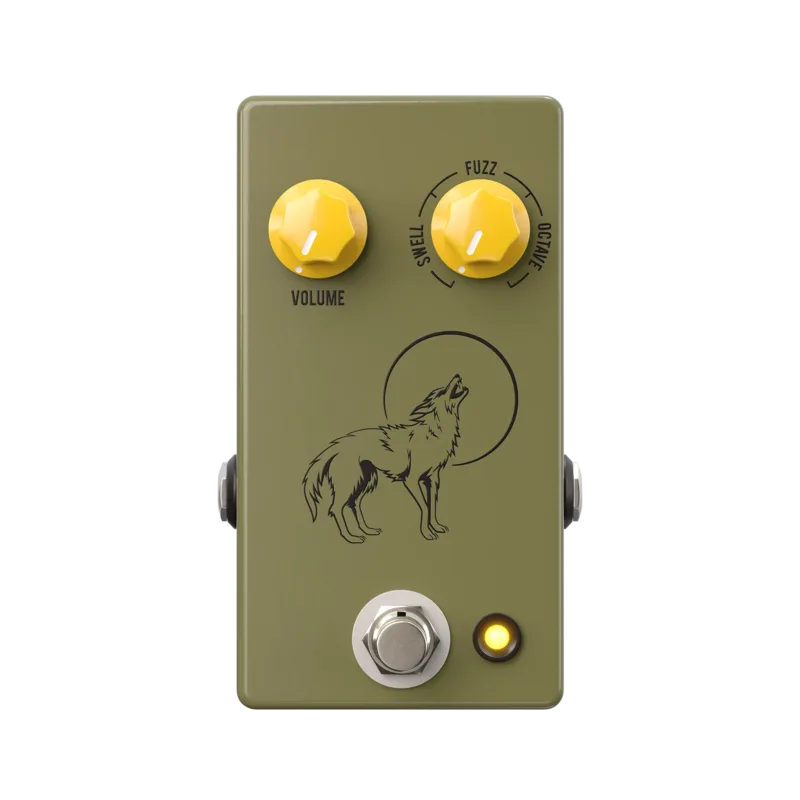


The JHS Coyote is an octave fuzz pedal from JHS Pedals, announced on 1 April 2026 and priced at $149.00 USD12. It is a complete replication of the obscure and very difficult to find Moonrock Fuzz by G.S. Wyllie, a two-knob, transformer-based circuit that JHS describes as "a new breed of octave fuzz based on a lost circuit that belongs to no known lineage"1. Josh Scott reimagined the original circuit, and the pedal is built in the USA34.
What makes the Coyote unusual is its control scheme: a single Mode knob sweeps continuously through three distinct effects, swell, fuzz and octave, with a standard Volume knob alongside it13. It is a compact, two-knob box that covers territory most fuzz pedals need multiple switches to reach.
What the Coyote does: swell, fuzz and octave on one knob
The Coyote has two knobs: Volume and Mode. The Mode knob sweeps continuously through three distinct zones, and where you set it determines which of three effects you hear16.
| Mode position | What it does |
|---|---|
| Fully counterclockwise (Swell) | Gated swell with blooming, reversed-tape quality; notes bloom in with a slow, breathing attack that rises up13 |
| Around noon (Fuzz) | A fully realized fuzz with rich low end and aggressive mids, in Tone Bender territory3 |
| Fully clockwise (Octave) | Aggressive octave-up snarl from intentionally uneven clipping that emphasizes the second harmonic36 |
JHS describes the knob as going from a swell when fully counterclockwise, to a fuzz at 12 o'clock, and an octaver when turned further clockwise4. Because the sweep is continuous rather than switched, you can find points between the three zones.
The three zones each have their own character. In the Swell zone, notes do not attack, they breathe, with a gated, reverse-tape character that swells in behind your pick6. The Fuzz zone is midrange-forward, with a full low end and aggressive mids that cut without being harsh, and Guitar World notes JHS's promise that the Fuzz mode can handle chords62. The Octave zone adds a biting high end to what is played, an octave up rather than down, channeling late '60s Hendrix and Stones territory62.
The Coyote is also touch-sensitive in ways octave fuzzes usually aren't. Delicious Audio found that rolling back your guitar volume makes it clean up, and digging in brings the response back6. Pedal of the Day's reviewer found the same thing: light picking gives warm, controlled fuzz while digging in triggers the swell, and rolling back the guitar's volume knob transforms the pedal7.
The Coyote is also touch-sensitive in a way octave fuzzes usually are not. At lower settings on the Swell / Fuzz / Octave control, light picking gives warm, controlled fuzz while digging in triggers the swell, and rolling back the guitar's volume knob transforms the pedal7. Pickup choice matters too: the reviewer found humbuckers push the swell and octave harder, while single coils give more clarity, and both sound great7.
Pickup choice matters too. Pedal of the Day found humbuckers push the swell and octave harder, while single coils give more clarity, and both sound great7.
Power and connections
The Coyote runs on 9V DC with a center negative plug and draws only 5mA1. Connectivity is simple: an input, an output and a 9V DC input4.
JHS warns: do not use more than 9VDC. Damage may occur and the warranty will be voided1.
The 5mA draw is low enough that the pedal is easy on any isolated power supply, and the true bypass switching means it leaves your signal alone when switched off16.
From G.S. Wyllie's Moonrock Fuzz to the Coyote
The Coyote is a complete replication of the Moonrock Fuzz by G.S. Wyllie, an incredibly rare original that JHS calls one of the rarest pedals of all time132. Glenn Wyllie's Moonrock fuzz was the source circuit, and Josh Scott reimagined it for modern production36. Guitar World reports Scott and co. took their time to master the tribute2.
Josh Scott has made a career of digging up lost circuits and handing them back to guitar players671, and the Coyote is a complete replication of the obscure and very difficult to find Moonrock Fuzz by G.S. Wyllie1. Glenn Wyllie's Moonrock fuzz was the source circuit for the pedal6.
A transformer-based octave circuit
The Coyote's circuit is transformer-based, which is part of why it sounds unusual6. Guitar World's reviewer notes the pedal has an unusual topology, using a transformer, but not in the normal way you would expect for an octave pedal4. JHS says the transformer is used as an inductive element shaping how the fuzz stage responds, and the result is "a texture and feel that doesn't exist anywhere else"1.
Importantly, JHS states the Coyote does not originate from any of the classic octave fuzz topologies: not the Octavia, not the Super Fuzz, not the Tone Machine1. That sets it apart from most octave fuzzes on the market, which trace back to those circuits.
What reviewers said
Early coverage was largely positive on the concept. Guitar Pedal X called it a decent, versatile and honest take on the original two-knob G.S. Wyllie circuit, though the reviewer felt it could have been a lot better overall8. The same site noted the Coyote's level at 12 o'clock is a fair bit below unity volume on the test unit, across a range of pickups4.
Pedal of the Day praised the pedal's touch-sensitive dynamic response, particularly at lower settings on the Swell / Fuzz / Octave control, where the Coyote becomes remarkably touch-sensitive7.
Videos
JHS Pedals
JHS Pedals
JHS Pedals
Questions
What is the Moonrock Fuzz?
The Moonrock Fuzz is an obscure, very difficult to find fuzz pedal created by the late G.S. (Glenn) Wyllie. It was a two-knob, transformer-based octave fuzz that sounded like nothing else on the market. The JHS Coyote is a complete replication of that original circuit, reimagined by Josh Scott.
Is the JHS Coyote an octave up or octave down?
It is an octave up. In the Octave zone, the Coyote adds a biting high end to what you play, an aggressive upper-harmonic snarl rather than a sub octave. The octave-up sound comes from intentionally uneven clipping that emphasizes the second harmonic.
Does the JHS Coyote clean up with the guitar volume knob?
Yes. Reviewers found the Coyote is touch-sensitive in ways octave fuzzes usually aren't. Rolling back your guitar's volume knob makes it clean up, and digging in brings the fuzz and swell back. Light picking gives warm, controlled fuzz while digging in triggers the swell.
Is the JHS Coyote true bypass?
Yes. JHS lists the Coyote as true bypass, so with the pedal switched off your signal passes through without buffering or coloration. It draws only 5mA, which makes it easy on any pedalboard power supply.
Where is the JHS Coyote made?
The JHS Coyote is made in the USA by JHS Pedals, the Kansas City company run by Josh Scott. It was announced on 1 April 2026 and is available widely, including through the JHS Pedals Webstore.
Sources (8)
- COYOTE - JHS Pedals, JHS Pedals
- JHS Coyote is based on one of the rarest fuzz pedals ever, Guitar World, 2026-04-01
- JHS Coyote Octave Fuzz: Rare Circuit Reimagined, gearnews.com, 2026-03-31
- JHS Coyote review, Guitar World, 2026-05-25
- Guitar Pedal X, Guitar Pedal X, 2026-04-01
- New Pedal: JHS Coyote Fuzz, Delicious Audio, 2026-03-31
- JHS Pedals Coyote Octave Swell Fuzz, Pedal of the Day, 2026-04-28
- Guitar Pedal X, Guitar Pedal X, 2026-05-28