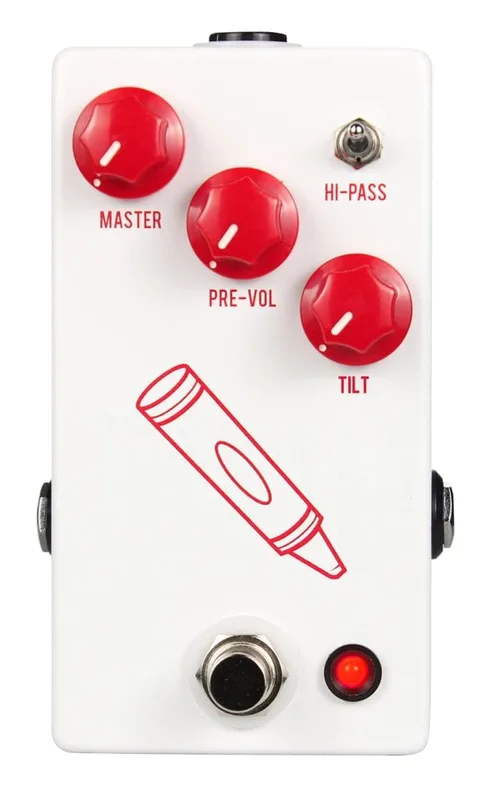


The JHS Pedals Crayon is a compact preamp and drive pedal that takes the distortion side of the company's Colour Box and puts it into a simpler, cheaper stompbox. Where the Colour Box aims to recreate the sound of plugging a guitar straight into a vintage studio console, the Crayon keeps the part of that circuit players reach for when they want color and grit: JHS describes it as "a powerful little box that has all the color and characteristics of a vintage studio preamp when cranked"1. Its Pre-Vol control sweeps from a gritty preamp drive all the way to over-the-top gated fuzz, which places it in the same family as fuzz pedals even though it was introduced as an overdrive.
The pedal was first revealed to Chicago Music Exchange on September 4, 2015, and then publicly shown on October 3, 2015 at the LA Amp Show in Van Nuys, California, with a MAP price of $1992. JHS discontinued it in September 20261.
The Crayon was discontinued in September 2026. It remains a common sight on used pedalboards, and its circuit lives on in spirit through the Colour Box line.
The sound of a guitar plugged straight into a console
The Crayon exists because of a sound players have chased for decades: a guitar plugged directly into a recording console's preamp, with no amp in the chain. Delicious Audio described the pedal as "designed to provide the sound of a guitar plugged directly into a recording console" in a simple three-knob format3. That sound has a long history in the studio, and Josh Scott, the pedal's designer, traces his inspiration to specific records: the guitars on Spoon's Gimme Fiction, Wilco's A Ghost Is Born, and the Beatles' White Album4. Scott says he wanted that sound for ten years before the company was able to build it4.
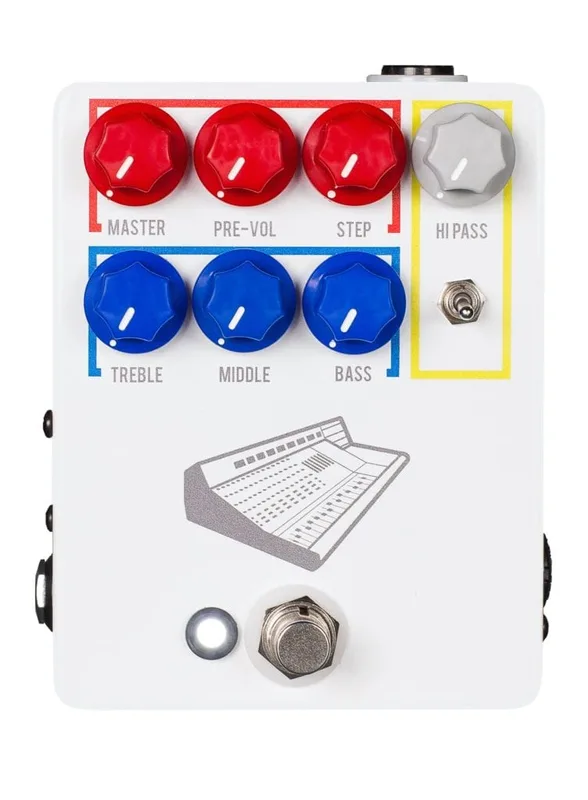
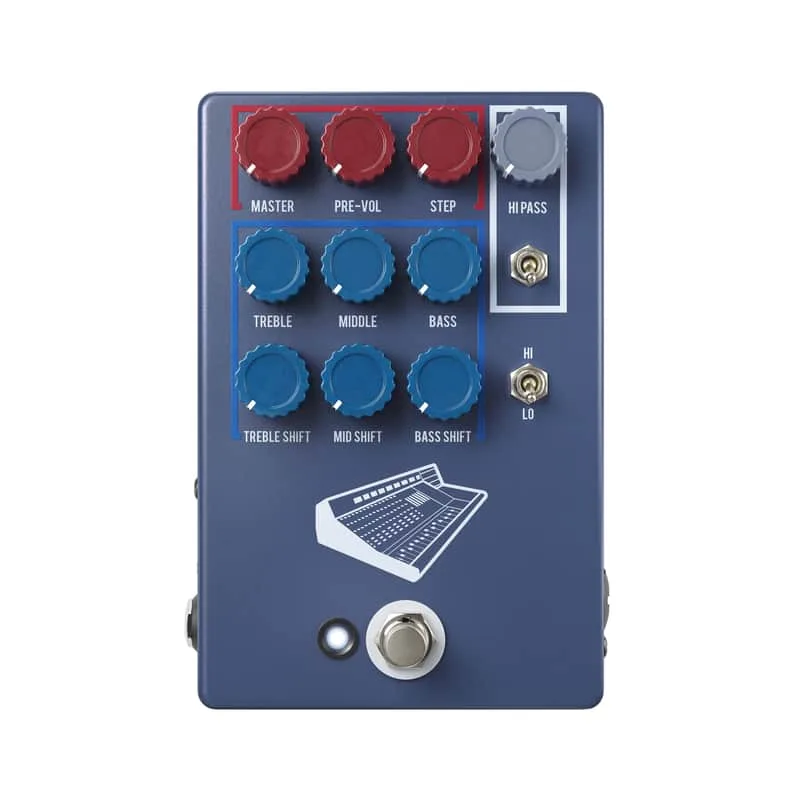
The parent product, the Colour Box, came first. Created in 2012, it was designed to give guitarists on stage the sound of plugging straight into a studio mixing console preamp, so nobody had to haul a console to a gig5. MusicRadar described the original as seeking "to replicate the opinion-dividing character of plugging your guitar straight into the studio mixing desk"6. The Colour Box V2 carries the idea further, with JHS saying it was built to "transform a guitar rig into the tonal equivalent of a Neve studio console"7. The Crayon strips that concept down to the drive section alone.
In a JHS demo video, the company describes the relationship plainly:
"this is simply the red section of the color box put into a single more easily accessible pedal4."
JHS Pedals demo8
Delicious Audio's 2016 writeup framed the Crayon as "the classic distortion aspect of that unit in a more affordable and streamlined stompbox format," and noted that it "has a lot to offer in the recording studio, although integrating this unit isn't quite as easy as with the XLR-friendly Colour Box"3. That XLR difference is the practical trade-off: the Colour Box connects to a mixing desk like a piece of studio gear, while the Crayon is a standard instrument-level pedal.
The controls
The Crayon keeps its control set to three knobs, one toggle, and one internal dip switch. All the control descriptions below come from JHS Pedals1.
| Control | What it does |
|---|---|
| Master | Sets the overall output volume of the unit |
| Pre-Vol | The gain control, sweeping from gritty preamp drive to over-the-top gated fuzz |
| Tilt | Active EQ: flat at 12 o'clock; clockwise boosts highs and cuts bass; counterclockwise boosts bass and cuts highs |
| Hi-Pass toggle | Cuts low end to help cut through the mix or get lo-fi sounds |
| Hi-Pass dip switch | Side-mounted switch selecting the Hi-Pass cutoff: 200Hz or 750Hz |
The Tilt control is the tonal heart of the pedal. It is an active EQ where, when set at 12 o'clock, you have a flat EQ, while turning clockwise boosts highs and cuts bass, and turning counterclockwise boosts bass and cuts highs1.
The Hi-Pass is the other half of the shaping equation. At 200Hz it trims the lowest bass, tightening up a boomy rig or a bass guitar. At 750Hz it removes a much larger slice of low end, which JHS points to for cutting through a mix or for deliberately lo-fi sounds1. For bass players especially, the two-position switch makes the difference between a usable drive tone and a thin one.
Where it came from and who uses it
The Crayon grew directly out of the Colour Box. JHS says the company "decided it was time to pare it down and give guitar players and bass players a simplified version" that keeps the distinct compressed overdrive and fuzz sounds of the original1. Guitar World introduced it in 2015 as an overdrive pedal2, and Delicious Audio called it a distortion pedal, reflecting how much ground the Pre-Vol knob covers3.
Before it was a product, it had a trial run with a touring band. Scott says he sent prototypes to Spoon, and the band toured with them4.
Its best-known user is The Edge of U2. JHS Pedals has said:
"The Edge (you know, the one from U2?) uses this, and it's very visible on his pedalboard910."
Scott later wrote that learning The Edge tours with one of his pedals, the Crayon, nearly made him spontaneously combust from joy10.
What reviewers said
Published reaction to the Crayon was positive. Delicious Audio concluded in 2016:
"For the player who is looking for an overdrive that’s a little old-school but with modern versatility, the JHS Pedals Crayon offers an intriguing option."3
Delicious Audio3
The same writeup flagged the studio limitation noted above: without the Colour Box's XLR connections, wiring it into a recording setup takes more work3.
JHS's own demo video walks through the full range of the pedal, from low-gain grit to gated fuzz, with Scott explaining each control and the records that inspired the design4.
A later JHS video covers the pedal's place in the Colour Box family and how the simplified version compares to the full console-style preamp8.
Videos
ProGuitarShopDemos
JHS Pedals
News
Questions
Is the JHS Crayon discontinued?
Yes. JHS Pedals discontinued the Crayon in September 2026, according to the maker's own product page. It was introduced in 2015 and remained in the lineup for about eleven years, so remaining stock is limited to what retailers still hold.
What is the difference between the JHS Crayon and the Colour Box?
The Crayon is a simplified version of the Colour Box. It takes the distortion side of the Colour Box circuit, which models a vintage Neve-style studio preamp, and puts it in a smaller, cheaper three-knob pedal. The Colour Box keeps its XLR connections for direct recording, which the Crayon does not have, so integrating it into a studio setup is less straightforward.
Does the Edge use a JHS Crayon?
Yes. JHS Pedals has said that The Edge of U2 tours with a Crayon and that it is very visible on his pedalboard. Josh Scott, JHS's founder, wrote that learning The Edge toured with one of his pedals nearly made him spontaneously combust from joy.
What does the Tilt knob do on the JHS Crayon?
Tilt is an active EQ. Set at 12 o'clock the EQ is flat. Turning it clockwise boosts highs and cuts bass, and turning it counterclockwise boosts bass and cuts highs. It is a single knob that shifts the whole tonal balance rather than boosting one narrow band.
What frequencies does the Crayon Hi-Pass cut?
The Hi-Pass cuts low end to help the pedal cut through a mix or get lo-fi sounds. A dip switch on the right side of the pedal selects the cutoff frequency: either 200Hz or 750Hz. The 750Hz setting removes much more low end for thinner, lo-fi tones.
Sources (10)
- CRAYON - JHS Pedals, JHS Pedals
- JHS Pedals Introduces The Crayon Overdrive Pedal, Guitar World, 2015-10-03
- JHS Crayon, Delicious Audio, 2016-08-17
- I Always Wanted This Sound: The JHS Crayon Preamp, Boost, Overdrive, Fuzz (Neve 1073 in a box!), JHS Pedals (YouTube), 2023-07-14
- How To Use The JHS Colour Box, JHS Pedals (YouTube), 2019-11-14
- JHS Effects releases the Colour Box Version 2 preamp pedal, MusicRadar, 2019-11-20
- COLOUR BOX V2, JHS Pedals
- JHS Colour Box: A 1073 You Can Take Anywhere, JHS Pedals (youtube.com), 2024-10-28
- WORST JHS PEDALS EVER MADE, JHS Pedals
- WHY YOU NEED A PREAMP, JHS Pedals
 Roy Mitchell-Cárdenas
 The Edge