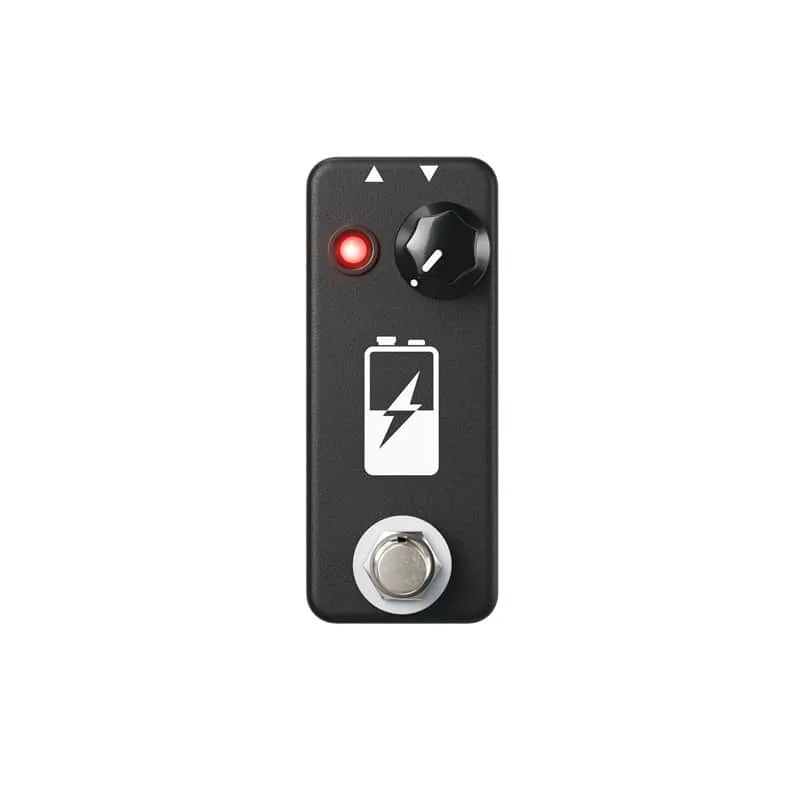


The JHS Volture is a voltage sag utility from JHS Pedals, a small box that sits between your power supply and a pedal and lets you trim the voltage that pedal receives. Fuzz circuits are especially sensitive to the voltage they get, so lowering it changes their character: JHS describes the result as "gated, distorted, possibly glitchy but always sputtery fuzz sounds"1. The pedal exists to replace the old dying-battery trick, where players let the battery in a fuzz run down on purpose to get that degraded, sputtering tone. JHS says the Volture lets you "precisely trim the input voltage and perfectly replicate the tone of a dying battery"1.
What it does and where it came from
Fuzz pedals behave differently as their supply voltage falls: the circuit starves, gates, and breaks up in ways players have chased for decades by simply letting the battery die. RockBoard's PedalPedia entry notes that "inherently simple devices like fuzz circuits are extremely sensitive to the amount of voltage that they receive," which is what the Volture exploits2.
On the JHS product page, the origin story is told directly: "a certain unnamed guitarist reached out to me for a practical solution for this technique, and the Volture was born."1 Rather than waiting for a battery to fade on its own, the Volture gives you a control to dial that state in and hold it.
A useful visual cue: as you turn the voltage down, the LED dims simultaneously with the voltage level, so you can see roughly where you are1.
Power and connections
The Volture takes a higher voltage in and puts a lower, adjustable voltage out1:
| Connection | Detail |
|---|---|
| Power input | 9, 12 or 18VDC, center negative1 |
| Voltage output | Adjustable, 7.5VDC down to 1.25VDC, center negative1 |
| Connectors | Industry standard 2.1mm power supply cables1 |
| Max load | Use with pedals drawing less than 50mA1 |
| Volture's own draw | 12mA per the spec line; 10mA in addition to the load when active, per the usage notes (JHS gives both figures)1 |
JHS warns that "The Volture should not be paired with any digital/logic circuitry-based pedal, otherwise the user risks potential damage"1. It was developed specifically for vintage fuzz circuits, but JHS says it "will work on any fully analog pedal"1. Keep it away from digital delays, multi-effects and anything else running logic circuitry.
Setup is a three-step chain:
- Connect your power supply output to the Volture's input, using a standard 2.1mm cable1.
- Connect the Volture's output to the pedal you want to sag1.
- Turn the voltage down from 7.5VDC toward 1.25VDC until the pedal hits the character you want, watching the LED dim as a guide1.
Versions and pricing
The Volture was announced as part of a group of new JHS pedals covered by guitar.com in February 2023, where Tamzin Kraftman noted it "does require a standard 9V battery"3. gearnews.com's report of the same launch, by Jef, listed the Volture at 109 euros in EU stores, with a Thomann listing at $79.00 USD / £71.00 / 84.00 euros4. JHS's own product page lists it at $80.00 USD as of 2026-10-251.
Videos
Telluride Music Co.
K&S Music, Inc
Cobrastrap Cob
Questions
Does the JHS Volture work with digital pedals?
No. JHS warns that the Volture should not be paired with any digital or logic circuitry-based pedal, because reducing the voltage risks potential damage to those circuits. It was developed specifically for vintage fuzz circuits and works on any fully analog pedal, so keep it with analog gear only.
Is the JHS Volture analog or digital?
The Volture is an analog device. It is a voltage sag utility rather than an effect in the usual sense: it passes power to another pedal at a reduced, adjustable voltage, which changes how that pedal's analog circuit behaves and sounds.
Does the JHS Volture need a battery?
Yes. According to guitar.com's news report on the Legends of Fuzz lineup, the Volture does require a standard 9V battery. That is fitting, since the pedal exists to recreate the sound of a battery dying inside a fuzz pedal, but under controlled conditions.
How do you connect the JHS Volture between a power supply and a pedal?
Simply place it in between your power supply and your pedal, using industry standard 2.1mm power supply cables. Feed it 9, 12 or 18VDC from your supply, then turn the Volture's control to send anywhere from 7.5VDC down to 1.25VDC to the pedal. JHS says it should be used with pedals drawing less than 50mA.
Sources (4)
- VOLTURE - JHS Pedals, JHS Pedals
- Volture by JHS, RockBoard PedalPedia, 2026
- JHS gets fuzztastic with three new pedals to its Legends of Fuzz lineup, guitar.com, 2023-02-27
- JHS Legends of Fuzz Effect Pedals: Mary-K, Plugin and Berkeley, www.gearnews.com, 2023-02-28