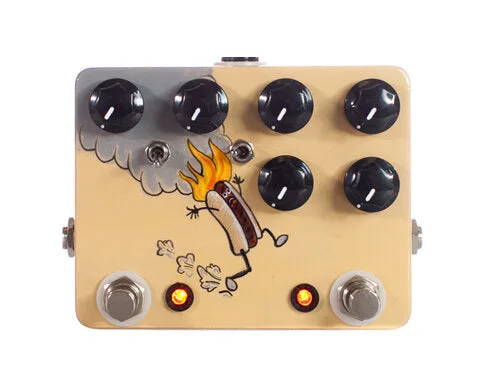



The JHS Bunrunner is a dual fuzz pedal from JHS Pedals: two separate fuzz circuits in one box, each with its own controls, usable on their own or stacked together. The left side is the JHS Astro Mess fuzz and the right side is a heavily modified Tonebender123. The pedal is discontinued, and reviewers noted it had been dropped from the lineup as early as 2014, with examples becoming harder to find on the used market since34.
The pedal came out of a collaboration. JHS says Josh Scott began working with Switchfoot guitarist Drew Shirley on his "Hello Hurricane" touring rig, and the number one need was a single pedal that could do a lot of fuzz. The Bunrunner 2 in 1 was the end result5. Pedal of the Day describes it as "a sonic marvel, and one of the most versatile and useful fuzzes we have ever had the privilege of playing"2.
Two fuzzes in one box
The idea behind the Bunrunner was coverage: instead of carrying two fuzz pedals, a player gets two quite different fuzz voices in one enclosure, and can run either one alone or both together53. Pedal of the Day's Mike B found that with two sections of differing fuzz to choose from, or together, the pedal covered a wide range, calling it one of the most versatile and useful fuzzes he had played4.
When both sides are combined, the reviewer writing in 2023 was blunt about the result3:
"you'll be hard-pressed to find another fuzz with as much gain, buzzsaw, warmth, distortion and blitz as the Bun Runner"
The Astro Mess side
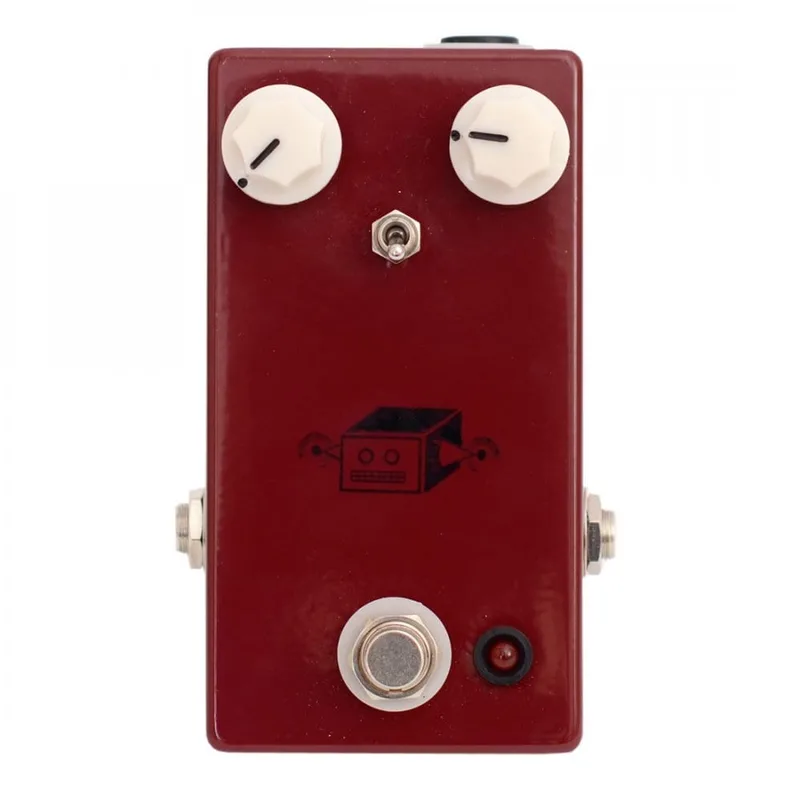
The left side of the Bunrunner is the JHS Astro Mess fuzz, and JHS says it is identical to the standalone single unit132. The Astro Mess itself was born from the same collaboration: JHS describes it as "the birth child of Switchfoot's Drew Shirley's request and Josh Scott's knowledge of fuzz"6. Jeds Peds, whose Hyper Fluff circuit the Astro Mess derives from, notes that "this has been copied by another reputable pedal manufacturer and sold as The Astro Mess"7.
JHS describes the Astro side as delivering "all the modern, gated and heavy fuzz you could ever use as well as 8 bit tones galore when needed," tipping its hat to classic high gain fuzz pedals like the Ampeg Scrambler, Kay Fuzz and Octavia1. Pedal of the Day characterized it as a high-gain, modern-sounding heavy fuzz with a broad range of tones, and highlighted its toggle switch, which "moves your tone from regular fuzz into a whole other stratosphere of sticky, note-heavy distortion"2.
The Gate toggle on this side is a sound-shaping tool in itself. JHS says flipping it up has you "splattering notes all over the place with style as the overall structures s" of your playing break down under pick attack1.
The Tonebender side
The right side is JHS' take on the Tonebender-style circuit, which JHS describes as a heavily modified Tonebender "oozing with germanium fuzz, warmth, character and fullness that is only found in the Bunrunner"1. Pedal of the Day found it features "warmer, fuller, less harsh-sounding tonal properties, and can in itself provide a nice range of drive sounds"3.
| Control | What it does |
|---|---|
| Volume | Output level for the Tonebender side5 |
| Tone | JHS calls it a tone shaping tool rather than a knob that removes harshness1 |
| Fuzz | Gain for the Tonebender side5 |
| Bias | JHS says it allows "big hefty overdrive drive tones all the way to a thick wall-of-fuzz heaven"1 |
The Bias knob is the control JHS singles out as unusual, since it spans from overdrive-like drive tones to a full wall of fuzz rather than acting as a simple trim1. Jeds Peds sells a Simply Oak kit that compares to the Tone Bender side of the JHS Bun Runner, for players interested in that circuit's lineage8.
Power: a positive ground circuit on a normal 9V supply
The Tonebender side is a true positive ground circuit, which is the kind of design that normally causes power problems on a pedalboard. Positive ground circuits typically cannot share a daisy chain or common supply with standard negative ground pedals. JHS solved this with voltage reversal circuitry built into the Bunrunner, so "you can run this pedal on a normal 9v supply with your other pedals"1.
The Bunrunner's Tonebender side is a true positive ground circuit, but the internal voltage reversal means it does not need a dedicated or reversed supply. It runs on a normal 9V supply alongside other pedals5.
V1 and V2
JHS lays out the two versions plainly:
- V1: Same exact circuit and enclosure as V2; some units do not have the Bunrunner icon1.
- V2: Adds the Order toggle switch, which lets you choose what circuit comes first when both are on at the same time1.
Pedal of the Day's coverage confirms the split from the player's side: the newer version has an Order toggle "so you can decide which side you want to be placed first or second in your signal chain," while the earlier version does not42. The 2017 review noted the same distinction when revisiting the pedal after reviewing V12.
The Order toggle matters most when both fuzzes are engaged, since stacking two fuzz circuits in series sounds different depending on which one hits the guitar signal first. On V1, that order is fixed; on V2, it is a switch decision245.
What reviewers said
Across nearly a decade of coverage, Pedal of the Day's verdict stayed consistent. In 2014, Mike B called it "one of the most versatile and useful fuzzes I have ever had the privilege of playing"4. The 2017 re-review repeated the assessment, and the 2023 retrospective added that with the pedal discontinued, it had become a sought-after find on the used market, with the combined sides delivering a level of gain, buzzsaw, warmth, distortion and blitz the reviewer found hard to match elsewhere32.
Videos
Prymaxe
Best Guitar Effects
Pedal of the Day
Questions
Is the JHS Bun Runner discontinued?
Yes. JHS Pedals no longer makes the Bun Runner, and reviewers noted as far back as 2014 that it had been discontinued, with used examples getting harder to find over time. The Astro Mess fuzz that forms its left side is discontinued as well.
What is the difference between Bun Runner V1 and V2?
According to JHS, V1 and V2 share the same exact circuit and enclosure, though some V1 units do not have the Bunrunner icon. V2 adds the Order toggle switch, which lets you choose which of the two fuzz circuits comes first when both are engaged at the same time.
Who designed the JHS Bun Runner?
JHS says the pedal came out of Josh Scott working with Switchfoot guitarist Drew Shirley on his Hello Hurricane touring rig. Shirley wanted one pedal that could cover a lot of fuzz ground, and the Bun Runner 2 in 1 was the result.
Can the Bun Runner use a standard 9V power supply?
Yes. The Tonebender side is a true positive ground circuit, which would normally rule out sharing a supply with other pedals, but JHS added voltage reversal circuitry so the Bun Runner runs on a normal 9V supply alongside the rest of a pedalboard.
Is the Bun Runner germanium?
JHS describes the Tonebender side as a heavily modified Tonebender oozing with germanium fuzz, warmth, character and fullness. The Astro Mess side is a different circuit, described as modern, gated and heavy with 8-bit tones.
Sources (8)
- BUNRUNNER, JHS Pedals
- JHS Pedals Bun Runner Fuzz Pedal, Pedal of the Day, 2017-03-16
- JHS Pedals Bun Runner 2-In-1 Fuzz, Pedal of the Day (www.pedal-of-the-day.com), 2023-04-30
- JHS Pedals Bun Runner 2-In-1 Fuzz, Pedal of the Day (pedal-of-the-day.com), 2014-07-03
- BUNRUNNER HAND PAINT, JHS Pedals
- ASTRO MESS, JHS Pedals
- Hyper Fluff, Jeds Peds
- Simply Oak, Jed's Pedals (jedspeds.co.uk)