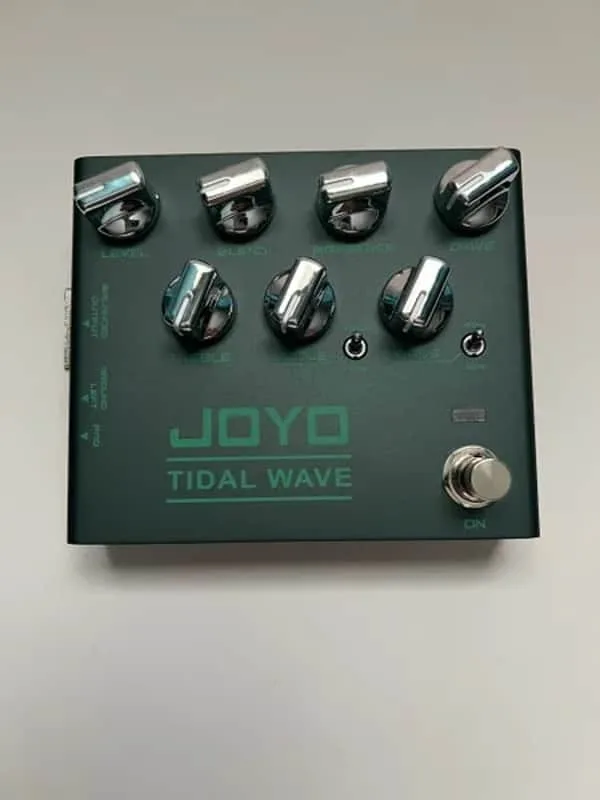


The Joyo Tidal Wave Preamp is a bass preamp and DI pedal built around the circuit of the tech21 SansAmp, one of the most familiar preamp designs in bass. It combines a 3-band EQ with drive, a cab-simulated XLR DI output and a headphone output, so the same pedal can shape your amp tone, feed a recording interface or front-of-house desk, and handle silent practice1.
Bass Musician Magazine's reviewer, Cláudio Ribeiro, judged it a faithful homage to the SansAmp for classic rock bass tones, writing that it "faithfully replicates the classic rock sounds of the tech21 SansAmp"1. In an August 2026 roundup of bass preamps and DI pedals, the same publication noted that "the Tidal Wave pairs a comprehensive control set with modern touches like a headphone output"2.
What it does
The Tidal Wave sits in the preamp pedal category and leans on its SansAmp lineage for its character. The reviewer found it at home with classic rock sounds, and its DI section carries cab simulation, meaning the XLR output sends a finished, speaker-simulated signal to a desk or interface rather than a raw preamp tone1. That makes it a candidate for players who record direct or whose venues take the bass signal from the stage rather than miking a cabinet.
The through output passes the original bass sound, so the DI and cab simulation can be used without altering what reaches your amplifier1.
The controls
The pedal's control set is broader than most compact preamps, with shift controls for the EQ bands and switches for the DI level and lighting1.
| Control | What it does |
|---|---|
| Treble, Middle, Bass | 3-band EQ with frequency selectors for bass (40Hz to 80Hz) and mids (500Hz to 1KHz) |
| Middle Shift and Bass Shift | Further fine-tuning of midrange and bass frequencies |
| Presence | Controls the dynamics of the high upper-mids, crucial for shaping drive tones |
| Drive | Introduces low-gain distortions and classic rock sounds into the clean tone |
| DI Attenuation Switch | Adjusts the level of the DI output signal |
| LED Light Switch Control | Customizes the ambient lighting of the pedal |
The frequency selectors on the bass and mid bands are the detail an experienced player will notice: rather than fixed EQ centers, you choose where the bass and middle controls act, which is what lets the pedal be tuned around a particular instrument or room1.
Power, size and practice use
The pedal runs on DC 9V with a power consumption of 100 mA1. Its dimensions are 130 x 110 x 50 mm and it weighs 442g, which the reviewer describes as a compact and lightweight design for easy transportation and setup1. Build quality is described as rugged and durable1.
The headphone output is the modern touch: it turns the pedal into a practice tool on its own, no amp needed1. Between that, the cab-simulated XLR out and the through output, the Tidal Wave covers practice, recording and live DI duties from one pedalboard slot1.
What reviewers said
Bass Musician Magazine's 2024 review is the published verdict on record. Cláudio Ribeiro's summary points:
- A faithful replication of the SansAmp's classic rock sounds1
- Professional-grade direct recording with authentic cab simulation1
- Compact, lightweight and ruggedly built1
- One criticism: the plastic knobs "may feel less premium compared to pedals with metal controls"1
"The inclusion of a headphone out, XLR DI out with cab simulation, and throughout for the original bass sound"
Videos
Jo Bass
Shak's Bass Channel
Peter K. Lee
Questions
Does the Joyo Tidal Wave have a headphone output?
Yes. The Tidal Wave includes a headphone output, which Bass Musician Magazine's review describes as transforming the pedal into a convenient practice tool. The same review lists it alongside the XLR DI out with cab simulation and a through output that passes the original bass sound, so the pedal covers silent practice, direct recording and live use in one box.
What power supply does the Joyo Tidal Wave need?
The pedal runs on a DC 9V supply, with a power consumption of 100 mA according to Bass Musician Magazine's review. A standard 9V center-negative pedal supply rated for at least 100 mA will run it, and the modest draw leaves headroom on a shared daisy-chain supply.
Does the Joyo Tidal Wave have an XLR output?
Yes. The Tidal Wave has an XLR DI output with cab simulation, which the Bass Musician Magazine review says offers professional-grade direct recording capabilities. A separate through output carries the original bass sound, so you can send a simulated signal to the front-of-house or interface while keeping your amp feed untouched.
How much does the Joyo Tidal Wave weigh?
Bass Musician Magazine's review gives the weight as 442g, with dimensions of 130 x 110 x 50 mm. The reviewer describes the design as compact and lightweight, aimed at easy transportation and setup.
Sources (2)
- Review: Joyo Tidal Wave Preamp, Bass Musician Magazine, 2024-06-10
- Best Bass Preamps and DI Pedals We've Reviewed (So Far), Bass Musician Magazine, 2026-08-24