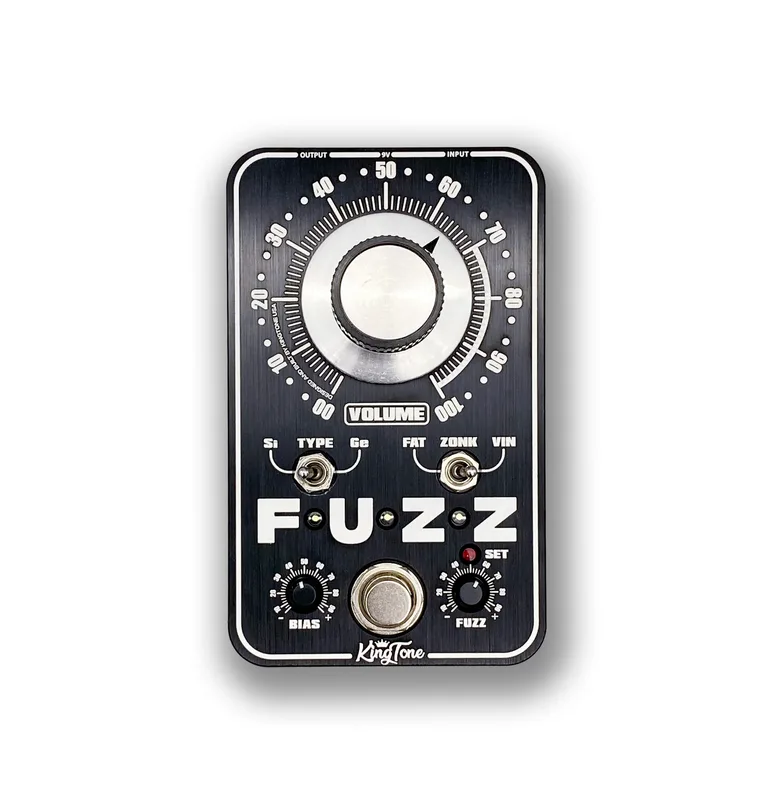


The KingTone Minifuzz Ge is a compact germanium fuzz pedal. Kingtone describes it as having "a warm, almost overdrive like fuzz tone" that "cleans up well to a beautiful, bright glassy clean tone", which puts it closer to the edge of overdrive than a full-on fuzz blast, and makes it responsive to rolling back the guitar's volume1.
Circuit and character
The pedal uses germanium transistors, the older transistor type associated with early fuzz designs. In a 2020 demo of modern Tone Bender style fuzzes, That Pedal Show's Dan and Mick placed the MiniFuzz in that family, with the segment titled "Zonk? Kingtone MiniFuzz" running at the 22:25 mark of the video3. Tone Bender style circuits are a British fuzz lineage distinct from the Fuzz Face, and the Zonk reference points to another vintage circuit of that era.
"Zonk? Kingtone MiniFuzz"
Power: center positive, isolated
This is the detail that trips players up. The Minifuzz Ge is a germanium pedal and, per Kingtone's support article, "needs to be powered with an isolated center positive cable"2. That is the reverse of the center negative standard used by nearly every modern pedal, so a normal daisy chain or standard isolated output will not work as-is.
Kingtone gives two ways to power it: "You can either use a reverse DC adapter or a reverse cable plugged unto an isolated output from you DC power supply"2. The output must be isolated, not a multi-output daisy chain.
In short, the two workable setups are:
- A reverse DC adapter on the pedal's power input.
- A reverse cable plugged into an isolated output from your DC power supply2.
Heat sensitivity
Germanium transistors shift with temperature, and Kingtone says so directly on the product page: "The Ge is can be sensitive to high temperatures so if you live in a hot climate or do a lot of outdoor summer shows you might want to consider the silicon version"1. Players in hot climates or who play outdoor summer gigs regularly may find the silicon version of the Minifuzz more consistent.
The V2
Kingtone's own product pages now carry the Minifuzz V2, including a black panel version14. The V2 lets a player switch between silicon and germanium voicings on one pedal, where the original Ge version is germanium only.
The V2 adds, per Kingtone's product page:
- A Silicon/Germanium Type knob
- A Red Bias LED
- Side panel DIP switches1
| Minifuzz Ge | Minifuzz V2 | |
|---|---|---|
| Transistor type | Germanium only2 | Silicon/Germanium Type knob2 |
| Bias indication | None listed | Red Bias LED1 |
| Internal options | None listed | Side panel DIP switches1 |
| Panel | Original | Black panel version available4 |
Videos
KingTone
RezaMatix
Joe Owl guitars
Questions
What kind of power does the Kingtone Minifuzz Ge need?
The Minifuzz Ge is a germanium pedal and needs an isolated center positive cable, the reverse of the usual center negative standard. Kingtone says you can either use a reverse DC adapter or a reverse cable plugged into an isolated output from your DC power supply. A standard center negative daisy chain or isolated output will not work with it as-is.
How does the Minifuzz Ge sound?
Kingtone describes the miniFUZZ Ge as having a warm, almost overdrive like fuzz tone that cleans up well to a beautiful, bright glassy clean tone. That Pedal Show placed it among modern Tone Bender style fuzzes, with the segment on the Minifuzz appearing around the 22:25 mark of their video.
Is there a newer version of the Minifuzz?
Yes. Kingtone now sells the Minifuzz V2, which adds a Silicon/Germanium Type knob, a Red Bias LED and side panel DIP switches. The original Ge version covers germanium only, while the V2 lets a player switch between silicon and germanium voicings on one pedal.
Sources (4)
- miniFUZZ V2 BLACK, KingTone Guitar, 2026-10-16
- Powering the miniFuzz Ge, KingTone, 2022-03-29
- Modern Tone Bender-Style Fuzz Pedals, That Pedal Show, 2020-08-07
- miniFUZZ V2 Germanium/Silicon Fuzz Pedal, King Tone Guitar (www.kingtoneguitar.com), 2026-10-17