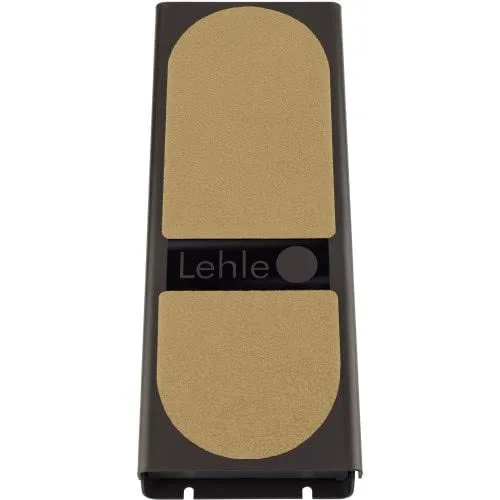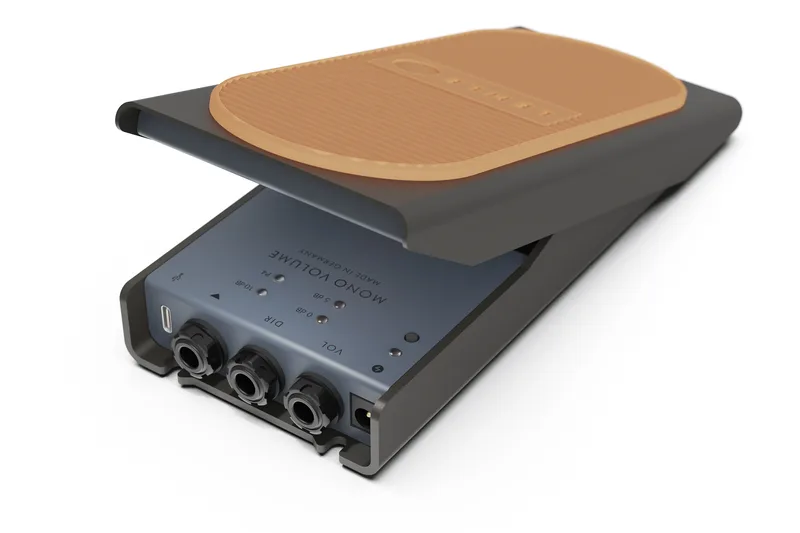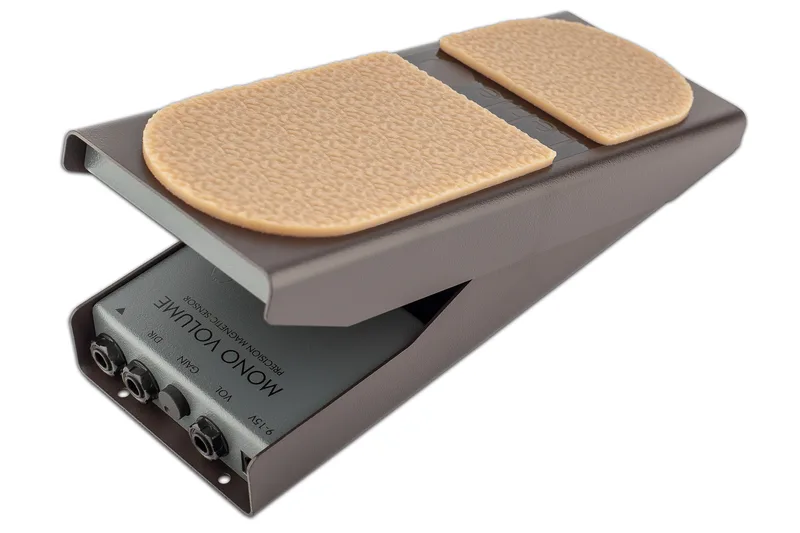


The Lehle Volume Pedal (Mono), sold as the Lehle Mono Volume, is an active volume pedal made by Lehle. Instead of the potentiometer, string and gear drive found in most volume pedals, it uses a magnet and a Hall sensor: the pedal moves only the magnet, and the sensor measures the changing magnetic field and controls a VCA, a voltage-controlled amplifier, which sets the output level1. Lehle describes the result as a pedal that operates almost wear-free1.
The pedal is aimed at players who want foot control of level without the scratchiness, taper drift and eventual repair that come with a mechanical pot. Premier Guitar's news coverage when the pedal arrived noted that it controls the signal from mute to 100 percent and more without altering the sound, with as little hum or noise as possible2.
A Hall sensor instead of a potentiometer
Most volume pedals work by wiping a wiper across a resistive track, either directly or through a string or gear. The Mono Volume does none of that. A magnet sits in the moving top part of the pedal, and a Hall sensor in the base measures the strength of its magnetic field; as you rock the pedal the distance changes, and that measurement controls the VCA6. JHS Pedals' buying guide puts it simply: when the toe of the pedal is pressed down, it gets closer to the magnet, and that affects the circuit7.
In a 2024 interview on Vertex Effects' "Chairmen of the Boards" podcast, Lehle's Joki Schaller explained the sensor choice8:
"the hall sensors we are using, they are some 3d sensors. They can measure in every direction, but that can also analyze6."
He added that the sensors can be pointed to the top only, so they do not interfere with anything else, and that the pedal has no gear and no string, changing volume without any gear part whatsoever6. The Hall sensor is made in Germany and calibrated to the built-in magnet and the pedal's control range9. Lehle's Mono Volume S manual sums up the practical benefit: with no mechanical potentiometer, the typical noise, endlessly expensive repairs and complicated adjustment can be avoided10.
Feel, tone and buffering
Mechanically, the Mono Volume runs on low-friction bearings of a high-performance polymer, and the pedal's mobility is adjustable via an adjusting screw, so you can set how stiff the rocking action feels1. Schaller's design brief, as he put it in the Vertex interview, is that "a volume pedal needs to change the volume and not the tone"6.
Bass Musician Magazine's Jake Wolf, reviewing the pedal in 2016, found it "a virtually wear-free volume pedal with super low signal to noise ratio, and exceptionally wide dynamic range," and noted that it offers a supremely smooth feel and volume taper, adjustable output gain, a built-in buffer, and flexible routing options5. The buffer matters here: a passive volume pedal placed early in a long cable run can load the signal and dull the top end, while an active pedal with a buffer keeps the level control from changing the tone.
Power and controls
The Mono Volume is an active pedal, so it needs power. The Mono Volume 90 manual states plainly that an external power supply is required11, and the pedal accepts a 9 to 15 volt signal, which Bass Musician Magazine noted makes it friendly for pedalboard power supplies11.
The Mono Volume 90 adds a MIN Control for the minimum level. With the control at its 7 o'clock position, the output is virtually mute in the heel position; turning it clockwise narrows the control range, for example attenuating only down to -10 dB. The first section of the control changes the pedal's reaction curve, and the second section increases the minimum level11.
The versions: Mono Volume, Mono Volume 90, Mono Volume S and Stereo
Lehle's mono volume pedal line has grown into several versions, and the differences are mostly physical121.
| Version | Connections | Extra control | Notes |
|---|---|---|---|
| Mono Volume | At the front | None | The original1 |
| Mono Volume 90 | At the side | Minimum-volume control | Smaller format1291 |
| Mono Volume S | Smaller and lighter body | Boost presets, MIDI over USB-C | 50% lighter, 35% smaller1310 |
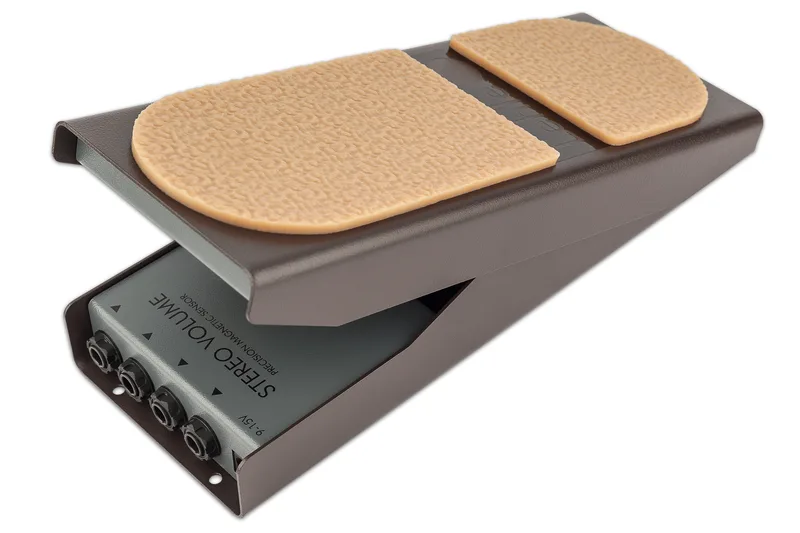
| Stereo Volume | Same features across stereo channels | For stereo rigs3 |
The Lehle Mono Volume is an active volume pedal and remains in the maker's current range349. Its enclosure is aluminum, while the bigger Lehle volume pedals are made from steel6. Lehle designs the pedal so the whole volume sweep happens with as little hum or noise as possible2. The Vertex Mono Volume Pedal is a volume pedal built for mono operation14.
For stereo rigs, Guitar World's buying guide points to the Lehle Stereo Volume, which shares the same features but across stereo channels3.
Where it came from and what reviewers said
Schaller tested early prototypes of the Mono Volume in 2015, according to his own account on Lehle's blog8, and Premier Guitar covered the pedal's arrival that January, describing a pedal that "works with a very precise Hall effect sensor instead of a 'normal' potentiometer"2. Premier Guitar's later quick-hit review of the Mono Volume 90 described it as "outfitted with a magnetic sensor and a voltage-controlled amplifier (VCA) rather than a mechanical potentiometer"15.
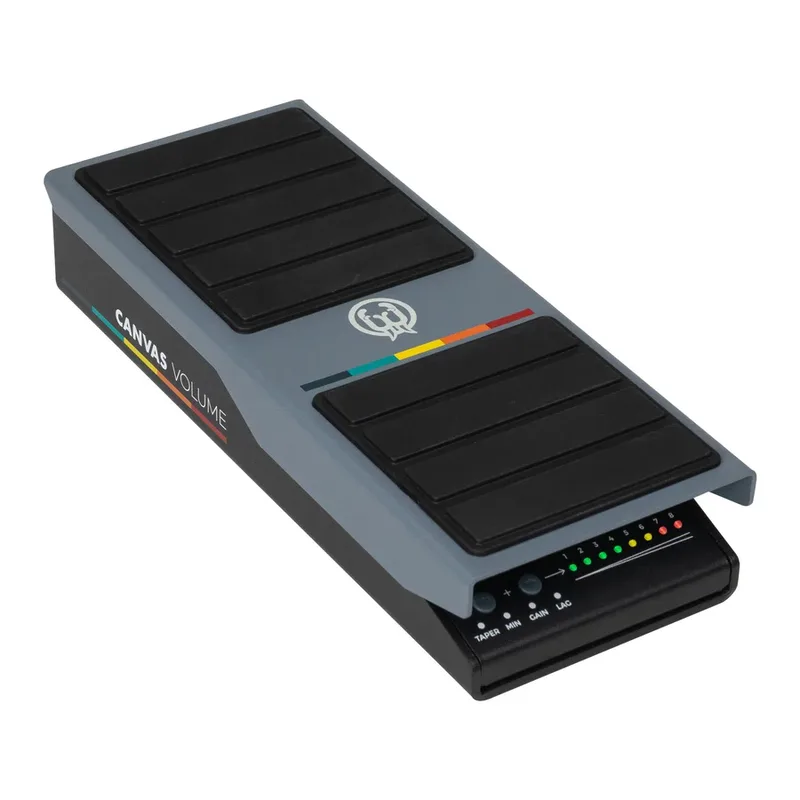
The pedal has since drawn strong press. In Guitar World's 2026 review of the Walrus Audio Canvas Volume, reviewer Daryl wrote:
"The Lehle Mono Volume Pedal is an industry standard at this point. Combining precise control with fantastic build quality and some handy extra features, this powerful pedal takes a different approach from its competitors, producing excellent results."16
Bass Musician Magazine's Jake Wolf concluded that solid feel, reliability and tonefulness are the hallmarks of a best-of volume pedal, and that Lehle took it one step further by adding their fantastic buffer, variable output gain and flexible routing options5.
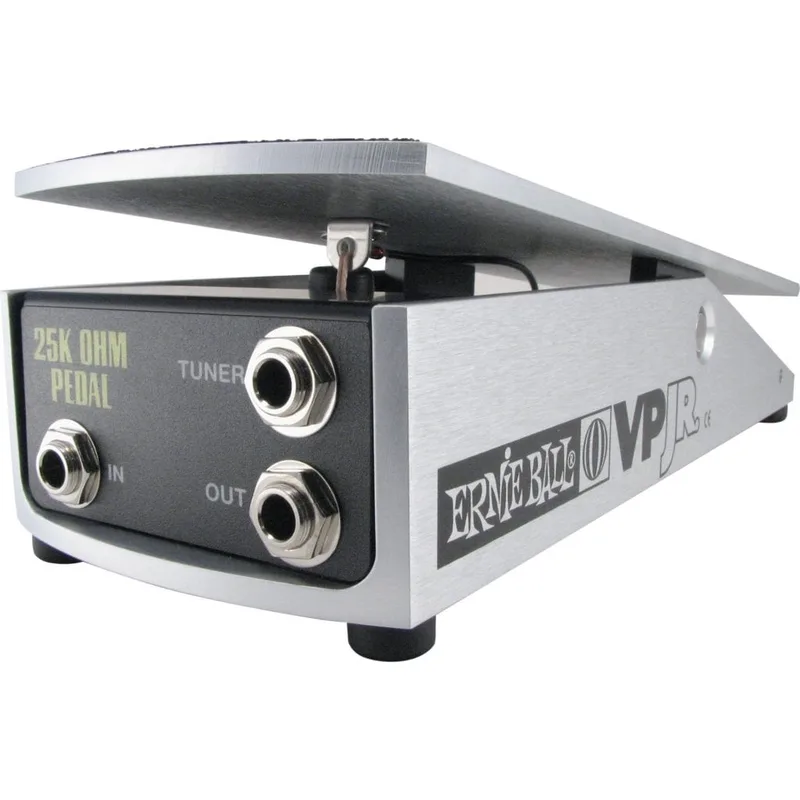
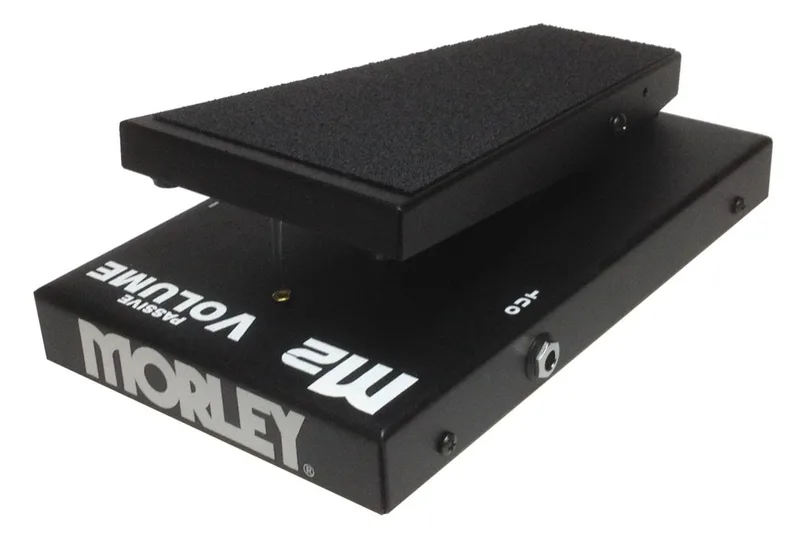
Lehle also publishes guidance on placement: its support material shows the Mono Volume used between output B and the wet effects in a wet/dry setup, controlling effect level by foot17. Players comparing alternatives can look at passive options like the Ernie Ball VPJR or Morley M2 Passive Volume, or other active designs such as the Walrus Audio Canvas Volume and Vertex Mono Volume Pedal.
Videos
shnobel
MR-Max Tube
Tech Tune Picks
Questions
How does a Hall effect volume pedal work?
A magnet sits in the moving top part of the pedal and a Hall sensor in the base measures the strength of its magnetic field. As you rock the pedal, the distance between magnet and sensor changes, and that measurement drives a voltage-controlled amplifier that sets the output level. No potentiometer, string or gear is involved, so there is almost nothing to wear out.
Does the Lehle Mono Volume pedal change your tone?
Lehle's position is that a volume pedal needs to change the volume and not the tone, and the pedal controls the signal from mute to full level without altering the sound. Bass Musician Magazine's reviewer described the result as a virtually wear-free pedal with a super low signal-to-noise ratio and an exceptionally wide dynamic range, helped by a built-in buffer.
How much smaller is the Mono Volume S?
Lehle says the Mono Volume S is 50 percent lighter and 35 percent smaller than the Mono Volume, and about 2 cm flatter while keeping the same pedal range. MusicRadar reported the same figures when the pedal was announced in May 2022.
Does the Lehle Mono Volume need power?
Yes. The Mono Volume 90 manual states that an external power supply is required, and the pedal accepts a 9 to 15 volt signal, which suits common pedalboard power supplies. The Mono Volume S can also be powered over its USB-C socket when it is connected to a computer for MIDI-USB expression use or a firmware update.
What is the difference between a mono and a stereo volume pedal?
A mono volume pedal handles one signal path with a single 1/4 inch input, while a stereo version applies the same features across stereo channels. Guitar World's buying guide suggests the stereo version for players running a stereo rig. Lehle also makes the Mono Volume S, a smaller and lighter mono variant.
Sources (17)
- LEHLE MONO VOLUME: Wear-free volume pedal with VCA, Lehle GmbH
- Lehle Launches New Basswitch Compressor & Pedals, Premier Guitar, 2015-01-25
- Best volume pedals 2025: control your tone with these essential pedal picks, Guitar World, 2023-12-08
- Lehle-Mono-Volume_Manual_EN.pdf, Lehle GmbH, 2023
- Lehle Mono Volume Pedal Review, Bass Musician Magazine, 2016-07-19
- Why EVERY Guitar Player Needs LEHLE On Their Pedalboard, vertexeffects.com, 2024-10-15
- HOW TO USE A VOLUME PEDAL, JHS Pedals
- Where should I place my volume pedal?, blog.lehle.com, 2015
- LEHLE MONO VOLUME: Wear-free volume pedal with VCA, Lehle GmbH
- LEHLE MONO VOLUME S, Lehle (support.lehle.com)
- Lehle-Mono-Volume-90_Manual_EN.pdf, Lehle GmbH, 2023
- LEHLE MONO VOLUME 90: Wear-free dual-out volume pedal, lehle.com
- LEHLE MONO VOLUME S: Compact wear-free volume pedal, Lehle GmbH
- Mono Volume Pedal, www.vertexeffects.com
- Quick Hit: Lehle Mono Volume 90 Review, Premier Guitar, 2018-02-01
- Walrus Audio Canvas Volume review | Guitar World, Guitar World, 2026-03-19
- LEHLE LITTLE DUAL II, Lehle (support.lehle.com)