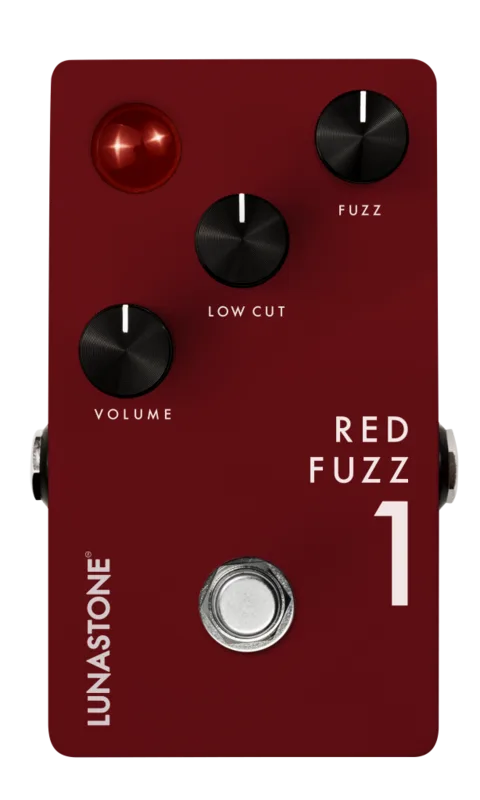


The LunaStone RED FUZZ 1 is an all-analog fuzz pedal from Danish maker LunaStone, first shown at NAMM in January 2018 and shipping that spring. LunaStone's pitch for it is simple: instead of a fuzz into a cranked amplifier, it puts both in one box, what the maker calls "a classic Fuzz and a stack and cram them together into one single piece of fat and beefy rock'n'roll hardware"12. The company also describes it as having "that classic over-saturated, thick Fuzzy sound" of the 60's and 70's, and says it "simply screams Hendrix-style Fuzz"1.
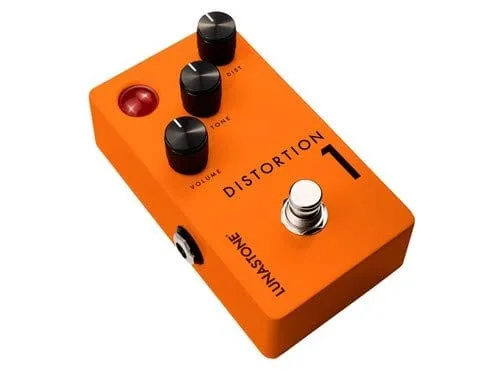
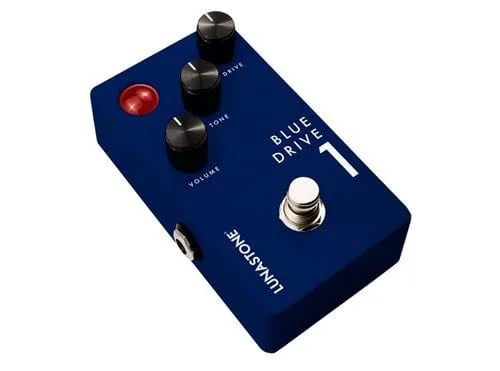
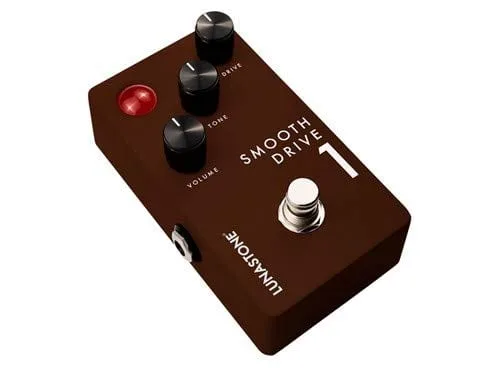
It launched alongside three siblings, the Distortion 1, Blue Drive 1 and Smooth Drive 1, at an expected price of about $1993, a figure Guitar.com confirmed as the list price4. Pedal of the Day reviewed it in December 2018 and found it "full of over-saturated, thick fuzz sounds throughout"5.
The controls: Volume, Fuzz and Low Cut
The Red Fuzz 1 keeps its control set to three knobs: Volume, Fuzz and Low Cut2. Pedal of the Day's review breaks down what each does5:
| Control | What it does |
|---|---|
| Volume | Master output control5 |
| Fuzz | Complete control over your distortion amount5 |
| Low Cut | Sets your EQ5 |
The Low Cut control is the practical answer to a common fuzz problem: thick, saturated fuzz circuits can pile on low end that turns to mud, especially with humbuckers or on smaller amps. Rolling off lows lets you sit the fuzz into a mix without losing the saturation.
The layout is the unusual part. The knobs are angled so that Volume and Fuzz sit at the edges of the enclosure, where you can reach them with your foot. LunaStone's own line is "Adjust with your foot on the fly"1, and Pedal of the Day noted that "the parameter knobs are angled specifically so you can control the Volume and Fuzz with your feet, for hands-free, on-the-fly operation"5. For a player who rides gain settings mid-song, that is a genuine alternative to bending down between phrases.
Switching, buffers and power
The Red Fuzz 1 is true-bypass, with soft relay-based footswitching rather than a stiff mechanical switch1. Classic fuzz pedals are famously fussy about what sits before them in the signal chain, and LunaStone addresses that directly: "Unlike the classic designs, Red Fuzz 1 also has built-in Fuzz-friendly buffers to make it more 'friendly' to the other pedals"1. In practice that means you can run it after other true-bypass pedals or a tuner without the loading and impedance problems that make vintage-style fuzzes thin out or gate unpredictably. If you want the background on why buffers matter, see buffer pedals.
Power comes from either a 9V battery or a standard 9V DC center-negative adapter, which is not included1. The listed power consumption is 75mA1, which is on the high side for a simple three-knob fuzz, so it is worth checking against a small daisy-chain supply if you power several pedals from one output.
The 75mA draw is the figure to watch. Many compact fuzzes draw a fraction of that, so a supply sized for vintage-style fuzz pedals may not have headroom for this one1.
Where the circuit came from
LunaStone does not publish a schematic, but outside writers have characterized the circuit. At NAMM 2018, Gearnews' Jef wrote that "that kind of sounds like an extended FuzzFace pedal to me"2. More specifically, a JHS Pedals article on LunaStone describes it as "a unique, silicon transistor Fuzz Face topology version of his own thing that has a lot of low end," referring to LunaStone founder Steen Grøntved6. For context, the original Fuzz Face itself most likely began as a modification of a Colorsound Tonebender, which was in turn an evolution of the Maestro Fuzztone circuit7.
So the honest answer for a player comparing circuits: it is Fuzz Face-family in topology, silicon rather than germanium, with LunaStone's own additions, the buffers and the Low Cut control, on top612.
What reviewers and players said
Pedal of the Day's December 2018 review covered the pedal's build and sound, summing up its appeal as "the feel and power of a true Marshall stack in a small box that will easily fit on any pedalboard"5. The review also highlighted the angled knob layout and the built-in buffer as practical touches5.
LunaStone's own demos give a sense of the range the maker claims for it, recorded with different guitars at different gain settings1:
- Low Gain: neck pickup on a Stratocaster1
- Medium Gain: both pickups on a Telecaster1
- Max Gain: bridge-position humbucker1
LunaStone's own demo material for the Red Fuzz 1 shows the pedal in two settings: a Low Gain demo played on the neck pickup of a Stratocaster, and a Medium Gain demo using both pickups on a Telecaster1. By October 2018 the company noted that "Red Fuzz 1 is now out there"8.
Videos
LunaStone Guitar Pedals
LunaStone Guitar Pedals
LunaStone Guitar Pedals
Questions
Is the LunaStone Red Fuzz 1 true bypass?
Yes. LunaStone lists the Red Fuzz 1 as true-bypass, and it uses soft relay-based footswitching rather than a mechanical true-bypass switch. The pedal also carries built-in fuzz-friendly buffers, which LunaStone says makes it friendlier to the other pedals on your board than classic fuzz designs.
Is the Red Fuzz 1 a Fuzz Face circuit?
Not exactly. Gearnews guessed it was an extended Fuzz Face circuit, and a JHS Pedals write-up describes it as a silicon transistor Fuzz Face topology of designer Steen Grøntved's own design with a lot of low end. LunaStone itself does not claim a Fuzz Face circuit, only a classic over-saturated 60s and 70s fuzz sound.
Does the Red Fuzz 1 run on a 9V battery?
Yes. LunaStone lists a 9V battery as the battery type, alongside a standard 9V DC center-negative adapter input, with the adapter not included. Power consumption is listed at 75mA, which is worth noting if you run it on a shared power supply.
Who designed the LunaStone Red Fuzz 1?
The Red Fuzz 1 comes from LunaStone, the Danish pedal company founded by Steen Grøntved. A JHS Pedals article describes the pedal as Grøntved's own take on a silicon transistor Fuzz Face topology. Martin Klaja made a demo video of the pedal for LunaStone in 2018.
Sources (8)
- Red Fuzz 1, LunaStone
- NAMM 2018: Lunastone to launch four natty new boutique drive pedals, gearnews.com, 2018-01-23
- NAMM 2018 News, LunaStone, 2018-01-22
- LunaStone launches range of drive pedals, Guitar.com, 2018-02-06
- LunaStone Pedals Red Fuzz 1 Pedal, Pedal of the Day, 2018-12-07
- HAVE YOU HEARD OF LUNASTONE?, JHS Pedals
- David Gilmour Tone Building, Kit Rae (kitrae.net), 2022-05
- Klaja Caught Red-Handed in a Fuzzy Moment, LunaStone, 2018-10-04