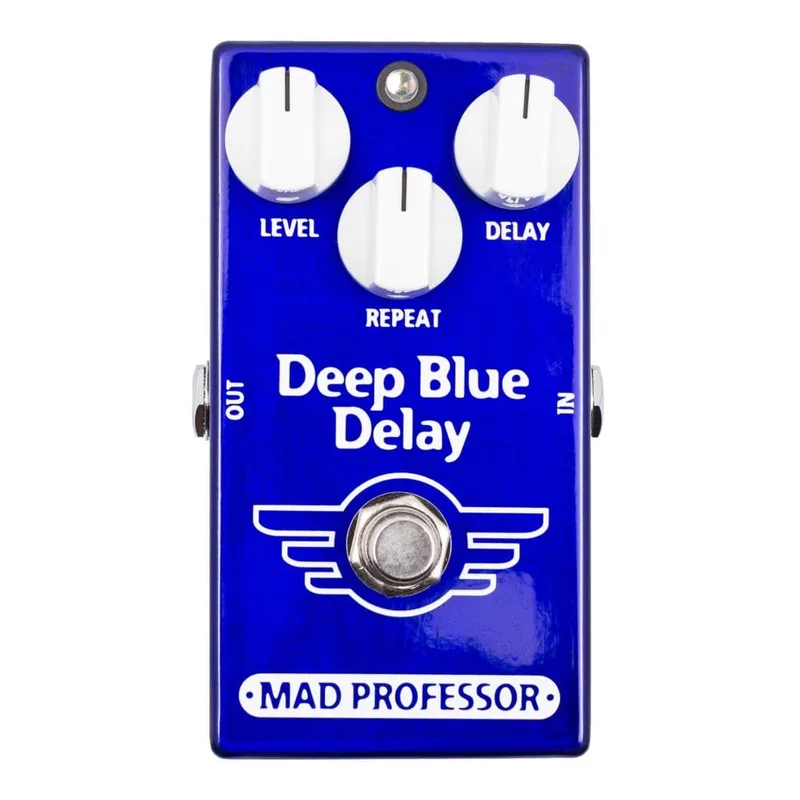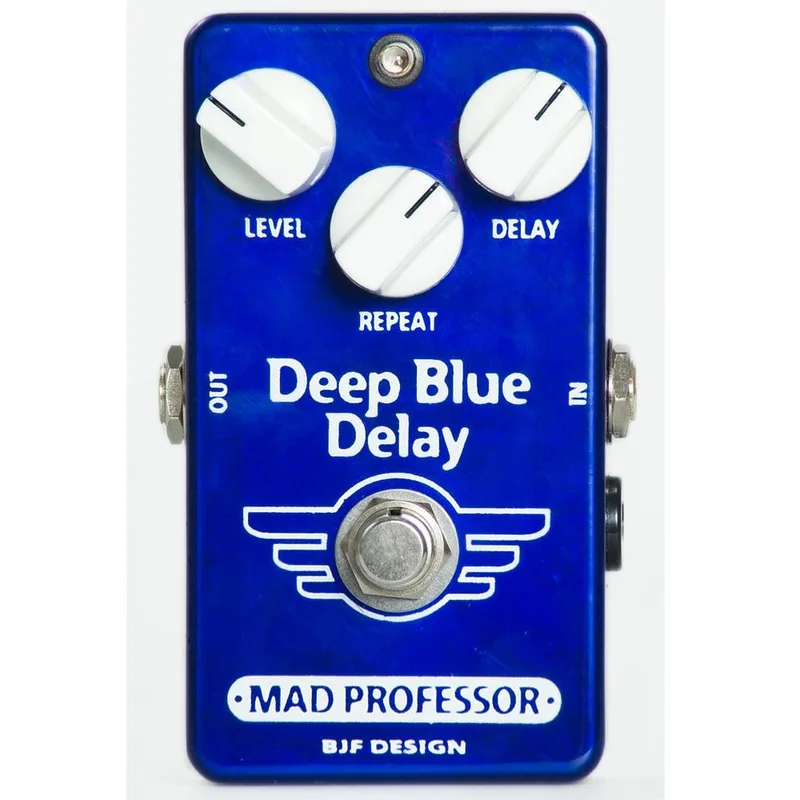


The Mad Professor Deep Blue Delay is a compact delay pedal from the Finnish maker Mad Professor, designed to replicate the warm sounds of classic tape-based echo units of the 1960s1. It keeps the interface deliberately small: three knobs and a bypass footswitch, with delay times from 25 to 450 milliseconds2. Despite the vintage brief, it is a digital delay with an analog direct path, so your dry signal stays analog while the repeats are generated digitally31.
The controls: Level, Delay, Repeat
The whole control surface is three knobs. As Delicious Audio put it when the handwired version returned: "Level, Delay, Repeat. That's it."3
| Control | What it does |
|---|---|
| Level | Sets the level of the repeat against the dry sound; it regulates the ratio of clean signal to delay effect rather than acting as a volume control21 |
| Delay | Sets the delay time, from 25 to 450 milliseconds23 |
| Repeat | The feedback knob; one repeat at minimum, infinite oscillation at maximum23 |
The Repeat knob is where the pedal's character lives. Guitar World's reviewer noted that adding a bit of the Repeat (feedback) knob lets you "conjure up some lo-fi reverb"2, and at the other extreme the feedback runs into infinite oscillation3, the runaway echo behavior players use for self-oscillating effects.
Power and connections
The Deep Blue Delay runs on a 9V battery or a 9V DC adapter, drawing 25 to 32mA2. Connections are a standard input and a standard output2, and the enclosure measures 63 (w) x 111 (d) x 50mm (h)2.
The 25 to 32mA draw is low enough that the pedal works fine on a typical 9V pedalboard supply, and the battery option means it can run standalone. There are no provisions for noise reduction in the circuit, which MusicRadar describes as a deliberate choice "to enhance the old-school vibe"12.
Handwired and PCB versions
The Deep Blue Delay is available in two main formats, and the difference between them is mostly construction and price.
| Handwired version | PCB version | |
|---|---|---|
| Construction | Handwired, through-hole components, Alpha pots, Switchcraft jacks3 | Pots, switch and jack sockets mounted on the circuit board1 |
| Enclosure | Custom sheet metal box with top-mounted jacks3 | Standard PCB-format build1 |
| Warranty | Lifetime warranty3 | |
| Price | The factory-built version is available at about one third of the handwired price3 | PCB construction brought the price down by a fair margin1 |
The Deep Blue Delay is available in both hand-wired and PCB (printed circuit board) formats, and Mad Professor will still make a hand-wired version to order1. MusicRadar notes that the Finnish company now offers a number of its stompboxes in the PCB format, with the pots, switch and jack sockets mounted on the board, and that the switch to printed circuit boards has brought the price down by a fair margin1.
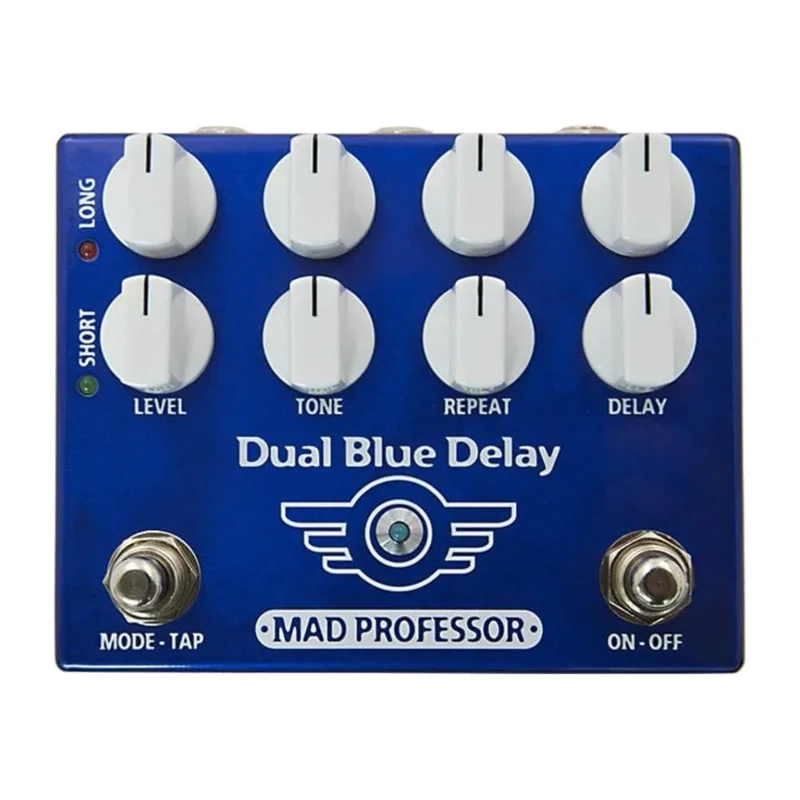
There is also a Mad Professor Dual Blue Delay, a version that is not handmade but offers two echo circuits, tap tempo and Tone controls, and costs about the same as the handwired Deep Blue4. A further variant, the Dual Blue Delay with Deep mod, modifies the Dual's short delay side to replicate exactly the sound of the Deep Blue Delay circuit, so slapback and always-on room-style echo can be dialed in5.
Sound and design
Mad Professor designed the Deep Blue to replicate the warm sounds of classic tape-based echo units of the 1960s1, and Delicious Audio describes the handwired version's character as landing "somewhere between vintage tape and analog delay, without pretending to be either"3. The dry signal is left unfiltered3, and the direct path is analog while the delay itself is digital31.
The pedal has found favor with notable players: Guitar Pedal X notes that the Deep Blue "has long been many a player's favourite delay", including Matt Schofield6.
What reviewers said
MusicRadar's review of the PCB version was positive about both the design and the price:
"This isn't just another stompbox. Mad Professor has put a lot of thought into its function and tone. Thanks to its more affordable price, even more of us can feel the love."
The same review highlighted how the Level control works, noting that "level isn't a volume control, it regulates the ratio of the clean guitar signal to the amount of delay effect"1, which is worth knowing before you set your levels by ear.
Related pedals
Players comparing delays in the Mad Professor range can also look at the Mad Professor Hand-Wired Deep Blue Delay as the made-to-order build, and the Dual Blue Delay for a two-circuit, tap-tempo alternative14.
Videos
ProGuitarShopDemos
ProGuitarShopDemos
Mad Professor Amplification
Questions
Is the Mad Professor Deep Blue Delay true bypass?
Yes. The Deep Blue Delay uses true bypass switching, so when the pedal is off your dry signal passes through without the circuit coloring it. The pedal also keeps the direct signal path analog while the delayed repeats are generated digitally.
Does the Deep Blue Delay take a battery?
Yes. It runs on a 9V battery or a 9V DC adapter, drawing 25 to 32mA. That current draw is modest by delay pedal standards, so a standard 9V power supply on a pedalboard will run it comfortably.
How long is the delay time on the Deep Blue Delay?
The delay time runs from 25 to 450 milliseconds. That covers slapback echo and room-style short delays through to medium-length repeats, but it is not a long delay for ambient or looping-style playing.
Can the Deep Blue Delay self-oscillate?
Yes. With the Repeat knob at minimum you get a single repeat, and at maximum the feedback runs into infinite oscillation, the classic self-oscillating delay behavior players use for runaway echo effects.
What is the difference between the handwired and PCB Deep Blue Delay?
The handwired version uses through-hole components, Alpha pots and Switchcraft jacks in a custom sheet metal box with top-mounted jacks, and carries a lifetime warranty. The PCB version mounts its pots, switch and jacks directly on the circuit board and costs roughly a third of the handwired price.
Is the Deep Blue Delay analog or digital?
It is a digital delay with an analog direct path. Your clean signal stays analog through the pedal, while the delayed repeats are digital. Mad Professor designed it to replicate the warm sounds of classic tape-based echo units of the 1960s.
Sources (6)
- Mad Professor Deep Blue Delay review, MusicRadar, 2011-03-31
- Mad Professor Deep Blue Delay review, Guitar World, 2024-02-01
- New Pedal: Mad Professor Deep Blue Delay (Handwired), Delicious Audio, 2026-05-20
- Best Tape Delay Pedals And Tape Echos In 2020, Delicious Audio, 2025-02-17
- Mad Professor adds four new "Lockdown Special" modded pedals, gearnews.com, 2020-05-19
- Guitar Pedal X, Guitar Pedal X, 2025-03-11