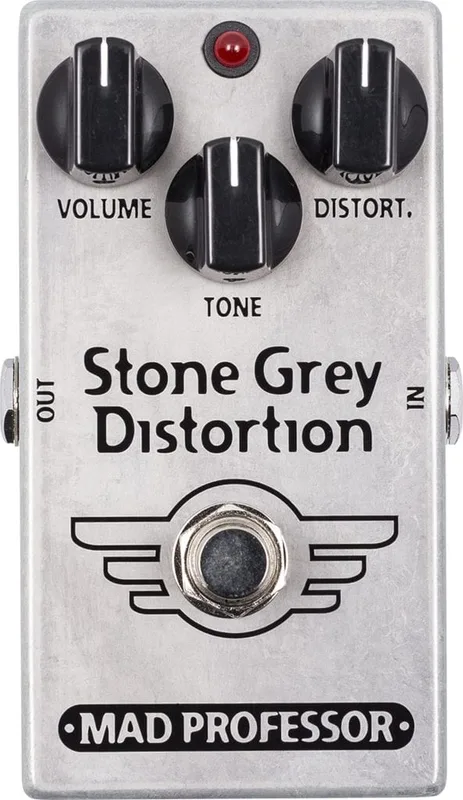


The Mad Professor Stone Gray Distortion is an analog distortion pedal from Mad Professor, first released in 20111. It was designed by Björn Juhl, the designer behind BJFe, and built around one clear goal: keeping clarity at heavy distortion levels. As RockBoard's PedalPedia puts it, the pedal "was developed for high gain applications and specifically for clarity at heavy distortion levels"2.
Premier Guitar's reviewer described the design intent in similar terms:
"Björn Juhl and his team designed the Stone Grey to dish out gobs of gain with ultimate clarity and string-to-string definition."
Where the circuit came from
The Stone Gray is not a modified Tube Screamer or a Marshall-in-a-box. According to Aion FX, the circuit was "originally derived from a distortion circuit called the 'CMOS Driver' from a Japanese electronics book published in the early 1980s"1. Before it became the Stone Gray Distortion, the same design was sold under other names: it was "initially called the Cliff Hanger and later the Cliff Hanger II"1.
Because the circuit is aimed at high-gain operation, it voices the low end accordingly. Aion FX notes that "since it's intended for high-gain operation, the Stone Grey has a significant amount of low cut"1. That low cut is part of how the pedal keeps its clarity and string-to-string definition when the gain is pushed hard, since heavy low-end content is what usually turns to mud first at high gain.
What reviewers found
Premier Guitar reviewed the pedal in August 2021 and came away impressed with its high-gain character. Testing it with a Les Paul Baritone through a Marshall Super Bass at high gain, the reviewer reported that "the Stone Grey kicked out a big, heavy, and tight metal sound with a super-satisfying bottom-end chunk"3. For players wondering whether the pedal holds up for metal, especially on longer-scale or baritone guitars, that review is the clearest published answer.
The Tone control also earned specific praise: "The Tone knob was very effective for dialing in just the right amount of crunch without getting brittle"3. Premier Guitar also characterized the pedal as one "that doesn't step on the amp's tone"3.
The Modernized Mod
In 2020, Mad Professor's Custom Shop released a limited "Modernized Mod" version of the Stone Gray. According to Aion FX, the mod was created "to help counteract this, adding 3 parallel parts on the solder side of the PCB" to increase bass frequencies and gain1. Gearnews reported on the release as one of four limited-edition modified versions of pedals from the company's back catalog4.
Gearnews described what the mod changes:
- The mid-range is notched up a bit compared with the original4
- The pedal has more gain than the original4
- The added bass parts open up more gain and even thicker drive tones4
For players comparing the two, the original Stone Gray leans on its low cut for tightness at high gain, while the Modernized Mod pushes back in the other direction with more bass and more gain on tap14.
Power and placement on a pedalboard
The Stone Gray runs on 9V DC with a center negative plug and draws only 8mA2. That current draw is low enough that it places almost no demand on a typical isolated or daisy-chain power supply, leaving headroom for hungrier digital pedals elsewhere on the board.
The $169 street price is from Premier Guitar's 2021 review3. The Modernized Mod was a limited-edition Custom Shop release from 20201, so availability of that version may differ from the standard pedal.
Videos
ProGuitarShopDemos
Mad Professor Amplification
Mad Professor Amplification
News
Questions
Who designed the Mad Professor Stone Grey Distortion?
The Stone Grey Distortion was designed by Björn Juhl, the Swedish designer behind BJFe and the Mad Professor line. Premier Guitar's reviewer noted that Björn Juhl and his team designed the Stone Grey to deliver high gain with clarity and string-to-string definition.
What circuit is the Stone Grey Distortion based on?
According to Aion FX, the circuit was originally derived from a distortion circuit called the CMOS Driver, published in a Japanese electronics book in the early 1980s. The design was initially called the Cliff Hanger and later the Cliff Hanger II before becoming the Stone Grey Distortion.
Is the Stone Grey good for metal with a baritone guitar?
Yes. In Premier Guitar's 2021 review, the pedal produced a big, heavy and tight metal sound with a satisfying bottom-end chunk when tested with a Les Paul Baritone and a Marshall Super Bass at high gain.
How much current does the Stone Grey Distortion draw?
The Stone Grey Distortion draws 8mA, running on 9V DC with a center negative plug, according to the maker's product page. That low draw makes it easy to run alongside other pedals on a typical power supply.
Sources (4)
- Protolith CMOS Distortion / Mad Professor Stone Grey, Aion FX, 2021-11-12
- Stone Grey Distortion by Mad Professor, RockBoard PedalPedia, 2026
- Mad Professor Stone Grey Distortion Pedal Review, Premier Guitar, 2011-10-18
- Mad Professor adds four new "Lockdown Special" modded pedals, gearnews.com, 2020-05-19